
The Royal Bank of Scotland has released the final designs of their new polymer ten and five pound notes.
“The Fabric of Nature” will for the theme for this note set. The new £5 note will be anchored by Scottish poet and writer Nan Shepherd(1893 – 1981). Shepherd’s portrait is offset in the background by a depiction of the Cairngorms, a mountain range in Scotland that feature frequently in her writings. A quote from her book “The Living Mountain” is also inscribed there-over.

Royal Bank of Scotland Polymer Nan Shepherd 5 Pound Obverse
The reverse of the new £5 note has a quote from the poem ‘The Choice’ by Sorley MacLean that is framed by two Mackerel. The choice to feature Nan Shepherd on the new £5 note was taken by the RBS Scotland Board.
The design of the new £10 note was chosen by the Scottish people through a series of public consultations and surveys. The result was a banknote featuring Scottish scientist Mary Somerville(1780 – 1872).
The obverse design is anchored by a portrait of Mary Somerville with a depiction of Burntisland Beach where she lived as a child. A Quote from ‘The Connection of the Physical Sciences’, written by Somerville, is inscribed at the center.
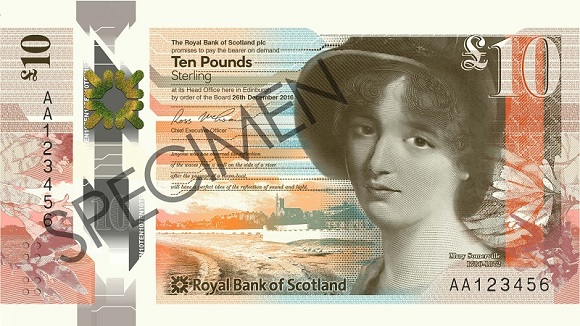
Royal Bank of Scotland Polymer Mary Somerville 10 Pound Obverse
The notes reverse features a quote from the poem ‘Moorings’ by Norman MacCraig framed this time by two otters at play.
Malcolm Buchanan, Chair, Scotland Board, said:
“The Royal Bank of Scotland has never before featured a woman on its main issue bank notes. It gives me enormous pleasure that we are able to celebrate the fantastic, and often overlooked, achievements of two great Scottish women. Both made huge contributions in their respective fields.”
The £5 note is scheduled for release later in 2016 and the £10 not will be released in 2017. The new polymer banknotes will take advantage of the latest security innovations that according to the Royal Bank of Scotland will “make them difficult to counterfeit but easy to authenticate”.
The Perth Mint has released their entire lineup of new coins from the February 2018 catalogue and with… The United States Mint has now released the 2018 Native American $1 Coins, in several product options for… The United States Mint has now released the special 2018 American Liberty One–Tenth Ounce Gold Proof Coin. Featuring…


Send it to another collector
More from this topic
Perth Mint Releases New Gold and Silver Coins for February 2018
US Mint Releases 2018 Jim Thorpe Dollar Coins

US Mint Releases 2018 1/10oz Gold American Liberty Proof Coin