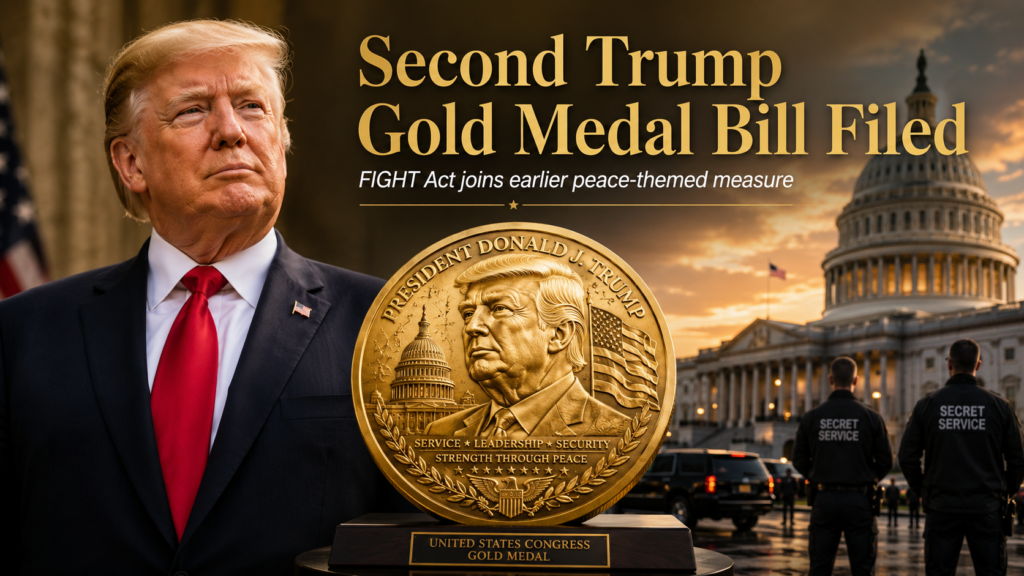
A second congressional gold medal bill honoring President Donald J. Trump was introduced in the U.S. House of Representatives on April 30, 2026, this one framed around the three documented attempts on his life rather than foreign policy. Rep. Clay Fuller, R-Georgia, filed the legislation, which would award gold medals to Trump, the United States Secret Service, and the Service’s local law enforcement partners in recognition of their role in protecting “our constitutional republican form of government.”
The new measure, H.R. 8594, is formally titled the Congressional Gold Medal For Inspiring Great Heroism and Tenacity Act, the FIGHT Act, and arrives less than seven months after a separate Trump gold medal bill was filed by a different Republican around an entirely different rationale. Together, the two bills give the 119th Congress two simultaneous, unrelated proposals to strike a gold medal for the same living president, both currently sitting in the same committee.
What the FIGHT Act Would Authorize
H.R. 8594 is unusual in scope for a presidential gold medal bill. Rather than authorizing a single medal, it would direct the Secretary of the Treasury to strike three gold medals of appropriate design: one presented to Trump personally, one presented to the U.S. Secret Service for display at the United States Secret Service Museum, and one presented to local law enforcement partners for display at the National Law Enforcement Museum. The Secretary would also be authorized to strike and sell bronze duplicates at cost-recovery pricing, the standard secondary-strike provision attached to most congressional gold medal legislation.
The bill anchors its case in three named incidents. The first is the July 13, 2024 rally in Butler, Pennsylvania, where Trump was wounded by gunfire from a rooftop and rallygoer Corey Comperatore was killed shielding his family. The second is the September 15, 2024 incident at Trump’s West Palm Beach golf course, in which a concealed gunman was discovered and detained before any shots were fired at the candidate. The third, and the most recent, is the April 25, 2026 attack outside the White House Correspondents’ Association Dinner at the Washington Hilton, where an assailant armed with a 12-gauge shotgun, a .38 semi-automatic pistol, and multiple knives charged the Secret Service security checkpoint and was shot and subdued before reaching the ballroom. A Secret Service officer was struck once in the chest and survived because of his ballistic vest. The accused, Cole Tomas Allen, has since been charged in federal court with attempting to assassinate the president.
The Other Trump Medal Bill Still in the Queue
H.R. 8594 is not the first congressional gold medal bill filed for Trump in the current session. H.R. 5789, the Donald J. Trump Congressional Gold Medal Act, was introduced October 17, 2025 by Rep. Derrick Van Orden, R-Wisconsin, and seeks a gold medal in recognition of Trump’s “extraordinary peacemaking efforts throughout the world” and his role in the Trump peace agreement to end the war in Gaza. That bill arrived with two dozen House cosponsors. As of late May 2026, H.R. 8594 has none.
The two measures rest on entirely different rationales. H.R. 5789 is a foreign-policy citation; H.R. 8594 is a domestic-security citation. Neither has yet been marked up. Both bills currently sit in the House Financial Services Committee for further consideration, the committee of jurisdiction for all congressional gold medal legislation because medals are struck by the U.S. Mint under Treasury authority.
For a congressional gold medal bill to advance, House rules require co-sponsorship by at least two-thirds of the chamber, 290 members in a full House, before the Financial Services Committee will typically consider it. Neither Trump bill is close to that threshold today.
A First Major Bill from a Brand-New Member
The FIGHT Act is also notable as one of the first pieces of standalone legislation introduced by Fuller, who was elected to Georgia’s 14th Congressional District in a special election on April 7, 2026 to fill the vacancy left by former Rep. Marjorie Taylor Greene. Fuller, a former Lookout Mountain Judicial Circuit district attorney, was endorsed by Trump during the primary and runoff. Filing a Trump-centered gold medal bill within roughly three weeks of being sworn in places the measure as much in the category of legislative signal as legislative vehicle.
That distinction matters for collectors trying to read the realistic odds of either Trump medal actually reaching the Mint. Congressional gold medals are the legislative branch’s highest honor, but the path from introduction to authorized strike is a long one, and many gold medal bills introduced as gestures never accumulate the cosponsors needed to move. The recent precedent is mixed: medals for the U.S. Capitol Police and others involved in the January 6, 2021 response moved quickly; medals for living political figures generally do not.
What Happens Next
Both bills will require additional cosponsors before either is taken up. If one were to advance, the Treasury Secretary would have broad latitude to choose the emblems, devices, and inscriptions, meaning the actual design of any Trump gold medal would be developed by the U.S. Mint and reviewed by the Citizens Coinage Advisory Committee and the Commission of Fine Arts before approval. None of that process has begun.
For collectors, the immediate practical takeaway is narrow. Two parallel Trump gold medal bills are now on the docket, one foreign-policy, one domestic-security, and neither is close to authorization. What is unusual is the duplication itself: it is rare for the same Congress to host two unrelated gold medal proposals for the same sitting president, advanced by different sponsors, around different events, with no apparent coordination between them. Whether either advances will depend less on the merits of the underlying case than on the slow accumulation of House cosponsors that all gold medal legislation must clear before the Mint ever gets the call.