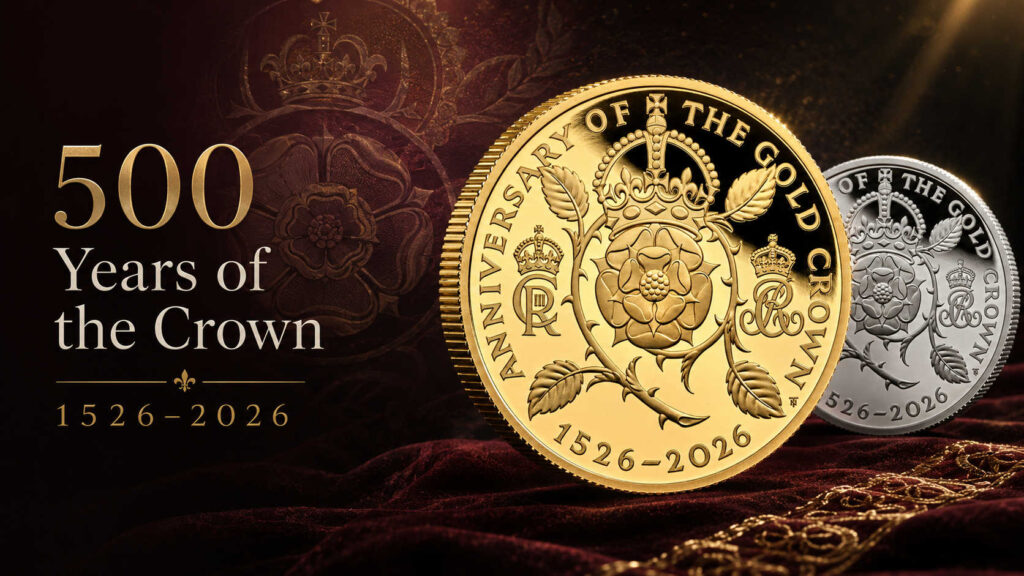
The Royal Mint has released 500 Years of the Crown, a UK £5 range marking half a millennium since the crown was first struck as an English coin in 1526. Carried across four editions and dated 1526–2026, the range commemorates one of the longest lived denominations in British coinage, a coin that began life in gold under Henry VIII and survives today as the nation’s commemorative five pound piece.
For collectors, the appeal is partly the anniversary and partly the spread. The range runs from a £17.50 Brilliant Uncirculated coin anyone can own to a 22 carat Gold Proof limited to 150 pieces at £5,890, a single design rendered across the full ladder of the Mint’s finishes, with the most historically resonant version reserved, fittingly, for gold.
The Coin Born in 1526
The crown owes its existence to a currency problem. In the 1520s, English gold was steadily draining abroad, where it fetched more than its face value at home. Henry VIII’s answer, as part of his second coinage reform, was a new gold coin pitched to compete with the French écu au soleil, the so called “crown of the sun.” Proclaimed in August 1526, the Crown of the Rose was struck in 23 carat gold and valued at four shillings and sixpence.
It was not a success. The denomination proved awkward, the export problem persisted, and within months the Mint replaced it with the Crown of the Double Rose, 22 carat gold, raised to a cleaner five shillings, and stamped with the Tudor rose where a royal portrait would normally sit. The Latin legend ringing that rose, RUTILANS ROSA SINE SPINA, “a dazzling rose without a thorn”, turned Henry himself into the flower at the coin’s centre.
From there the crown endured. Gold crowns were struck intermittently until 1662; a silver version arrived under Edward VI in 1551 and became the more familiar circulating piece. The crown survived the Act of Union, the move to milled coinage, and the slow retreat of large silver from everyday pockets, before settling into its modern role as a commemorative coin, one that has carried a £5 face value since 1990. That the Royal Mint frames this anniversary as the ANNIVERSARY OF THE GOLD CROWN is no accident: the very first crown, the one this range counts five centuries from, was gold.

A Design Five Centuries in the Making
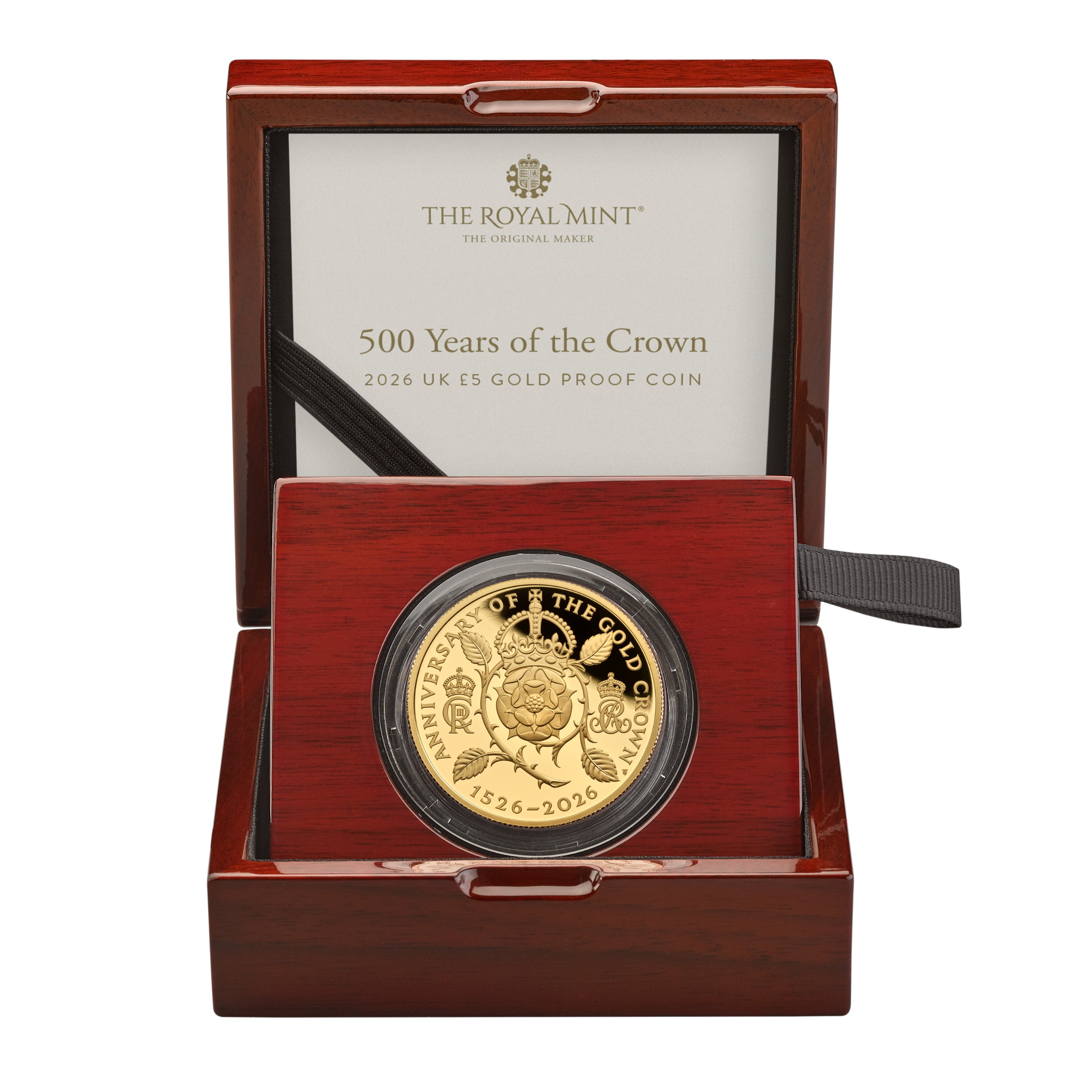
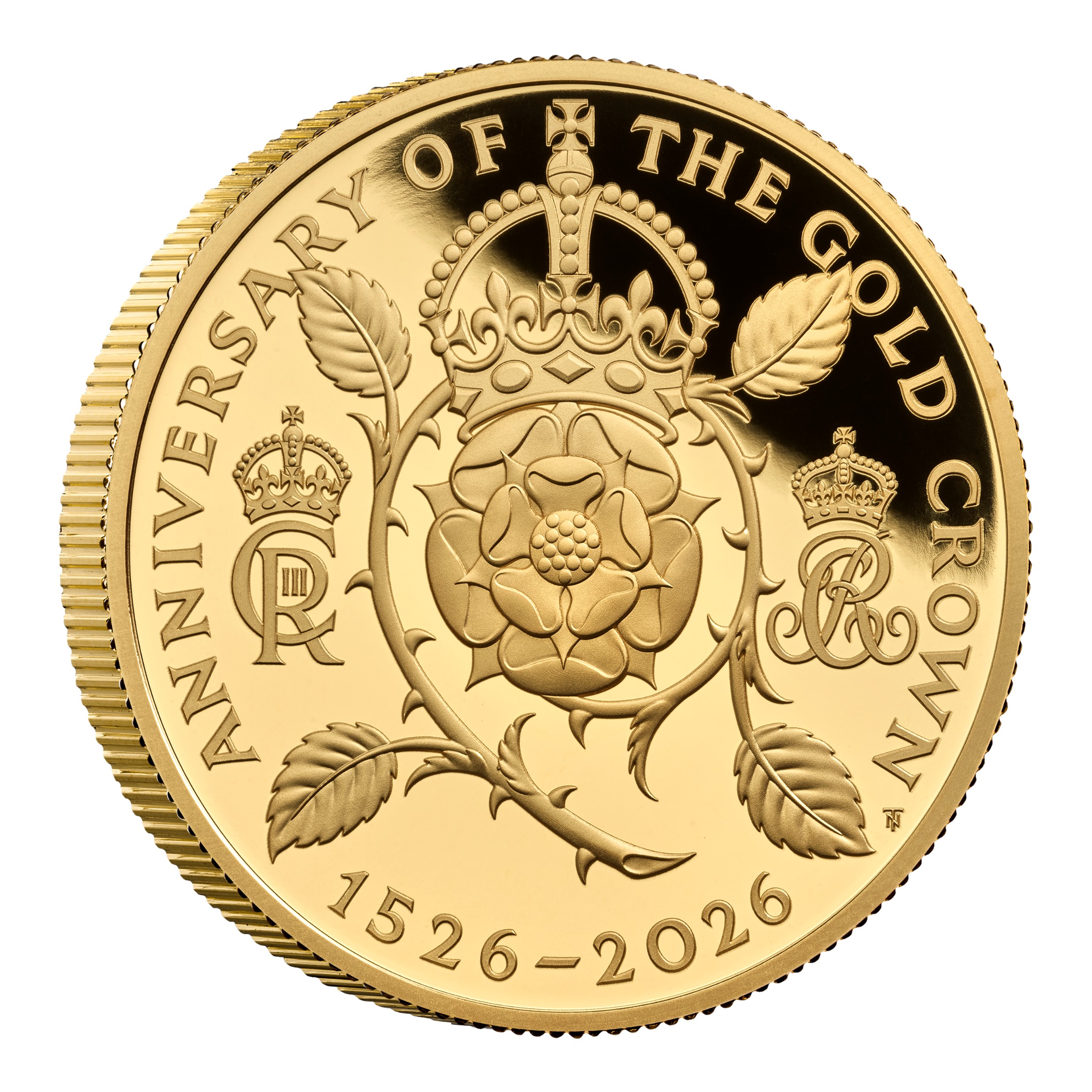
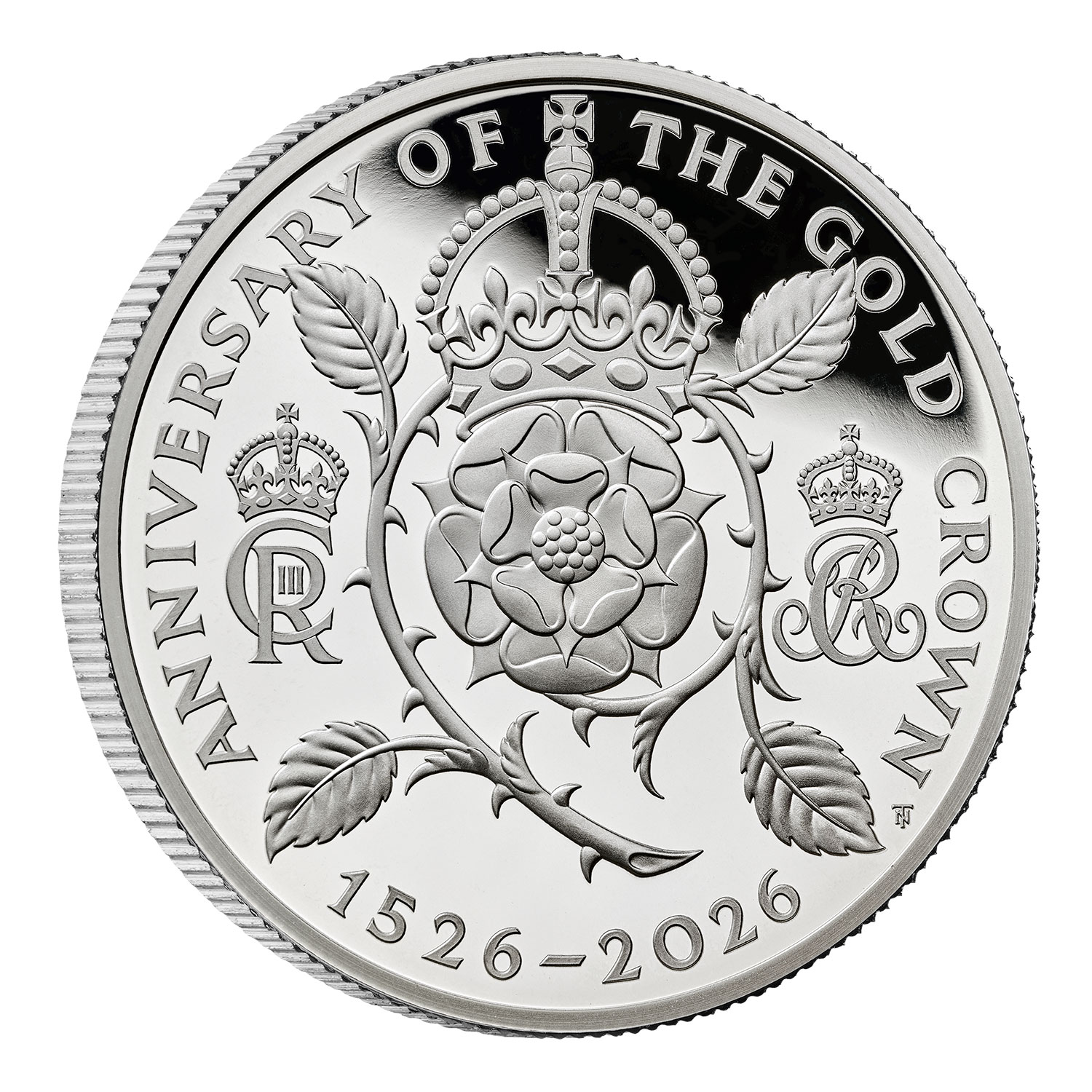
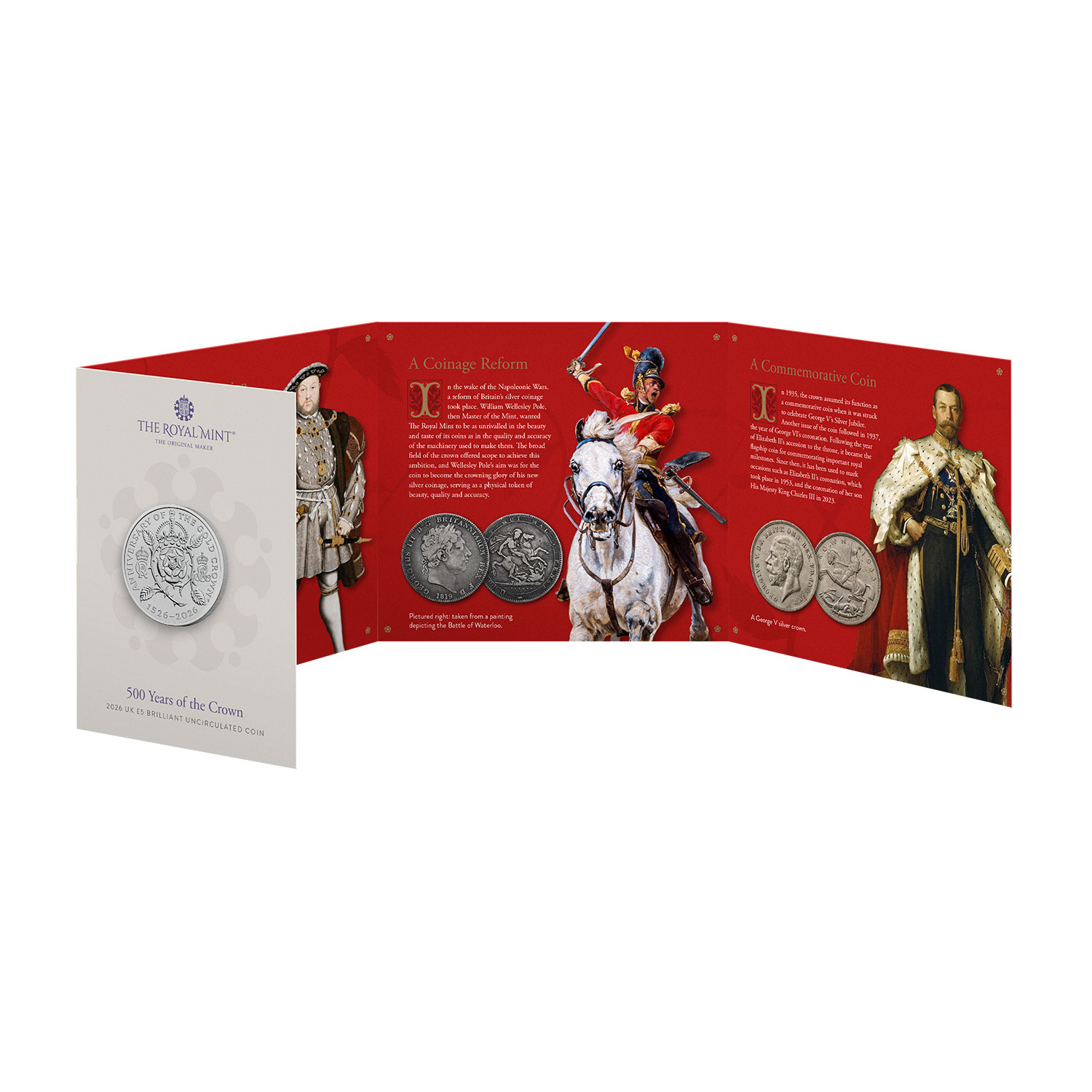
The anniversary design is the work of Timothy Noad, whose reverse places a single Tudor rose at the centre and rings it with the inscription ANNIVERSARY OF THE GOLD CROWN and the dual dates 1526–2026. The Royal Mint highlights it as a unique obverse, and it carries a deliberately layered piece of symbolism, the cyphers of both His Majesty King Charles III and Her Majesty The Queen, binding the modern monarchy to the design’s Tudor roots.
The rose does most of the historical work. A border of five roses frames the design, one for each century since 1526, and the Mint notes the flower’s long service on British coinage, including as a privy mark during the reign of Edward IV. Between those roses runs an unusual detail: elongated beading, the stretched dotted border characteristic of coins struck without a collar, when the metal spreads outward under the press. Here it is recreated by design rather than by accident, a quiet nod to how the earliest crowns were actually made.
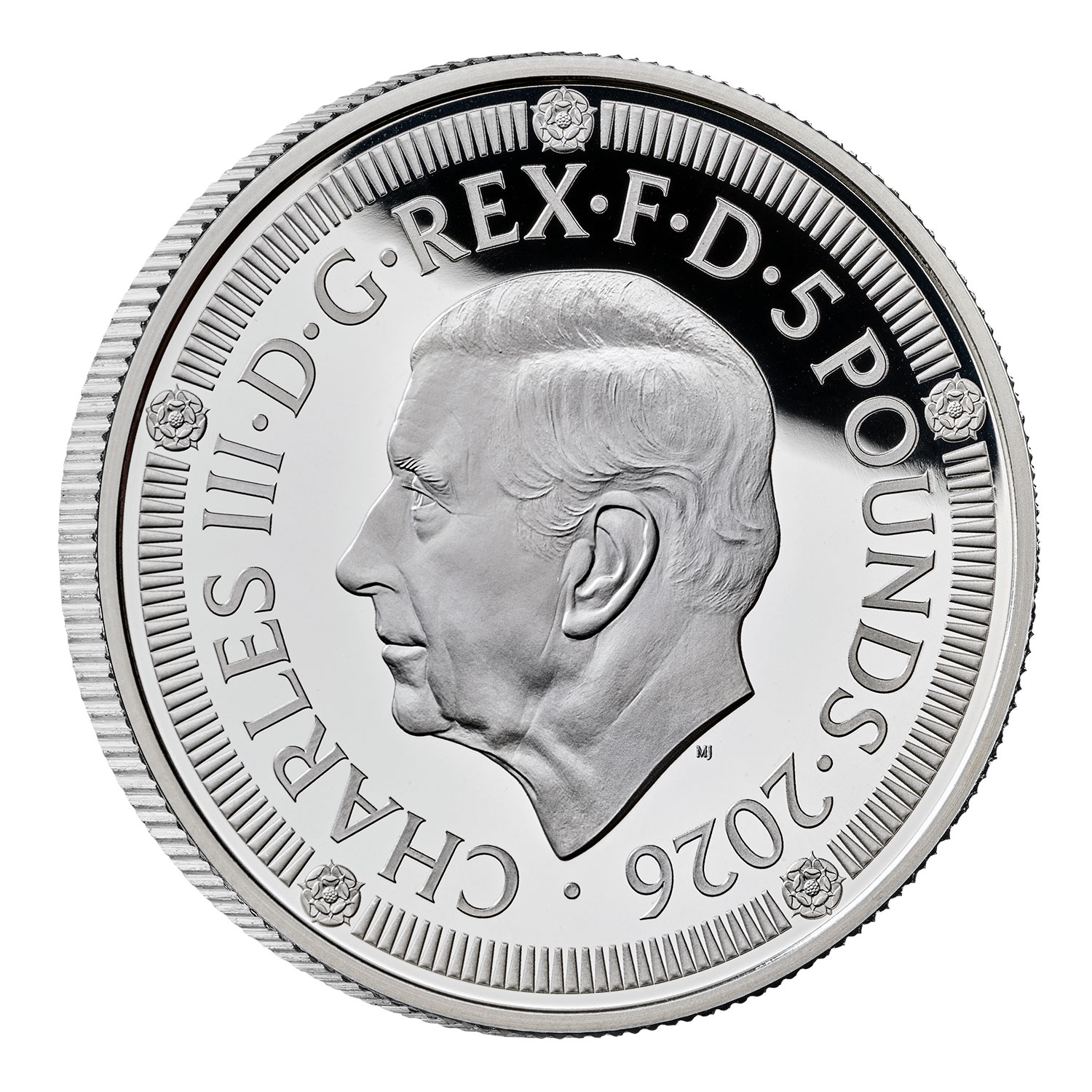
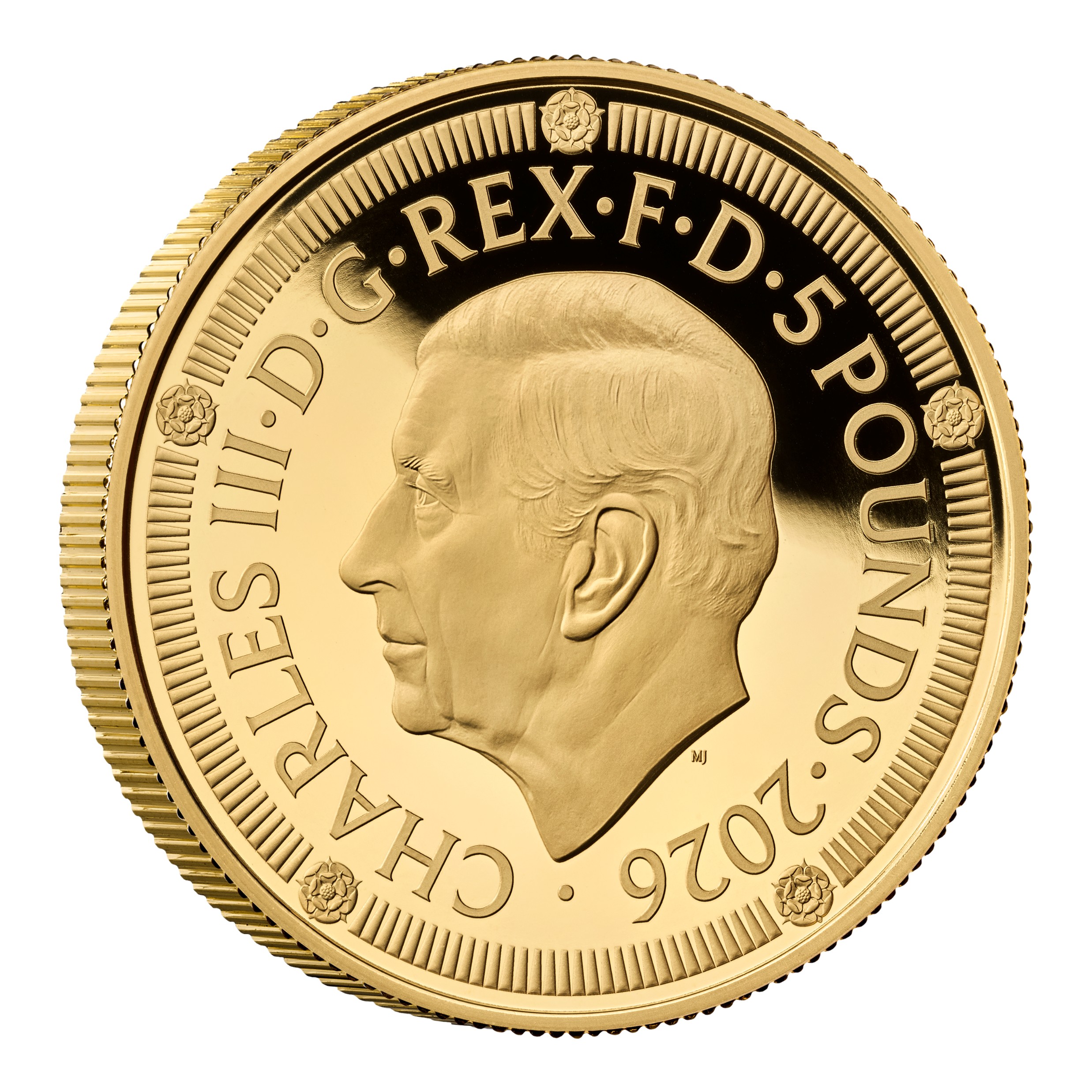
The portrait side comes from Martin Jennings, whose definitive effigy of King Charles III is paired with the legend CHARLES III · D · G · REX · F · D · 5 POUNDS · 2026. Together, the two faces do exactly what the Mint set out to do, fuse a 500 year old denomination with the coinage of the present reign.
Four Editions, From Change Jar to Five Figures
The single design appears across four very different coins. The entry point is the Brilliant Uncirculated edition at £17.50, struck in cupro nickel to the standard 38.61mm crown size and finished to a far higher quality than anything found in circulation. It carries no edition limit, the one piece in the range built for reach rather than rarity.
Above it sits the Silver Proof at £160, struck in 28.28g of .925 sterling silver to the Mint’s Proof standard and capped at an edition of 3,000. For collectors who want weight as well as finish, the Silver Proof Piedfort at £297.50 doubles the thickness to 56.56g of the same sterling silver, limited to 1,500, the piedfort tradition of striking a coin on a double thick blank, here applied to the anniversary design.
The range tops out with the Gold Proof at £5,890. Limited to just 150 pieces and struck in 39.94g of 22 carat gold, it is the edition that closes the loop on the whole project: 916.67 fineness is the same crown gold standard the Crown of the Double Rose was struck in five hundred years ago. Of the four, it is the only one whose metal matches the coin it commemorates. The Mint lists it as shipping in late July.
What It Means
Five hundred years is a long time for any coin to stay recognisable, and the crown has not survived by staying useful, it stopped being everyday money long ago. It survived as an idea: a large, ceremonial piece reserved for the moments a country wants to mark. 500 Years of the Crown leans into exactly that. From a four shilling and sixpence gold coin minted to chase French écus, to a £5 commemorative carrying a king’s portrait and five Tudor roses, the line is unbroken even where the purpose has changed entirely. For collectors, the question the range really poses is a pleasant one, not whether to mark the anniversary, but in which metal.