
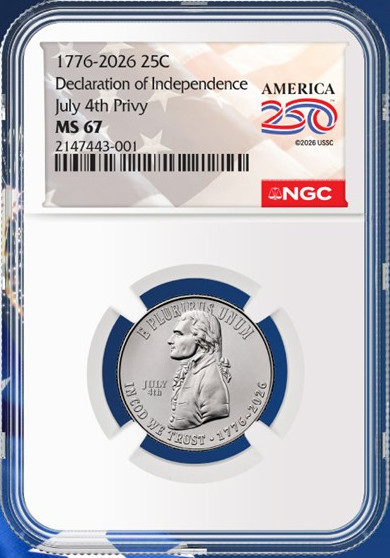
There is a quarter worth $2,500 somewhere in America’s loose change, and nobody knows whose pocket it will land in. Numismatic Guaranty Company has offered a $2,500 cash reward to the first eligible collector who submits a circulating 2026 Declaration of Independence quarter bearing the special “July 4th” privy mark.
The catch is that you have to find it first. The U.S. Mint is releasing 250,000 of these privy marked quarters into ordinary circulation, mixed in with the tens of millions of standard Declaration quarters already moving through banks and cash drawers. The bounty turns a routine commemorative into a nationwide treasure hunt, and the prize could surface in any everyday transaction.
The Bounty, and the Catch
NGC’s terms are simple, with a few conditions that matter. The reward goes to the first eligible collector to send the privy marked quarter in for grading, and entry requires a paid NGC collector membership, which currently starts at $39 a year. NGC dealers are not eligible, keeping the competition pointed squarely at hobbyists.
One point is worth being clear about, because it is easy to misread. NGC is not buying the coin. The company will grade the first qualifying quarter, return it to its owner, and pay out the $2,500 on top. The finder keeps both the slab and the cash, which is a meaningfully better outcome than a simple purchase offer.
What You Are Looking For
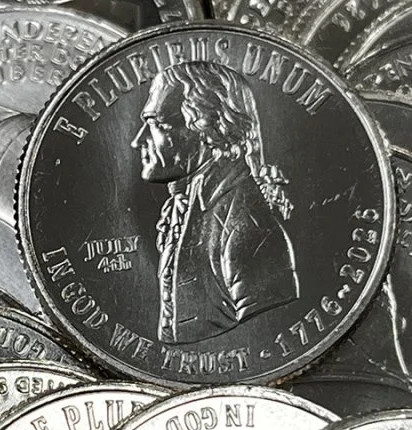
The identifying feature is small but unmistakable. The special quarter carries a “July 4th” privy mark on the obverse, to the left of Washington’s portrait, and it bears no mint mark at all. That absence is the real tell. Standard Declaration of Independence quarters struck in Philadelphia and Denver carry their respective P and D marks, so a privy marked example with a blank where the mint mark should be is the one to set aside.
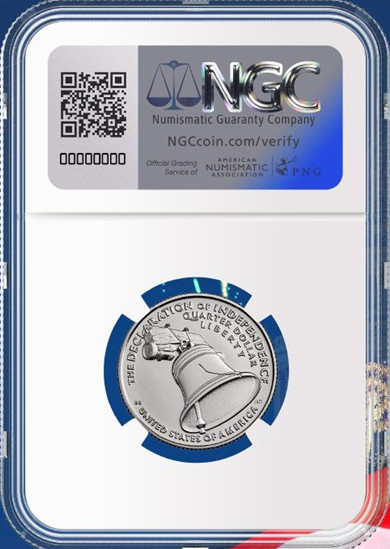
Everything else matches the regular issue. The coin shows the dual date 1776 to 2026, and the reverse is unchanged, depicting the Liberty Bell with its familiar crack and the inscriptions UNITED STATES OF AMERICA, LIBERTY, QUARTER DOLLAR, and THE DECLARATION OF INDEPENDENCE. At a glance it is an ordinary quarter. The difference is in the details, which is exactly what makes the search worthwhile.
A Rarity Hiding in Plain Sight
The Mint announced the program on June 23, confirming that the privy marked quarters would be folded at random into the standard Declaration run and distributed through banks and financial institutions ahead of Independence Day. There was no sales listing, no order page, no household limit. Unlike the Mint’s commemorative coins and medals, these pieces were never offered for sale. They were simply set loose.
That is what gives the hunt its long odds. Through May, the Mint had already struck 89.8 million standard Declaration quarters, and production could eventually pass 200 million based on the totals from the first two 2026 designs. Against that backdrop, 250,000 privy pieces are a thin needle in a very deep haystack. Anyone could find one. Almost everyone won’t.
Where It Fits
The Declaration of Independence quarter entered circulation on June 1 as the third of five one year designs in the Mint’s Semiquincentennial series. It followed the Mayflower Compact and Revolutionary War quarters and will give way to the U.S. Constitution and Gettysburg Address issues before the year is out. The July 4th privy is the program’s wink at its own occasion, a small mark tying the coin to the holiday it celebrates.
Collectors who do strike lucky have one more option to consider. NGC is offering its officially licensed America250 certification label, which carries the official logo of the United States Semiquincentennial Commission, for those who want the finished slab to reflect the milestone as well as the grade.
The Real Prize
For most collectors the appeal here was never the grade on the holder. It is the idea that a $2,500 coin is out there in circulation right now, indistinguishable from the change you carry, waiting on someone sharp enough to notice the missing mint mark. Only one finder will collect the bounty. The rest of the hobby gets a reason to look twice at every quarter through the summer, which, for a circulating commemorative, may be the more lasting reward.