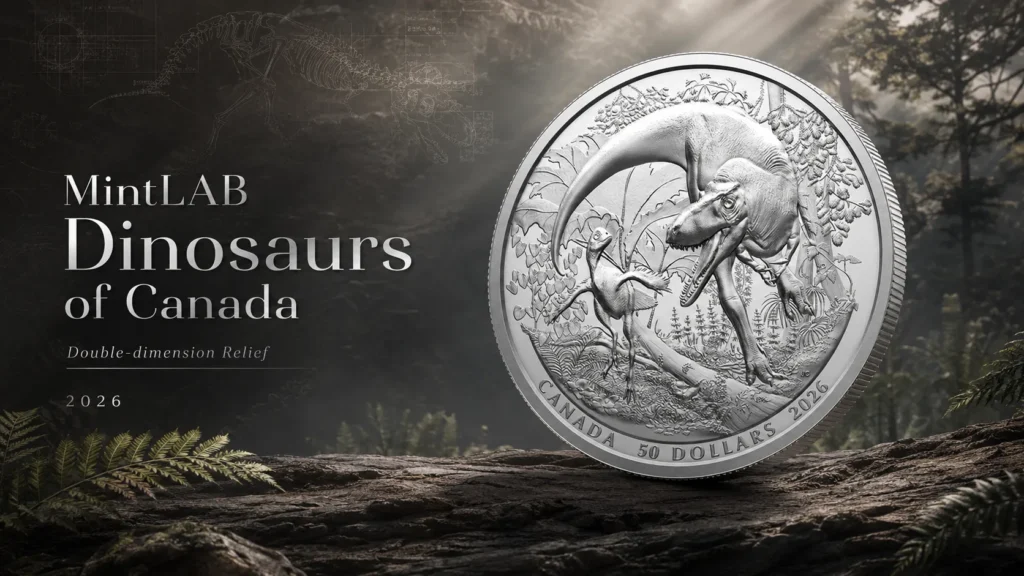
The Royal Canadian Mint has released a coin that took seventeen years, a dead tyrannosaur, and a technology its own R&D department spent three years trying to find a home for. The 2026 MintLAB Exceptional Discoveries: Dinosaurs of Canada fine silver coin is the first piece ever struck in the Mint’s new Double-dimension Relief, a technique that combines Super Incuse and Ultra High Relief on opposite sides of the same coin, and it is limited to just 647 examples worldwide at $1,829.95 CAD.
The coin belongs to the Mint’s MintLAB line, the experimental series in which the R&D team releases authentic trial pieces, real prototypes created during the development of future coin technologies, each accompanied by a certificate signed by the Mint’s Chief Technology Officer. What sets this release apart is that the technology and the subject arrived together: the story the coin tells is a genuine paleontological first, and the Mint built the striking method around it.
The Gorgosaurus Fossil Behind the Coin
In 2009, a skeleton of a young Gorgosaurus libratus was discovered in Alberta’s Dinosaur Provincial Park. Finding a juvenile tyrannosaur is rare on its own. What made specimen TMP 2009.12.14, now curated at the Royal Tyrrell Museum of Palaeontology in Drumheller, genuinely exceptional was what it still held inside: the remains of its last meal, preserved in the stomach cavity.
According to Dr. François Therrien, the Royal Tyrrell’s Curator of Dinosaur Palaeoecology and who helped lead the study on the specimen, everything previously known about tyrannosaur diets came from inference, chiefly tooth marks left on the bones of large herbivores. This fossil delivered direct evidence for the first time. Inside the stomach of the young Gorgosaurus, estimated at between five and seven years old, were the legs of two Citipes elegans, small birdlike caenagnathids about the size of a turkey, neither of which had reached its first year.
The implications reshaped how paleontologists understand tyrannosaur growth. Juveniles, with their lightly built skulls and sharp teeth, hunted small, young prey and selectively ate the meatiest portions. Adults, with powerful jaws and blunter teeth, took down the large duckbilled and horned dinosaurs. In other words, young and old tyrannosaurs occupied different roles in the same ecosystem, and this single specimen proved it.
Double-dimension Relief: Super Incuse Meets Ultra High Relief
Double-dimension Relief is the Mint’s answer to a question its R&D department had been carrying since roughly 2023: could two of its most successful striking technologies coexist on one coin? Yannick Cormier of the Mint’s R&D team recalls that the idea of pairing the techniques preceded any theme, and the team struggled to find a subject that could unite them until the Commercial Team suggested a dinosaur design.
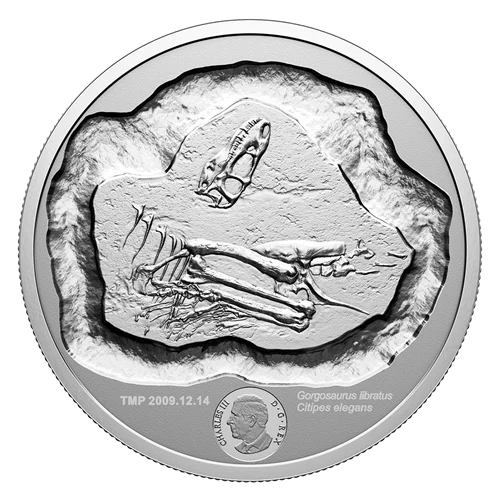
The fossil solved the problem elegantly, because the discovery itself has two dimensions. The obverse recreates the dig site: an engraved representation of the Gorgosaurus skeleton with the Citipes remains positioned exactly as they were preserved in the stomach cavity, surrounded by a trench struck Super Incuse to a depth of 1.5 mm, simulating the excavation. It marks the first time the Mint has applied Super Incuse to a coin’s obverse. Steven Rosati’s effigy of His Majesty King Charles III appears below the fossil.
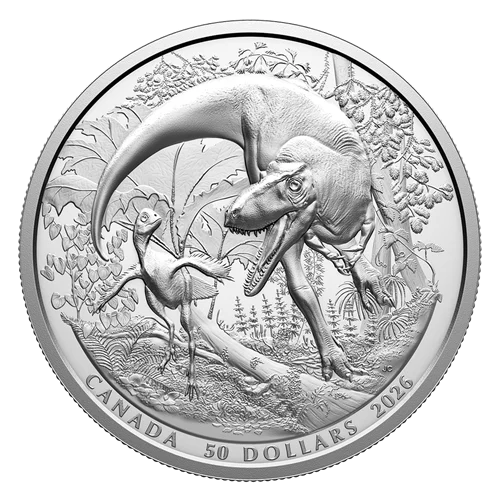
Flip the coin and the animal comes back to life. The reverse, designed by Canadian paleoartist Julius Csotonyi, renders Late Cretaceous Alberta in Ultra High Relief rising 2.0 mm above the surface, with the young Gorgosaurus in full pursuit of a yearling Citipes, a scene of predator and prey set 75 million years ago in what is today southern Alberta. There is no colour anywhere on the piece; frosted finishes diffuse the light and carry the contrast on both sides.
Past on one face, present on the other, and the same story told twice. Dr. Therrien reviewed both designs for scientific accuracy and consulted throughout, an arrangement 3D artist and engraver Ryan Poser, a lifelong dinosaur fan by his own account, credits for the fidelity of the final sculpt.
Dinosaurs of Canada Silver Coin Specifications
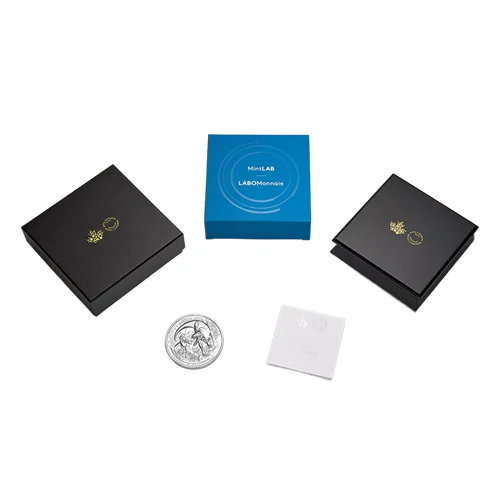
The piece is struck in 156 grams of 99.99% pure silver at 65.25 mm in diameter, carries a $50 face value with a serrated edge and proof finish, and ships encapsulated in a black wood Royal Canadian Mint case with a custom MintLAB beauty box. The serialized certificate takes the form of an art card showing a photograph of the actual fossil specimen. There is no GST or HST on the purchase, and shipping is limited to Canada and the United States.
Why This MintLAB Release Matters to Collectors
MintLAB releases are, by design, glimpses of where minting technology is headed, and Double-dimension Relief will almost certainly resurface on future issues once the technique matures beyond the trial stage. But the 647 collectors who secure this coin will own the piece where it began, and one of the rare modern issues where the numismatic innovation and the scientific discovery genuinely deserve each other. A fossil that recorded a single moment 75 million years ago has now been recorded twice more, once below a coin’s surface and once above it.