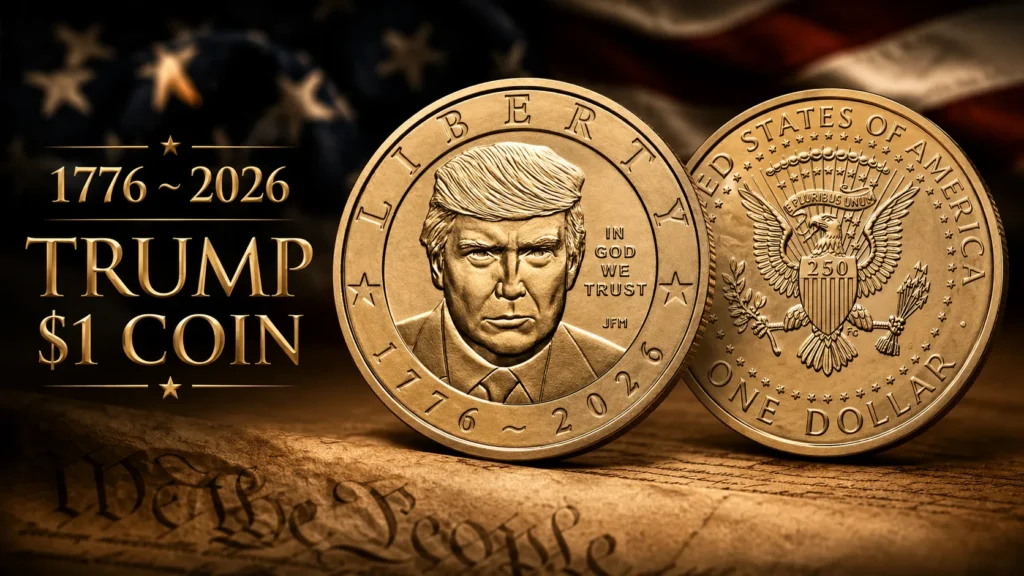
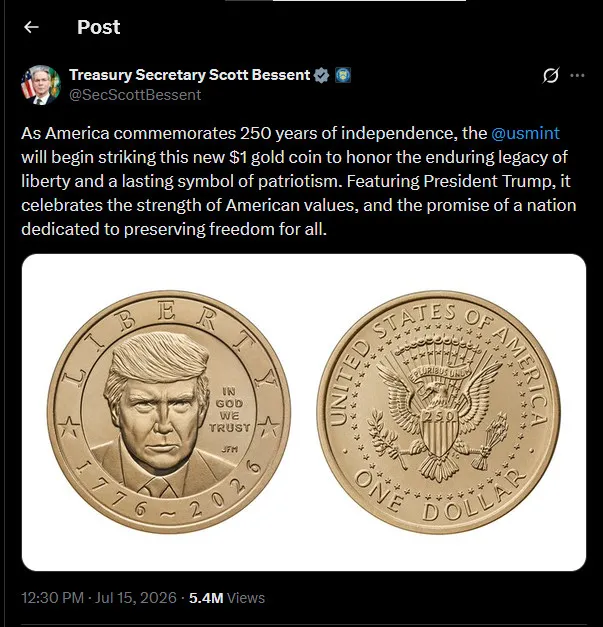
The Treasury Department has unveiled the final designs for a 1776 ~ 2026 Trump $1 coin, confirming that the United States will place a sitting president on its Semiquincentennial dollar for the first time in the modern era. The coin, announced by Treasury Secretary Scott Bessent on July 15, will be struck at the Philadelphia Mint with a circulating finish and is expected to reach collectors in U.S. Mint products late this fall.
The announcement settles months of speculation that began when the Mint’s candidate designs surfaced in federal review this February. It also confirms something the review process itself had already hinted at: the final selections belong to the Treasury, and the Treasury exercised that authority in full.
Trump $1 Coin Designs and Specifications
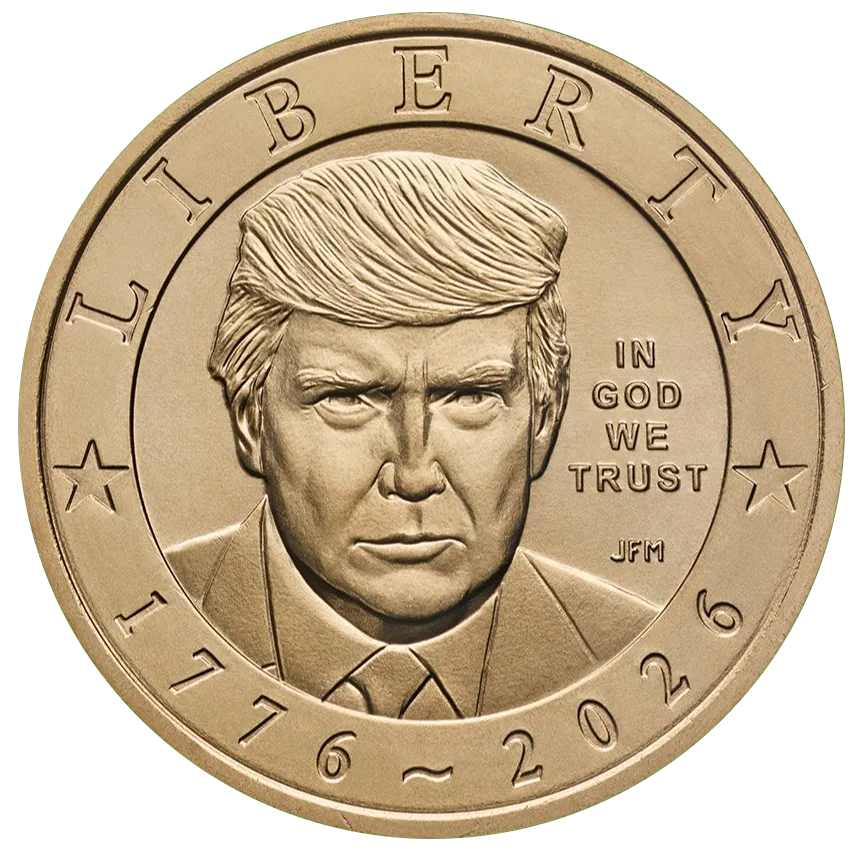
Despite its gold color, the 2026 Trump dollar contains no gold or other precious metal. It uses the same manganese brass clad composition as the Native American and American Innovation dollars, weighing 8.10 grams at 26.49 millimeters in diameter, with a composition of 88.5% copper, 6% zinc, 3.5% manganese and 2% nickel. Unlike its Native American and Innovation counterparts, the coin will carry a plain edge without lettering, and no mint mark.
The obverse presents a nearly forward-facing portrait of President Donald J. Trump, an unusual orientation in a coinage tradition that has favored the profile since the republic’s first cents. The portrait is the work of U.S. Mint Chief Engraver Joseph Menna, whose initials JFM appear above the president’s shoulder. Surrounding inscriptions read LIBERTY, IN GOD WE TRUST and the dual date 1776 ~ 2026.
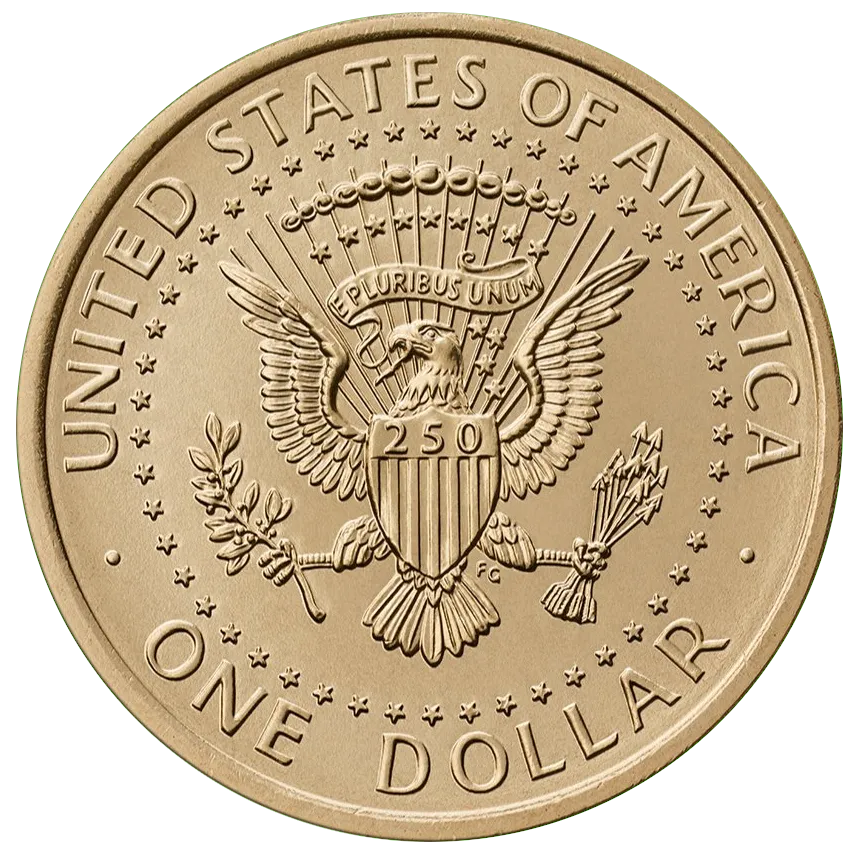
The reverse reaches back into the Mint’s own design history. It depicts the Presidential Seal as rendered by former Chief Engraver Frank Gasparro, the heraldic eagle familiar to generations of collectors from the Kennedy half dollar: olive branch in one talon, bundle of arrows in the other, shield on the breast, and a banner inscribed E PLURIBUS UNUM in the eagle’s beak. For this issue, the numeral 250 sits within the shield to mark the nation’s 250th anniversary, alongside the inscriptions UNITED STATES OF AMERICA and ONE DOLLAR.
Whether any examples will actually circulate is an open question. The Mint has not said whether the Federal Reserve will order the coins, and no dollar coins have been ordered for circulation in recent years, though the Mint continues striking them for collector products.
How the Trump Coin Bypassed CFA and CCAC Design Review
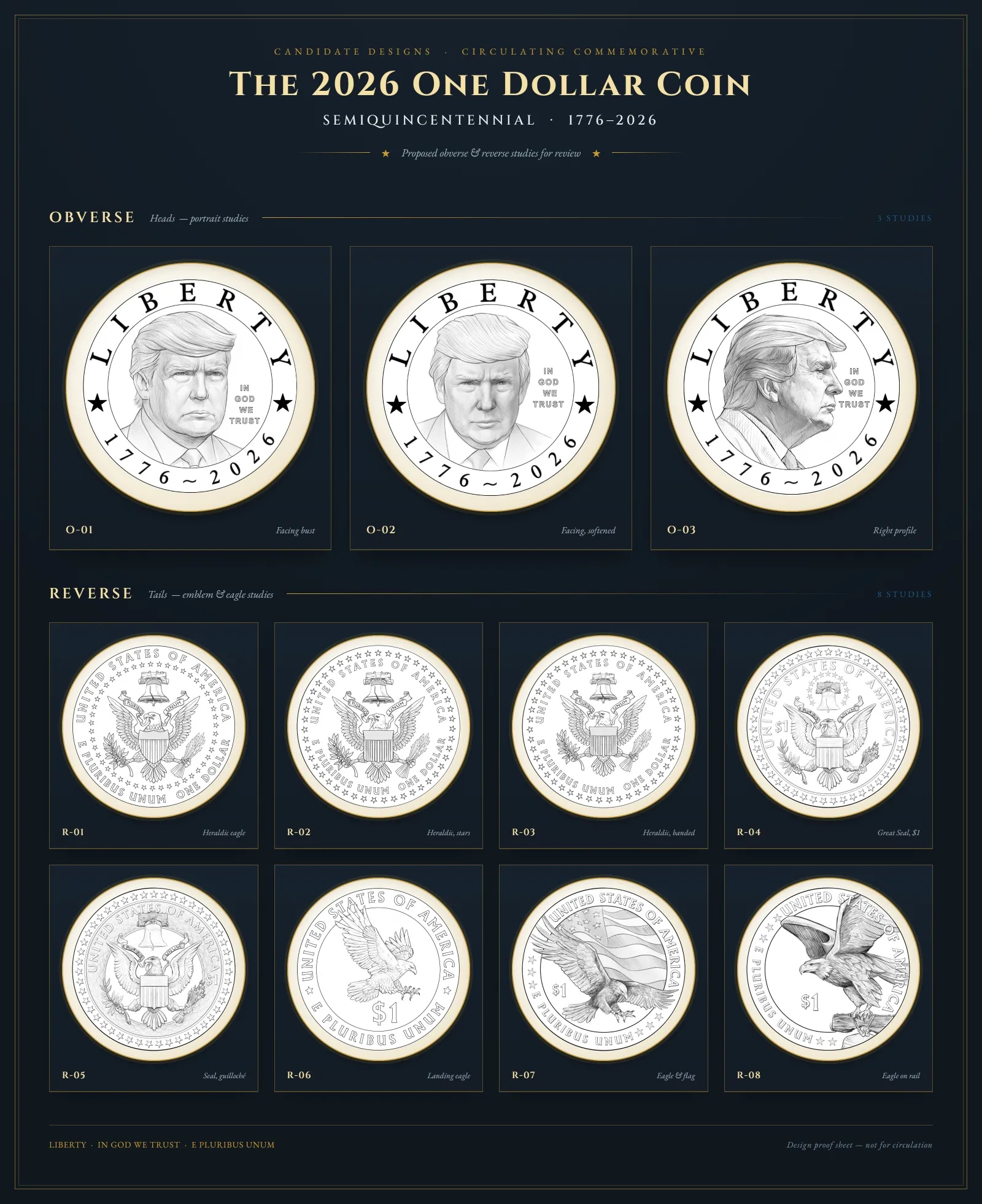
The path to these designs ran through the federal design review process, and then around it. In February, the Mint presented three candidate Trump obverses and eight reverses featuring eagles, Great Seal imagery and Liberty Bell elements. The Commission of Fine Arts recommended obverse #3, a profile portrait, paired with reverse #5, a heraldic eagle adapted from the Great Seal, while also expressing interest in learning which designs the president himself preferred.
Neither recommendation was adopted. The Treasury selected the forward-facing obverse #2 and the Presidential Seal reverse instead. That outcome is entirely lawful, federal design recommendations are advisory, and final selections rest with the Treasury secretary, but it is a visible reminder of where the authority actually sits.
The Citizens Coinage Advisory Committee, which normally reviews proposed coin designs alongside the CFA, declined to consider a Trump coin at all.
Can a Living President Appear on a U.S. Coin?
The coin’s legal foundation is the Circulating Collectible Coin Redesign Act of 2020, which authorizes the Treasury secretary to issue $1 coins during 2026 with designs emblematic of the Semiquincentennial. The law prohibits portraits of living people on the reverse, but places no comparable restriction on the obverse, a gap the Treasury’s legal research concluded made the coin lawful, according to a Mint representative during the CFA review.
The choice has nonetheless generated debate over the longstanding American convention against depicting living presidents on money, with critics including members of Congress weighing in publicly after the announcement. History offers precedents, though few. The 1926 Sesquicentennial half dollar carried then President Calvin Coolidge for the nation’s 150th anniversary, and the 1995 Special Olympics World Games silver dollar portrayed Eunice Kennedy Shriver, the first living woman on a U.S. coin. The pattern is hard to miss: America’s anniversaries have a way of bending its coinage conventions.
Trump Coin Release Date, Price and Mintage
Product options, release dates, prices, mintage limits and household order limits remain unannounced, with collector products expected late this fall. For collectors, the practical questions now are the familiar ones: which finishes, at what price, and in what quantity. But the larger significance of this dollar was settled the moment the designs were unveiled. Whatever one thinks of the portrait on its obverse, the 1776 ~ 2026 Trump dollar will enter the record as the coin that tested, and redrew, the boundary between American money and the living presidency.