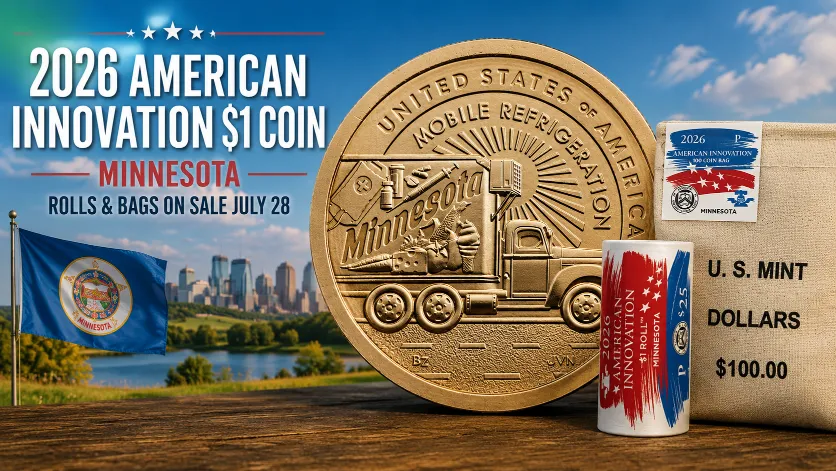
The U.S. Mint will open sales for the rolls and bags of the 2026 American Innovation $1 Coin honoring Minnesota on Tuesday, July 28 at noon Eastern. The reverse celebrates one of the least glamorous but most consequential inventions of the twentieth century: mobile refrigeration, the technology that finally let fresh food travel farther than a load of ice could carry it.
It is the fourth and final American Innovation dollar of 2026, closing the year’s run of state designs, and it wears the Semiquincentennial privy mark that every 2026 dollar in the series shares.
At a Glance
What’s on offer, July 28 release
| Product | Mint | Coins | Price | Product code | Available |
|---|---|---|---|---|---|
| Roll | Philadelphia (P) | 25 | $61.00 | 26GRD | 8,400 |
| Roll | Denver (D) | 25 | $61.00 | 26GRH | 7,350 |
| Bag | Philadelphia (P) | 100 | $154.50 | 26GBD | 3,150 |
| Bag | Denver (D) | 100 | $154.50 | 26GBH | 2,950 |
On sale Tuesday, July 28, 2026 at noon Eastern. Circulating quality. Household limit 10 per product. No overall mintage limit.
Coin specifications
| Detail | Specification |
|---|---|
| Program | American Innovation $1 Coin (Public Law 115-197) |
| State and theme | Minnesota, Mobile Refrigeration |
| Year | 2026 (fourth and final 2026 issue) |
| Denomination | $1 |
| Composition | 6% zinc, 3.5% manganese, 2% nickel, balance copper |
| Weight | 8.100 g |
| Diameter | 1.043 in (26.49 mm) |
| Edge | Lettered, incused: 2026, mint mark, E PLURIBUS UNUM |
| Mints | Philadelphia (P), Denver (D) |
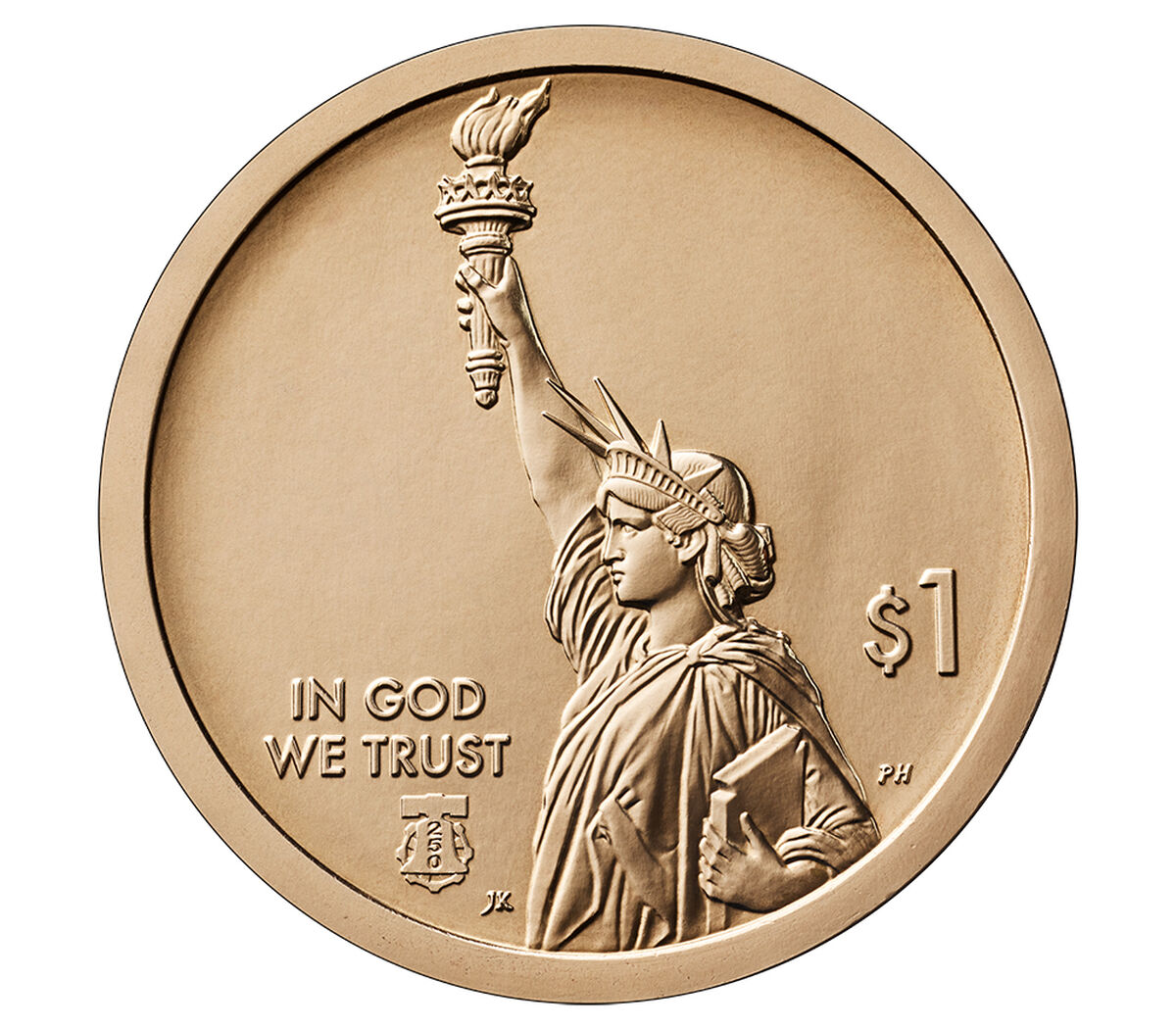
| Obverse | Statue of Liberty in profile; IN GOD WE TRUST, $1 |
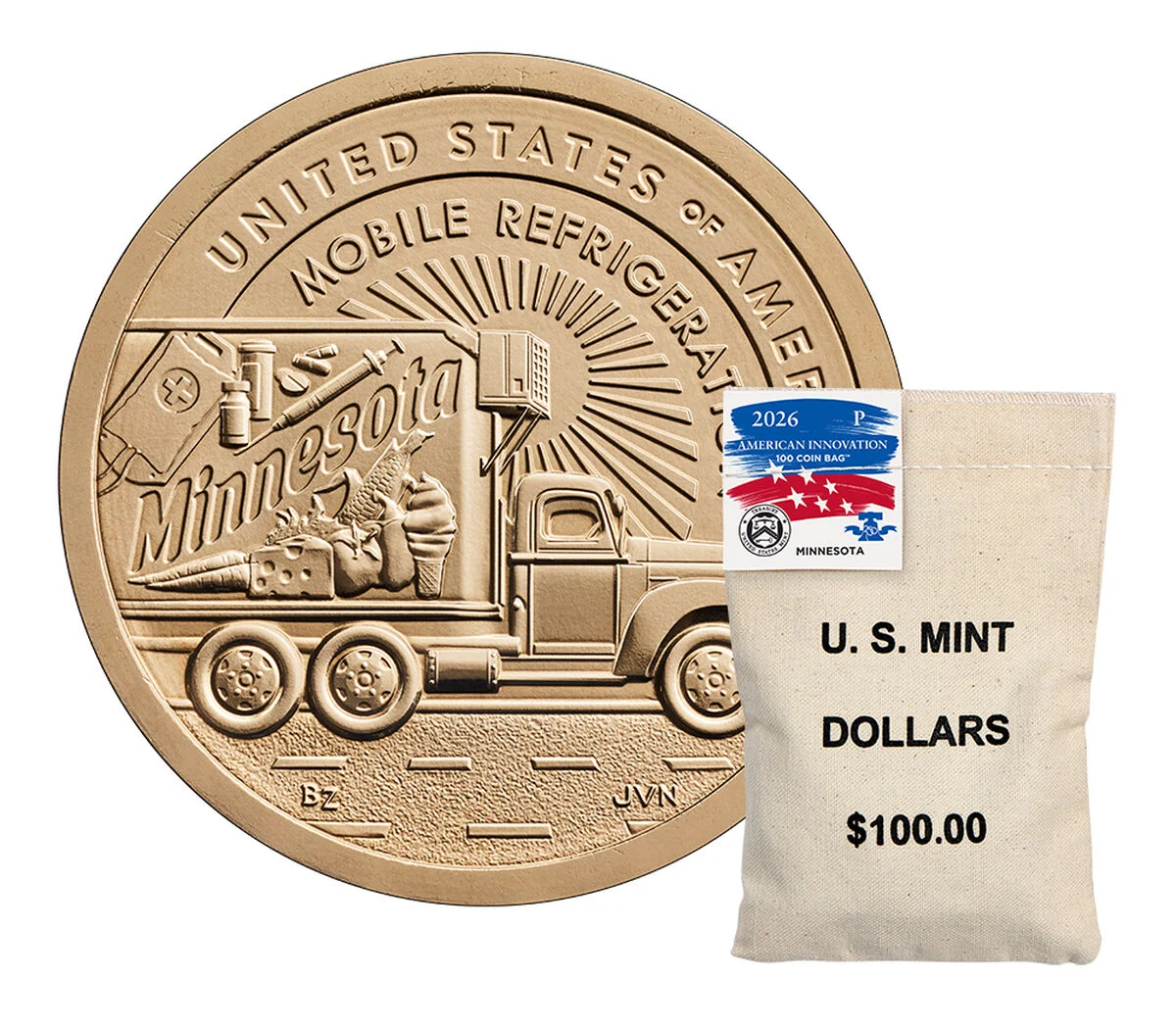
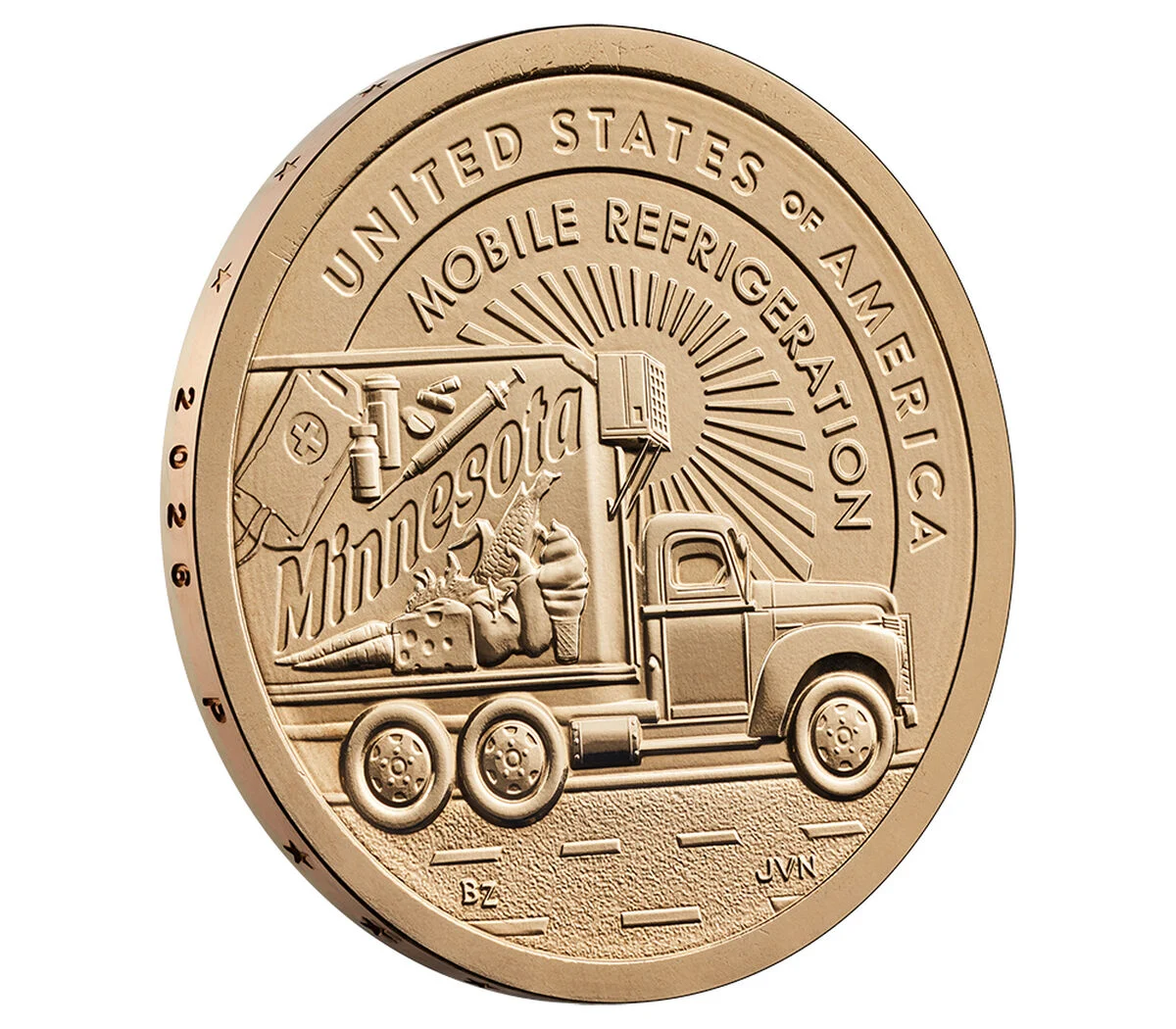
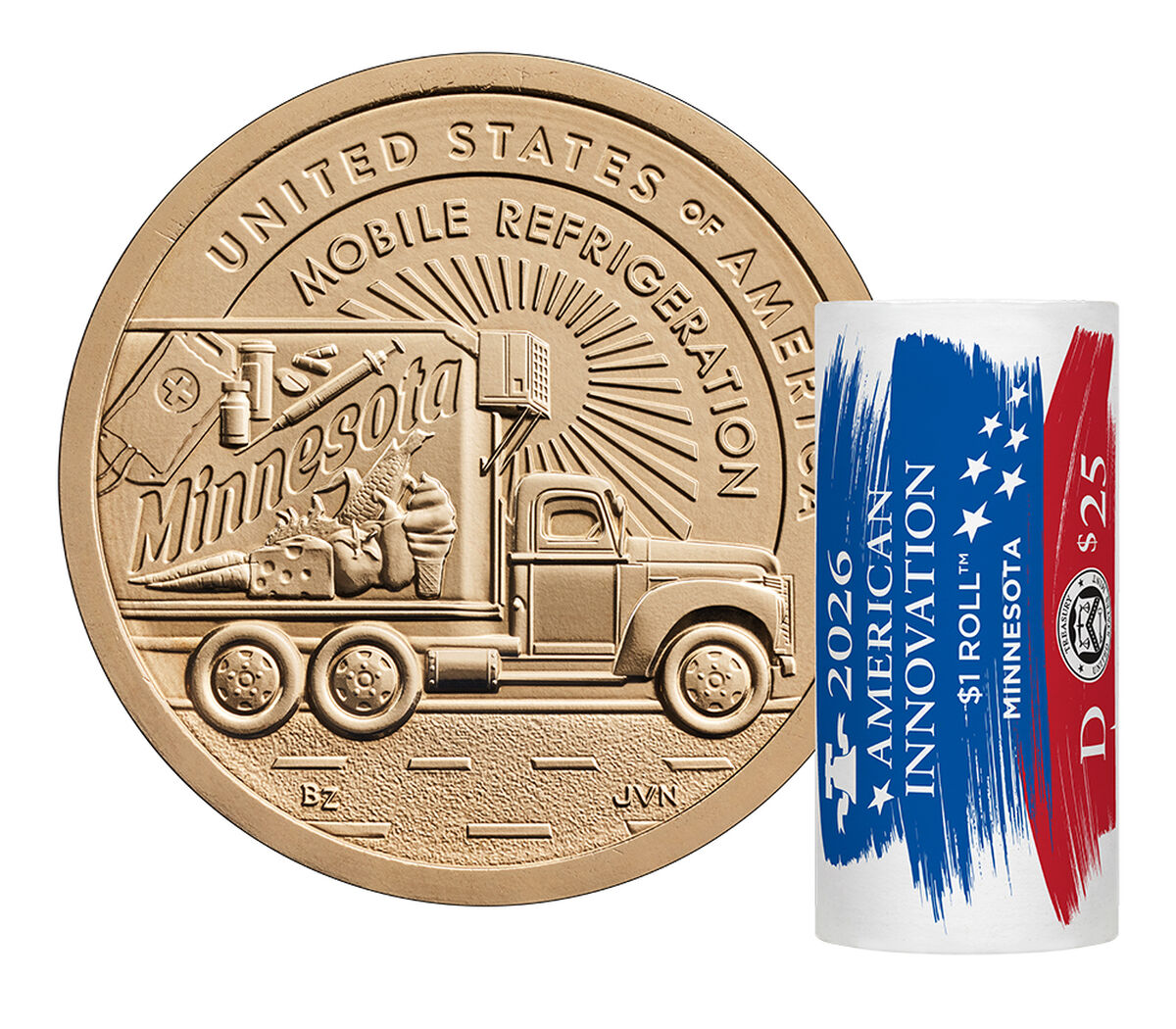
| Reverse | 1940s truck with front mounted refrigeration unit; UNITED STATES OF AMERICA, MINNESOTA, MOBILE REFRIGERATION |
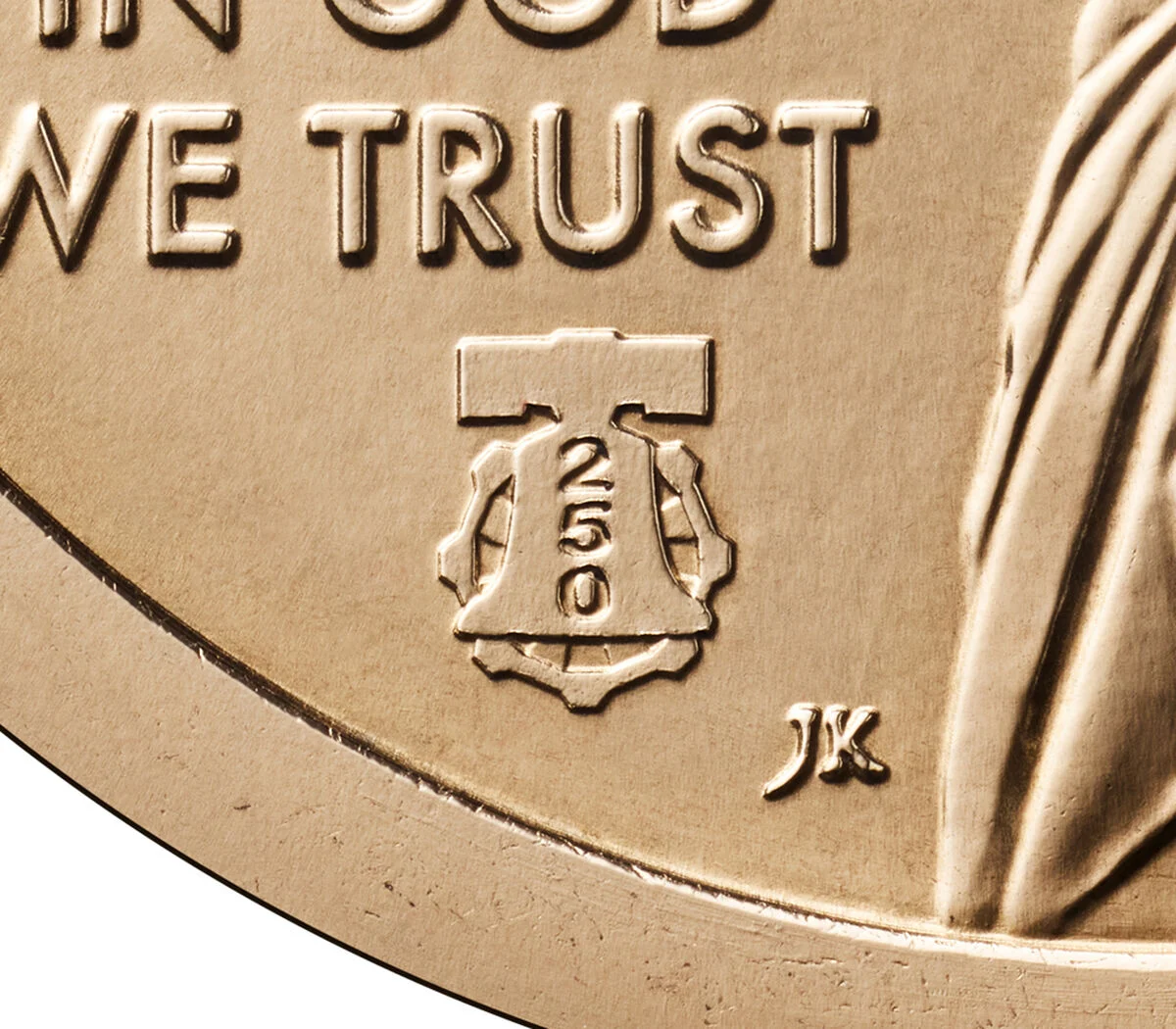
| Privy mark | Stylized gear with Liberty Bell “250” (Semiquincentennial) |
| Mintage limit | None |
The Design: A 1940s Truck and Its Cargo
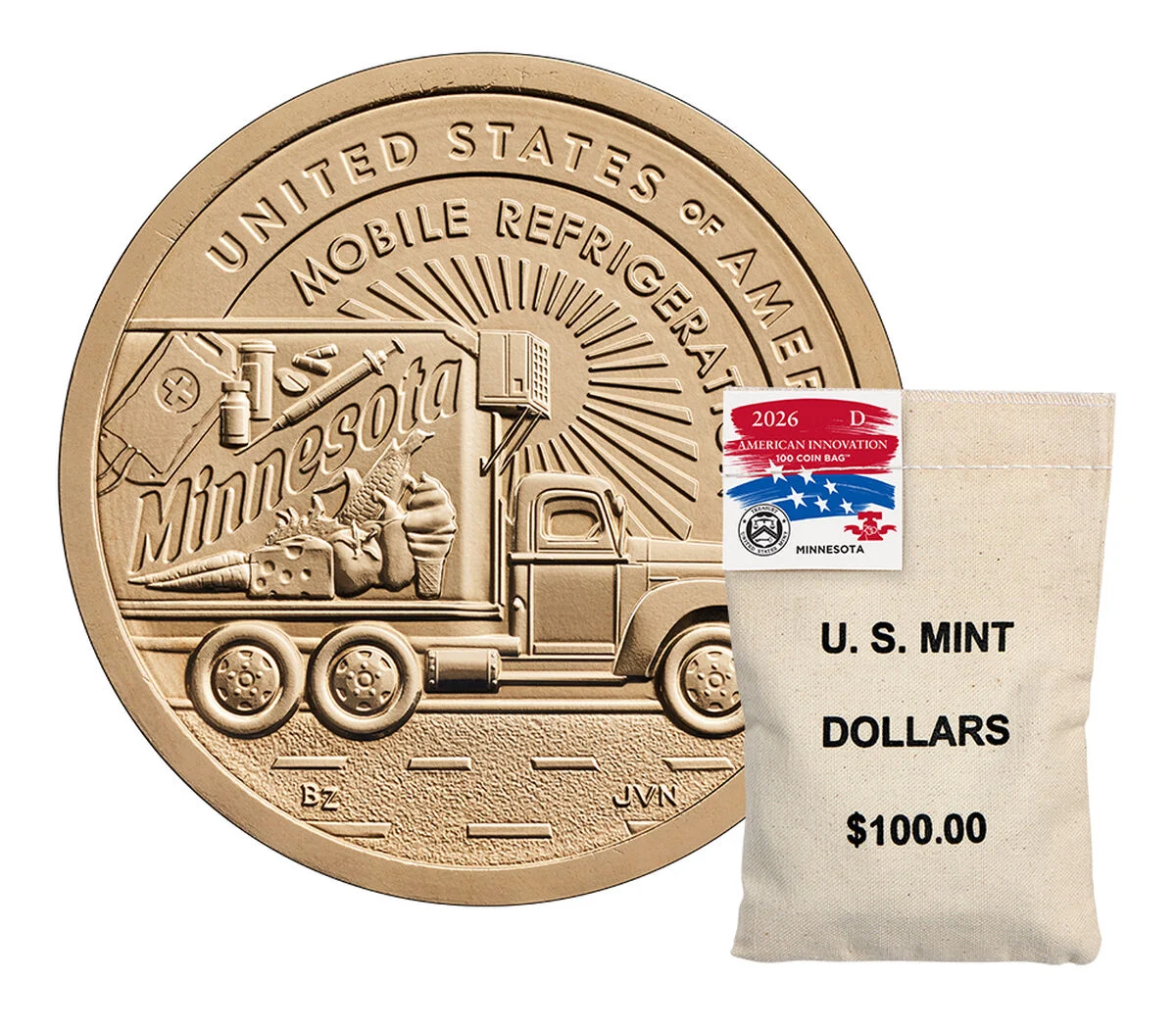
The Minnesota reverse is built around a single image: a 1940s era truck fitted with an early, front mounted refrigeration unit. Small icons run along the side of the truck, each standing for one of the temperature sensitive goods that the innovation suddenly made transportable over long distances. The design carries the standard series inscriptions, UNITED STATES OF AMERICA and MINNESOTA, with the additional legend MOBILE REFRIGERATION naming the achievement outright.
Mint Director Paul Hollis framed the design as a tribute to the ingenuity and perseverance of the people who helped build the modern food distribution chain, the invisible network most of us only notice when it fails.
The Self-Taught Engineer Behind the Cold Chain
Behind the innovation on the coin stands a man the press release names directly: Frederick McKinley Jones.
Born in Cincinnati in 1893, Jones lost his mother young, left formal schooling early, and taught himself mechanics in an auto garage before he was old enough to drive what he repaired. He moved to Minnesota, working as a mechanic in the small town of Hallock and later as an engineer in Minneapolis, which is why this is Minnesota’s story to tell. Around 1940 he patented the first practical portable refrigeration unit rugged enough to survive the vibration of over the road travel, the hurdle that earlier attempts had never cleared. That invention became the foundation of Thermo King and, with it, an entire transport refrigeration industry.
The reach went well beyond groceries. During the Second World War, Jones’s cooling units preserved food, blood, and medicine bound for the front, and air conditioned field hospitals where the alternative was doing without. Over a career that produced more than sixty patents, recognition came late and, in the end, posthumously: in 1991 he became the first Black American to receive the National Medal of Technology, presented by President George H. W. Bush nearly thirty years after his death.
Minnesota Governor Tim Walz tied the coin back to that legacy, casting mobile refrigeration as the innovation that launched the frozen food industry, kept fresh food available year round, and moved critical supplies to soldiers overseas. The coin, in other words, honors both a technology and the self-taught engineer who made it work.
Rolls, Bags, and the 250th Anniversary Privy Mark
For collectors, the July 28 release comes in four configurations, all in circulating quality. A 25 coin roll sells for $61.00, offered from Philadelphia (product code 26GRD) and Denver (26GRH). A 100 coin bag sells for $154.50, again split between Philadelphia (26GBD) and Denver (26GBH). Orders are capped at 10 per household for each product.
The availability numbers are worth a look before the on sale time. The Mint lists no overall mintage limit, but it caps each product configuration, and the bags are the tighter of the two: 3,150 Philadelphia bags and 2,950 Denver bags, against 8,400 and 7,350 for the corresponding rolls. If any of these four is going to test collectors’ reflexes at noon, the bags are the likelier candidates.
Every 2026 coin also carries the year’s special obverse detail. The shared American Innovation obverse shows the Statue of Liberty in profile with IN GOD WE TRUST and $1, marked each year by a stylized gear privy that stands for industry and innovation. For 2026 that gear is joined by a Liberty Bell bearing the inscription 250, the Mint’s nod to the nation’s Semiquincentennial. The edge, incused rather than raised, reads 2026, the mint mark, and E PLURIBUS UNUM. Underneath the design sits the familiar manganese brass dollar planchet, 8.1 grams and just over 26 millimeters across.
What It Commemorates
The Minnesota dollar closes 2026’s American Innovation quartet without much fanfare, which is fitting for a coin about infrastructure most people never think about. Its worth to collectors is less in the alloy than in what the image records. For those building the full state by state set, it is the necessary fourth entry of the year. For everyone else, it is a pocket size reminder that a self-taught engineer from a Minnesota town most Americans could not find on a map quietly changed how the world eats, and waited a lifetime to be thanked for it.