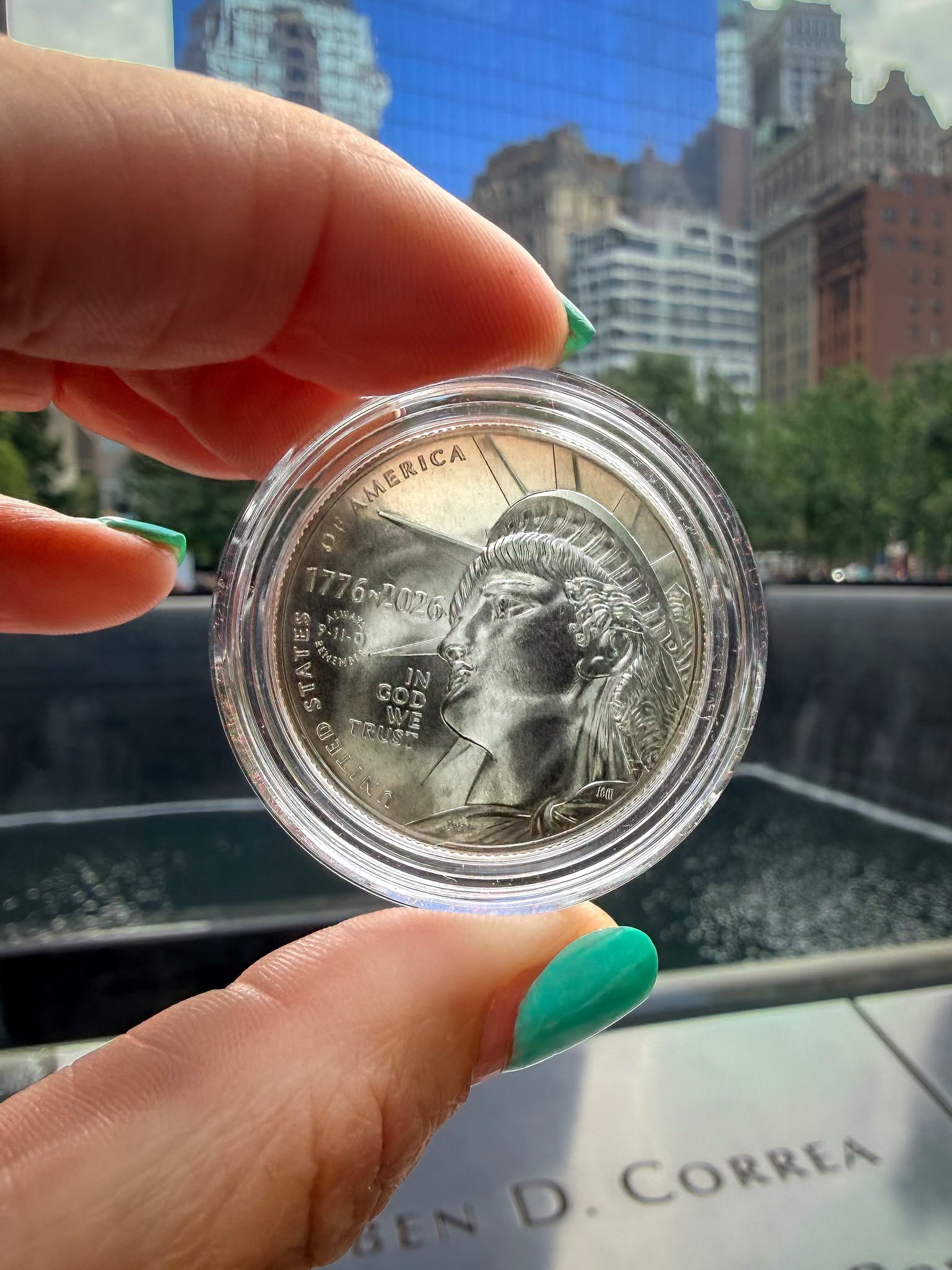
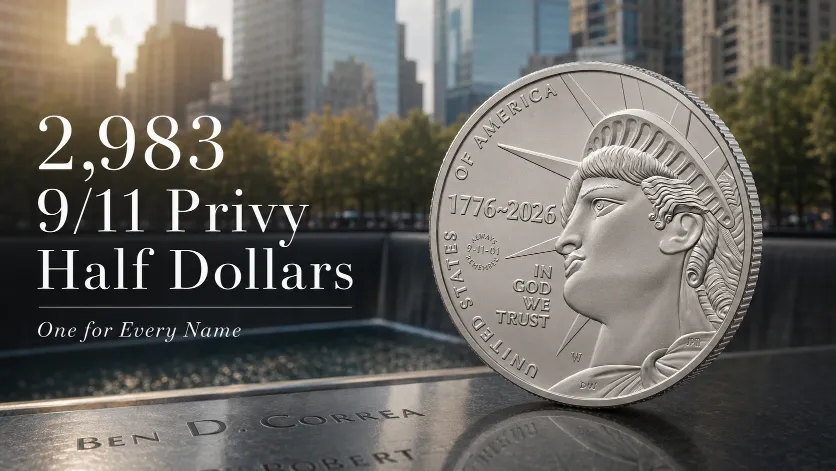
The United States Mint has presented the National 9/11 Memorial & Museum with 2,983 Enduring Liberty half dollars, each struck at West Point and each carrying a 9/11 privy mark reading ALWAYS REMEMBER around the date 9-11-01. The number is the story. It matches the 2,983 names recorded at the Memorial, one coin for every person killed in the September 11, 2001, attacks and in the February 26, 1993, World Trade Center bombing.
The coins were delivered ahead of next month’s remembrance event, which marks a quarter century since the attacks and falls inside the nation’s 250th anniversary year. Two anniversaries meeting in one year is the premise of the entire issue, and the Mint has built the coin around what came after the attacks rather than around the attacks themselves.
A Mintage Measured in Names: Why 2,983
Special issues normally take their mintage from a demand forecast, a product limit, or the practical arithmetic of a press run. This one takes it from a memorial wall.
That single decision does more editorial work than any design element on the coin. A figure like 2,983 cannot be rounded up to a comfortable 3,000 or trimmed to fit a budget line, because every unit in it stands for a person. The Mint has issued commemoratives with symbolic mintages before, but rarely one where the count carries the whole meaning of the object.
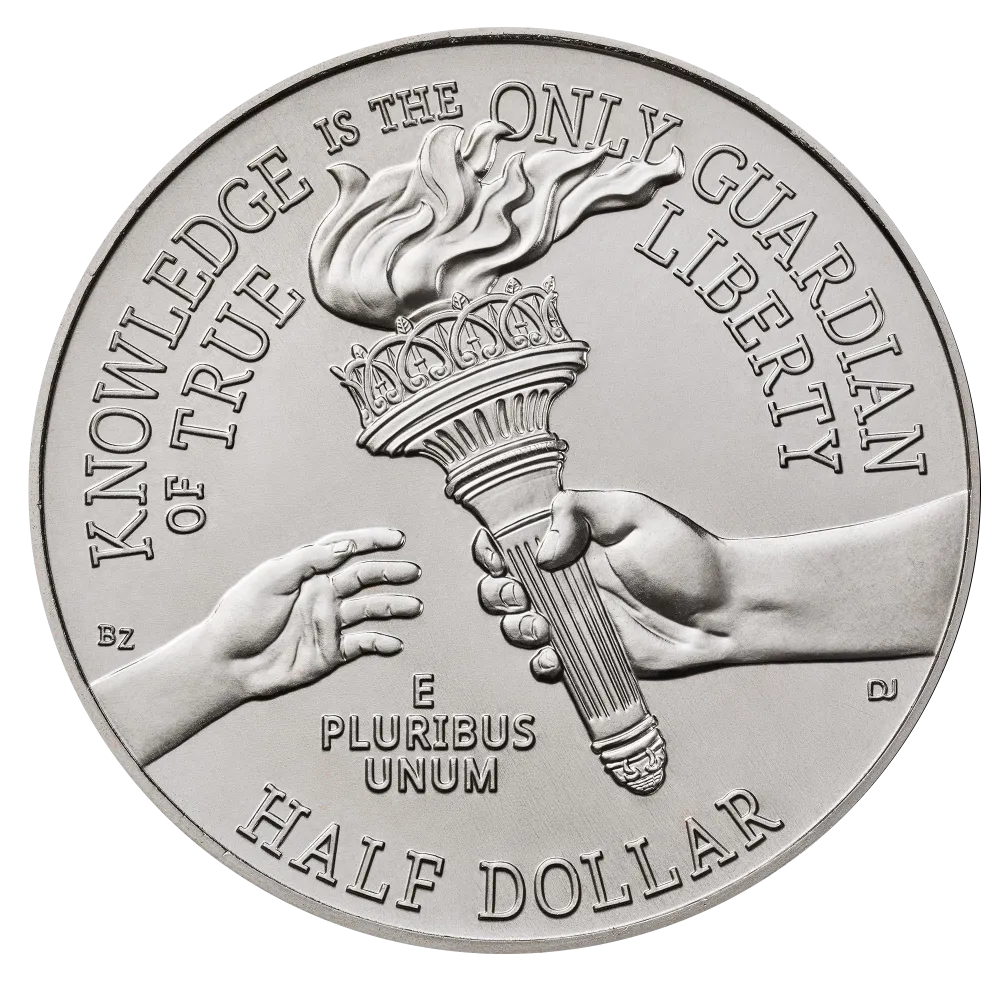
Mint Director Paul Hollis described the coin as a tangible representation of the strength it took for the country to look forward, both at its founding 250 years ago and, more sharply, 25 years ago. The nation, he said, continues “to pass the torch of enlightenment to future generations” in honor of the 2,983 victims. That phrasing lands differently once you have seen the reverse of the coin it is describing.
The 9/11 Privy Mark and the West Point Strike
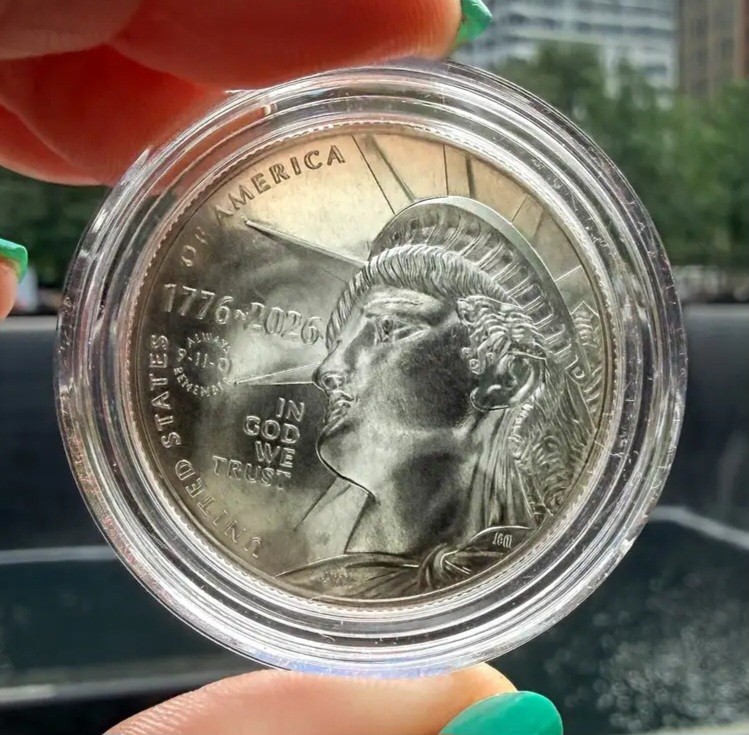
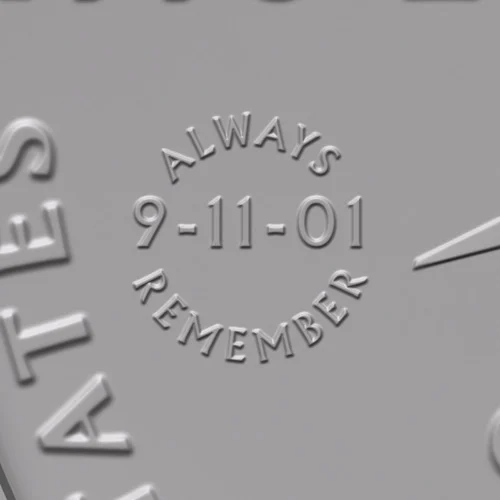
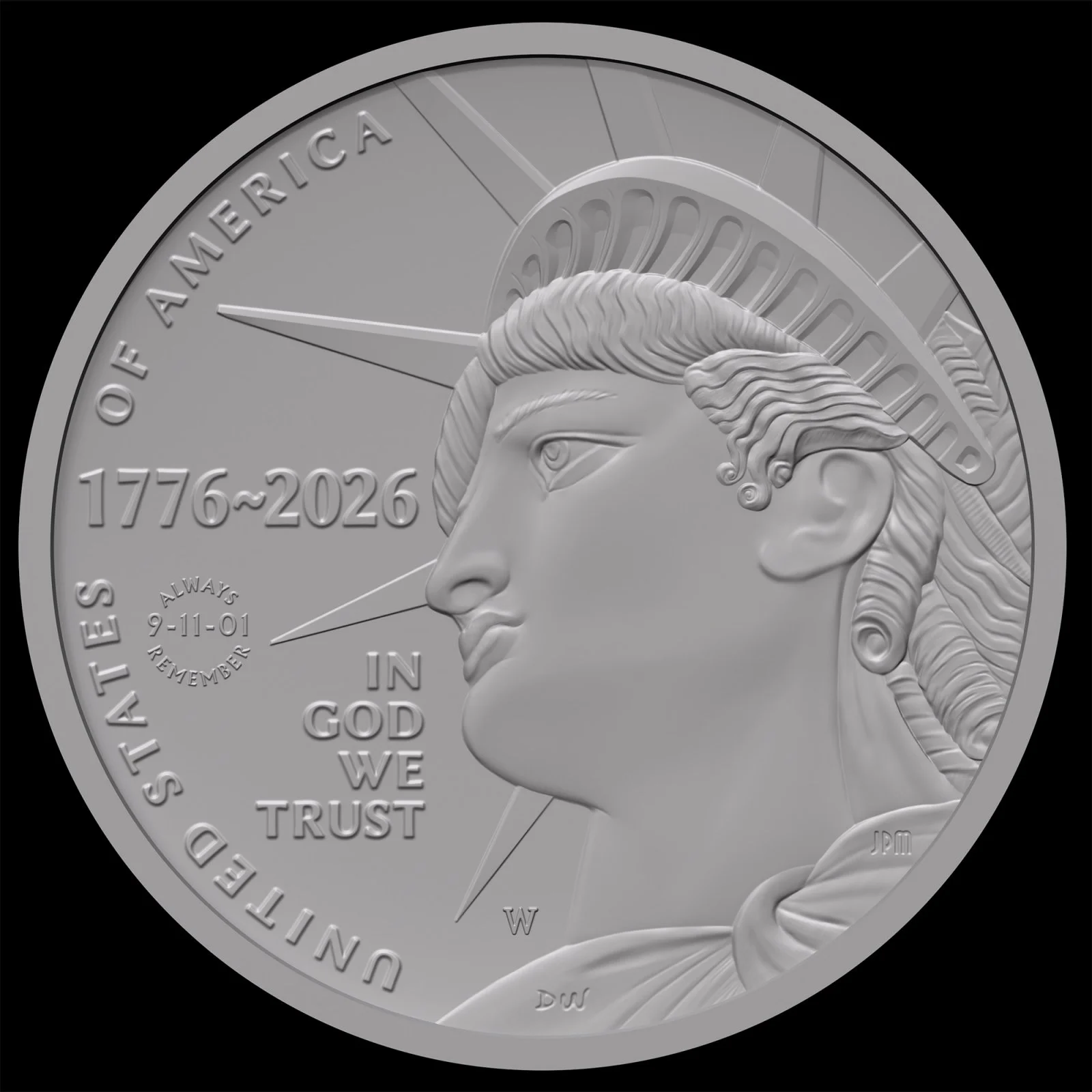
The privy mark sits on the obverse: the date 9-11-01 enclosed within the pledge ALWAYS REMEMBER. The phrase is not new to U.S. coinage. The Mint used the same wording on its 2011 September 11 National Medal, which makes this a continuation of an existing commemorative vocabulary rather than an invention for the occasion.
The striking facility matters just as much. West Point does not produce circulating half dollars. Philadelphia and Denver do, and the standard Enduring Liberty issue carries a P or a D accordingly. Every one of these 2,983 pieces instead carries a W, a mint mark that appears on no other half dollar of the design, struck at a facility in the same state where the towers stood.
Nothing else separates them. The composition is the same clad alloy, the denomination is the same fifty cents, and they are legal tender exactly as the coins in circulation are. Two small marks are the entire difference between an ordinary 2026 half dollar and a memorial object.
Inside the 2026 Enduring Liberty Half Dollar Design
The Enduring Liberty half dollar is a one year design created for America’s Semiquincentennial, and it already carried news value before the privy mark was added. It is the first U.S. half dollar since 1964 to be issued without President John F. Kennedy’s portrait.
The obverse, designed by Donna Weaver and sculpted by John McGraw, gives a close view of the Statue of Liberty, her gaze fixed outward as though on something ahead of her. The inscriptions are UNITED STATES OF AMERICA, IN GOD WE TRUST, and the dual date 1776 ~ 2026. The reverse, designed by Beth Zaiken and sculpted by Darla Jackson, shows Liberty handing her torch to a new generation, the flame trailing behind it, with the inscriptions E PLURIBUS UNUM, HALF DOLLAR, and KNOWLEDGE IS THE ONLY GUARDIAN OF TRUE LIBERTY.
The result is a coin pulling in two directions at once. The design was conceived to look forward, toward whoever receives the torch next. The privy mark added to it is a promise to look back. Both readings now share the same piece of clad, and the tension between them is the most interesting thing about the issue.
The underlying coin exists because of the Circulating Collectible Coin Redesign Act of 2020, Public Law 116-330, signed into law on January 13, 2021.
No Public Sale Announced: What the Market Does Not Get
The Mint has not announced any plan to sell the privy mark coins to the public, and it has not said how the National 9/11 Memorial & Museum intends to use or distribute them. For an issue this small, that silence is the most consequential detail in the announcement.
The contrast with the standard issue is severe. U.S. Mint branded rolls and bags of the Enduring Liberty half dollar went on sale May 26, with two roll sets priced at $60 holding a roll of 20 from Philadelphia and another from Denver, and $180 bags holding 100 coins from each facility. Collector demand ran hard from the opening. Through May 31, the two products together accounted for nearly 9.5 million half dollars, far outpacing the opening sales of recent Kennedy releases. By August 16, two roll set sales had reached 99,738, leaving them 262 short of the 100,000 product limit and listed as unavailable for an extended stretch, while bag sales climbed to 39,971. Combined, those products represent 11,983,720 half dollars.
Set that against 2,983. For every coin carrying the privy mark, roughly four thousand of the same design exist without it. One of those numbers describes a successful Mint product. The other describes a list of the dead.
Two Privy Marks, One Year: The 9/11 Half Dollar and the July 4 Quarter
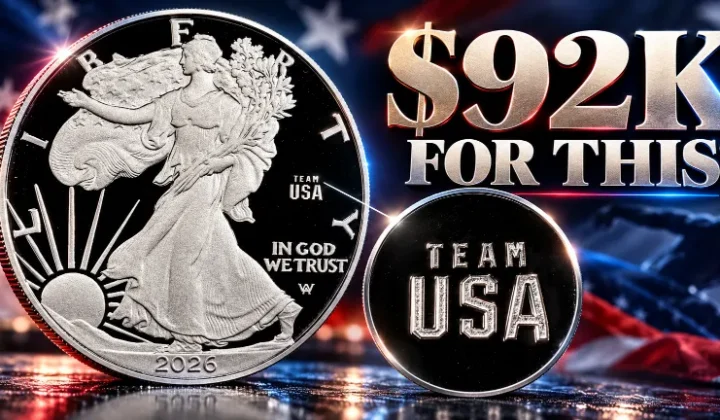
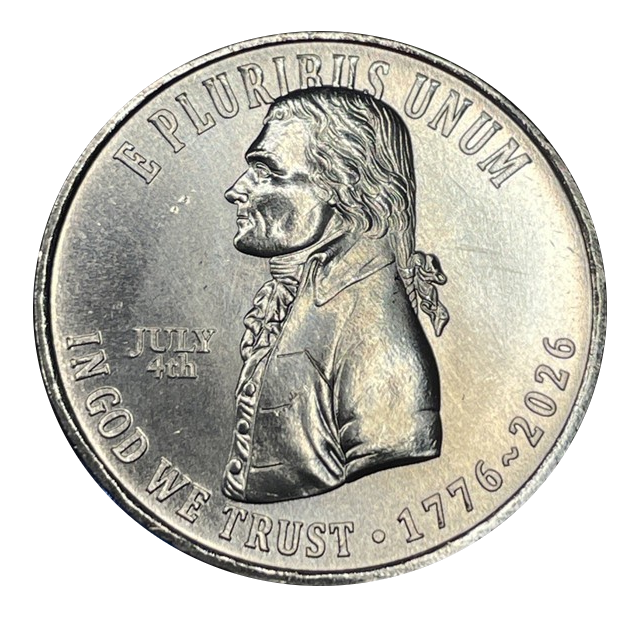
The 9/11 halves are not the Mint’s first privy mark experiment of the Semiquincentennial. On June 23, the Mint announced 250,000 Declaration of Independence quarters carrying a July 4 privy mark, and released them the opposite way: mixed at random into standard production and shipped to banks and financial institutions nationwide ahead of Independence Day. Mint Director Paul Hollis called that release “a defining moment in our nation’s story” and framed it as something Americans would go looking for.
Set the two issues side by side and they are almost perfect inversions of each other.
The quarter was built to be found. Its privy mark sits in the open field to the left of Jefferson, and the coins carry no mint mark at all, the privy standing in place of the usual P or D. Identification runs on an absence: the mark is there, the letter is not. The 9/11 half dollar works the other way. It is identified by a presence, the W of West Point, on a denomination that never carries one in circulation.
The scale inverts too. 250,000 quarters sounds small until you set it against a design the Mint had already struck 89.8 million standard examples of by the end of May, which is what turned the release into a genuine nationwide hunt, complete with grading service bounties for early submissions. 2,983 half dollars is not a hunt. There is nothing to search for, because the entire issue was handed to one institution in one delivery.
The Mint has now used the same tool for three different jobs inside a single year. The July 4 quarter used a privy mark to manufacture chance, dropping a scarce variety into everyday change. The 250 edge numbered 2.5 ounce silver quarters struck at Philadelphia on the Fourth used one to mark a ceremonial strike. The 9/11 half dollar uses one to mark a count. Only the third has a mintage that answers to something outside the Mint entirely.
What Happens Next for the Enduring Liberty Half Dollar
The Enduring Liberty design retires at the end of the year. Beginning in 2027, Kennedy returns to the half dollar with a new portrait, and the reverse moves to designs honoring youth sports and Paralympic sports, which makes the 9/11 privy coins a small, closed subset of a design that was already scheduled to disappear.
Whatever the Memorial decides to do with them, the count will not change. Collectors will follow whether these pieces are certified, whether examples reach the market, and what they bring if they do, but none of that determines what the issue is. The Mint struck a specific number for a specific reason, and for once the mintage is not a measure of scarcity. It is a measure of loss.
Frequently Asked Questions
How many 9/11 privy half dollars did the U.S. Mint strike? 2,983, matching the number of names recorded at the National 9/11 Memorial & Museum for the victims of the September 11, 2001, attacks and the February 26, 1993, World Trade Center bombing.
Where were the 9/11 privy half dollars struck? At the Mint’s West Point facility in upstate New York. Each coin carries a W mint mark, while standard Enduring Liberty half dollars are struck in Philadelphia and Denver with a P or a D.
What does the 9/11 privy mark say? It shows the date 9-11-01 enclosed by the phrase ALWAYS REMEMBER, the same wording the Mint used on its 2011 September 11 National Medal.
Can collectors buy the 9/11 privy half dollar? The Mint has not announced a public sale, and it has not said how the National 9/11 Memorial & Museum intends to use or distribute the coins.
How does the 9/11 privy half dollar differ from the July 4 privy quarter? The July 4 quarters were released into circulation at 250,000 pieces with no mint mark, the privy replacing the usual P or D. The 9/11 half dollars number 2,983, carry a W mint mark from West Point, and were presented to the National 9/11 Memorial & Museum rather than distributed to the public.