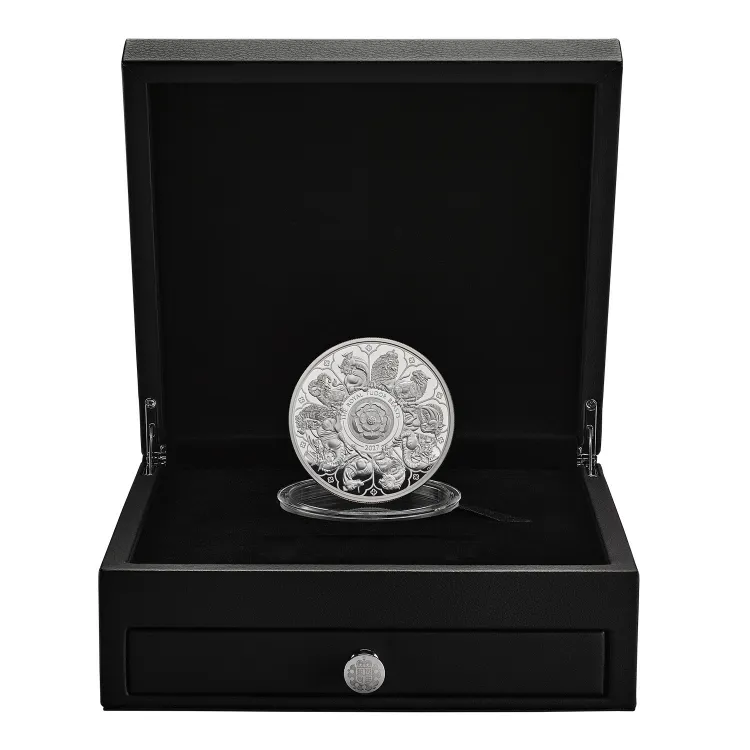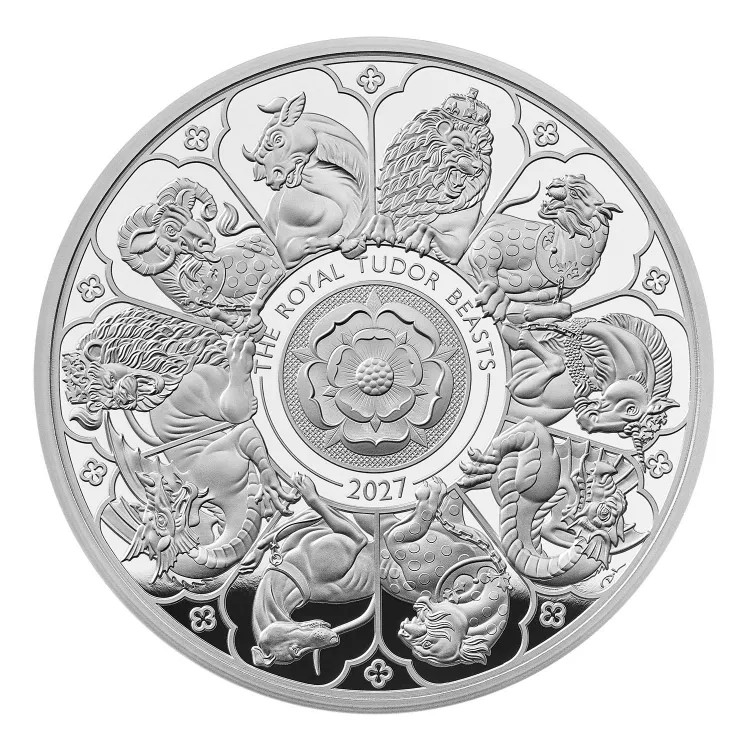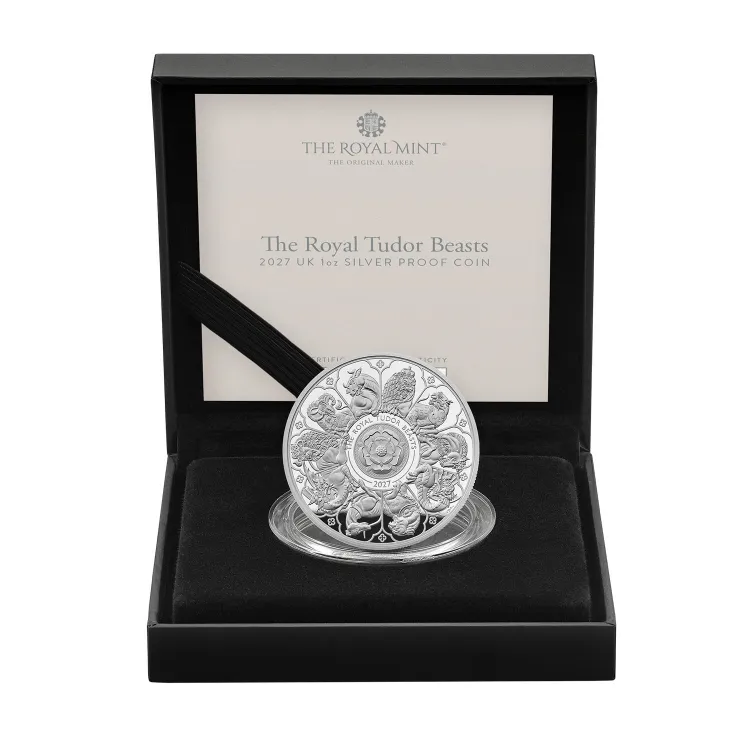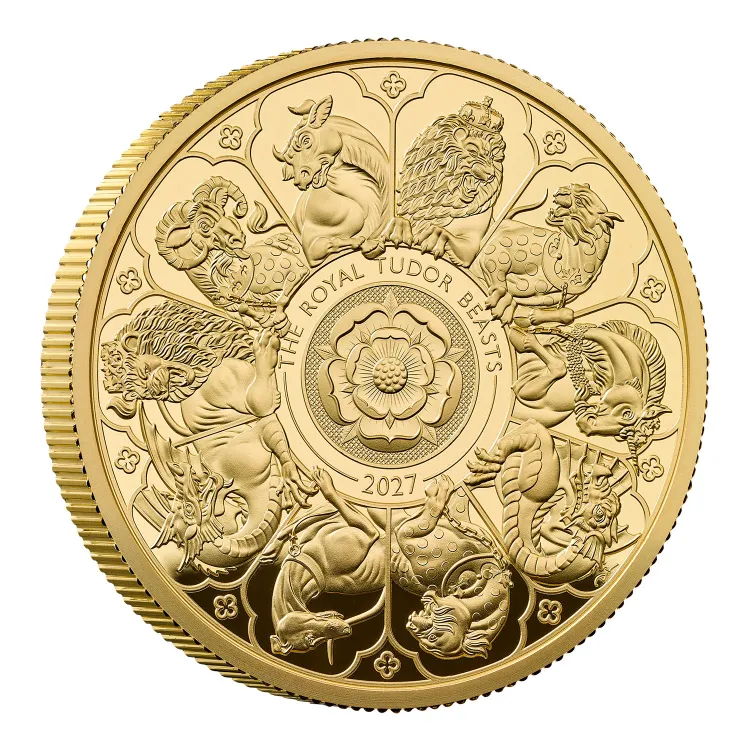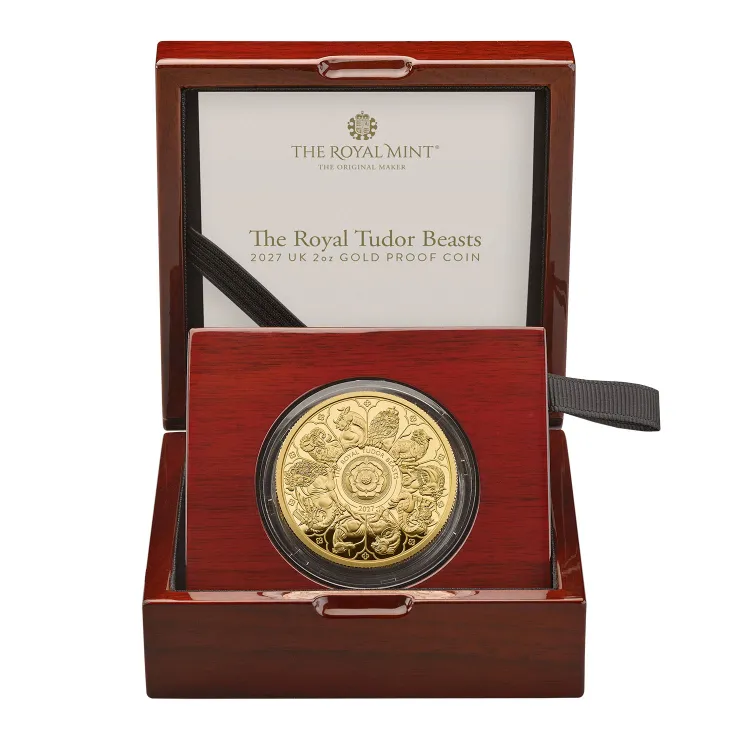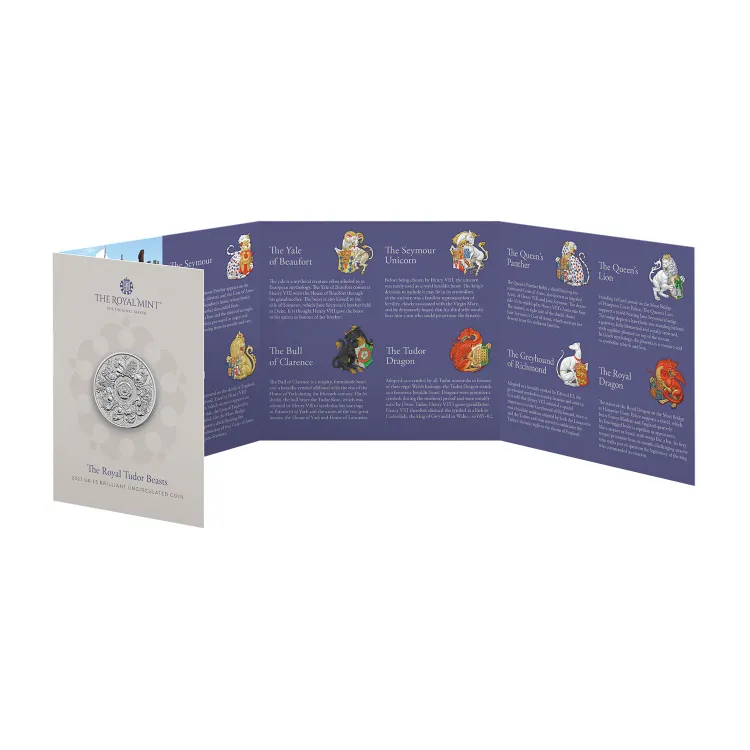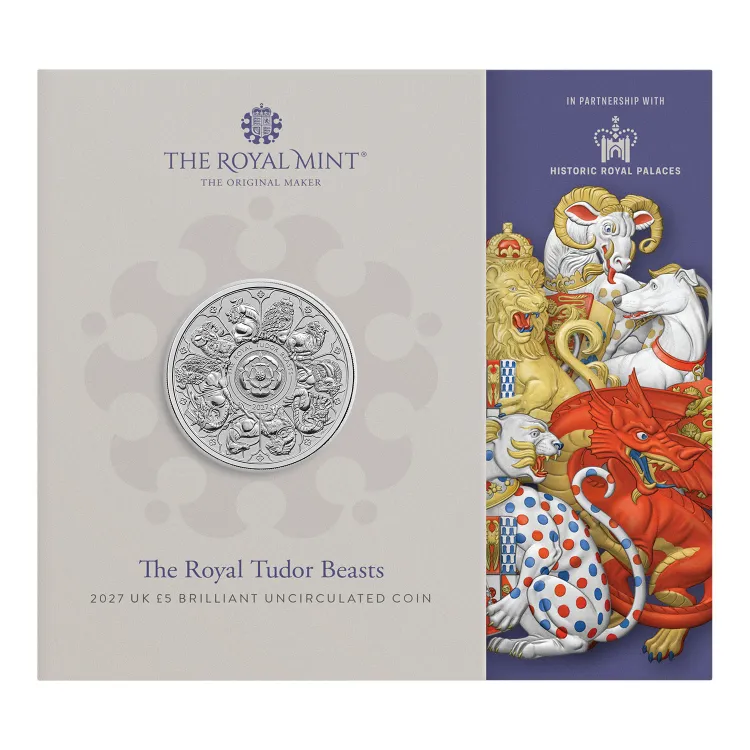
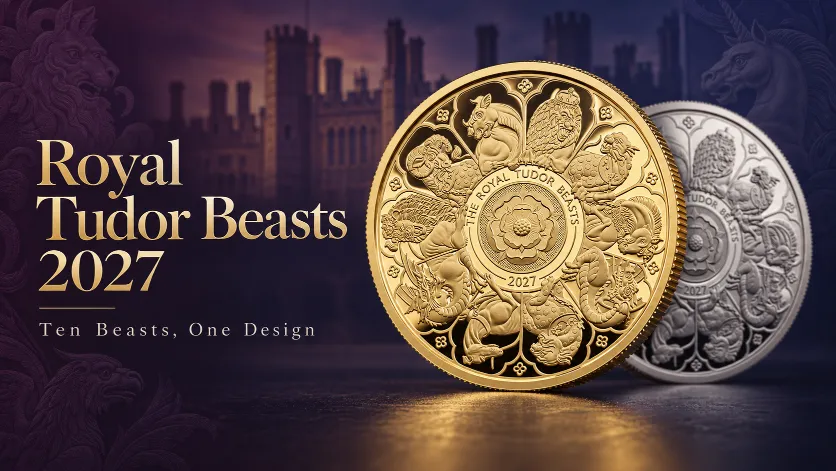
The Royal Tudor Beasts 2027 coin does the one thing none of the previous ten could do. It puts every beast on the same piece of metal. The Royal Mint has issued it as the final commemorative release in The Royal Tudor Beasts Collection, with a reverse by David Lawrence that arranges all ten heraldic guardians in a ring around a Tudor rose, and it arrives as a range of nine products running from an £18.50 cupro-nickel £5 up to a 2oz gold proof at £10,535.
Most of that range has already gone. Seven of the nine editions were listed as no longer available at the time of writing, leaving the 1oz silver proof at £165 and the £5 Brilliant Uncirculated coin at £18.50 as the only two still open to order, both shipping late September. For a collection that spent five years selling out beasts one at a time, it is a familiar ending.
Ten beasts, one design
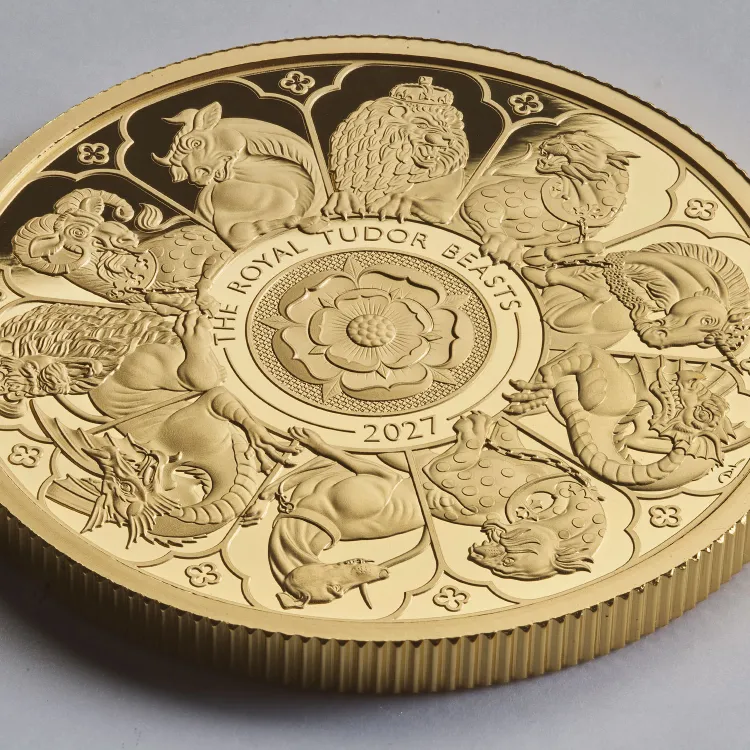
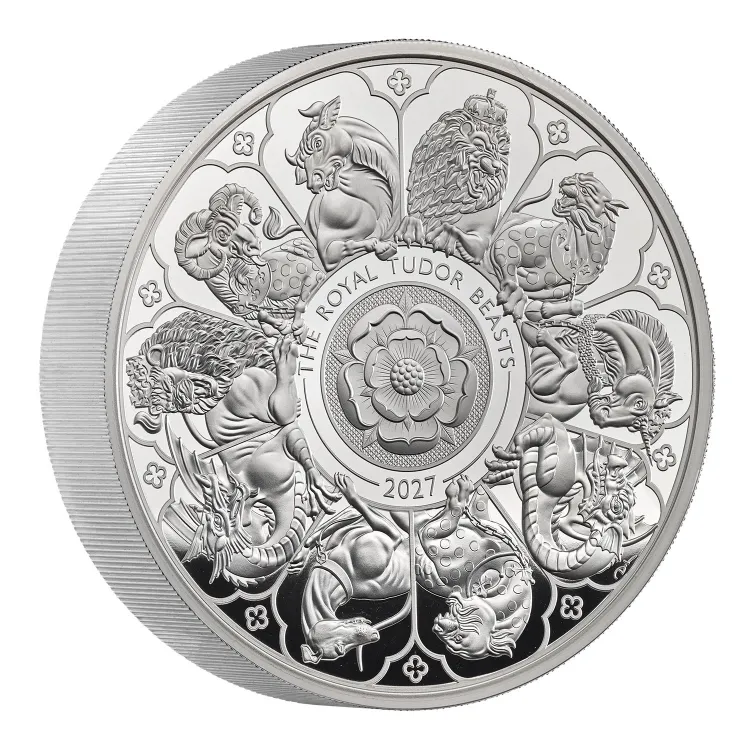
The reverse is a ring. Ten beasts sit shoulder to shoulder in a circle, each still holding its own shield, with the inscription THE ROYAL TUDOR BEASTS running around a raised Tudor rose at the centre and the date 2027 below it. The Royal Mint describes the arrangement as a protective circle, which is the correct reading of the heraldry: these are guardians, and what they are guarding is the emblem of the dynasty that claimed them.
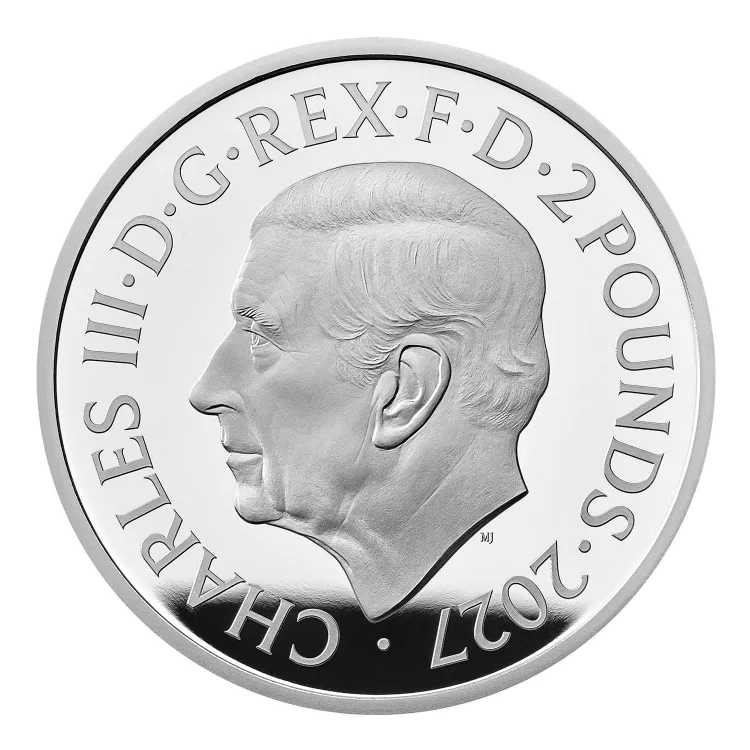
Martin Jennings’ portrait of King Charles III occupies the obverse across every edition, with the denomination changing according to the format. That denomination range is unusually wide for a single design. The 1oz silver proof is a £2 coin, the 2oz silver a £5, the 5oz and 10oz silver both £10, the 1/4oz gold a £25, the 1oz gold a £100 and the 2oz gold a £200. The cupro-nickel Brilliant Uncirculated coin is a £5.
One detail separates the smallest proof from the rest. The 1oz silver proof, and the two coins inside the silver proof two-coin set, carry plain incuse edge lettering reading • HAMPTON COURT PALACE • ROYAL TUDOR BEASTS. Every other proof in the range has a milled edge. It is a small thing, but it means the cheapest proof in the range is also the only one that names the place the whole collection came from.
The ten stone beasts of the Moat Bridge at Hampton Court
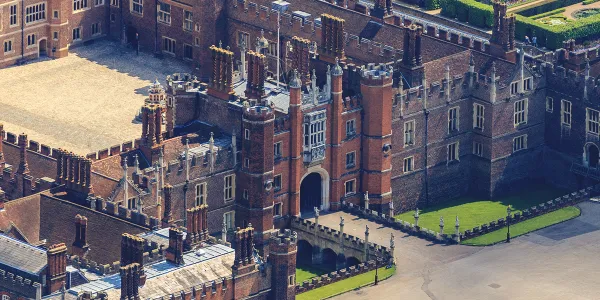
Hampton Court Palace was Cardinal Wolsey’s before it was Henry VIII’s, and it became the King’s residence early in a reign that would eventually run to six marriages. After Henry married Jane Seymour in 1536, he commissioned a new entrance to the palace and set a line of carved beasts along the bridge over the moat, each one chosen to make an argument about ancestry.
The ten are the Seymour Panther, the Lion of England, the Yale of Beaufort, the Bull of Clarence, the Seymour Unicorn, the Tudor Dragon, the Queen’s Panther, the Greyhound of Richmond, the Queen’s Lion and the Royal Dragon. Between them they trace the lineage of Henry and his new queen, which was precisely the point. A dynasty that had taken the throne by conquest in 1485 had good reason to carve its claim in stone at the front door.
There is a wrinkle worth knowing. The beasts a visitor walks past today are not Henry’s. The originals were lost during late 17th century remodelling of the palace, and the statues now standing on the bridge are 20th century recreations worked from the original specifications. The collection that closes with this coin has therefore been reimagining a reimagining for five years, which is a more Tudor outcome than it first appears.
David Lawrence and the crowding problem
David Lawrence has designed every coin in the collection, and the brief he described for the individual beasts was a balancing act between centuries of inherited meaning and something that would read as new, “a new vision that is still true to the past” as he put it. On the single beast coins that meant filling a field with one creature and letting the detail carry it.
This coin inverts the problem. Ten beasts in a 38.61 mm field, each needing to stay recognisable to a collector who has spent five years learning the differences between a Queen’s Panther and a Seymour Panther, is a compression exercise before it is an artistic one. The ring formation is the answer: by giving each beast a fixed radial slot and keeping its shield attached, the design lets the eye pick out individuals rather than reading the whole as ornament. On the 65.00 mm silver pieces it has room to breathe. On the £5 in cupro-nickel it is doing considerably more work.
The 2027 Royal Tudor Beasts coin range
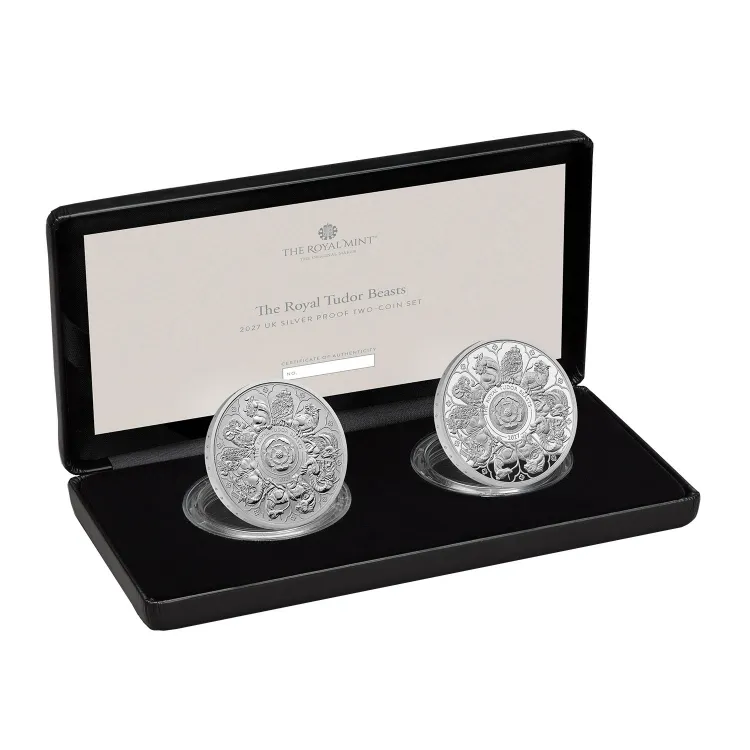
Nine products carry the design. Prices, edition limits and availability as listed by The Royal Mint at the time of writing:
| Edition | Denomination | Metal and weight | Diameter | Edition limit | Maximum mintage | Issue price | Status |
|---|---|---|---|---|---|---|---|
| £5 Brilliant Uncirculated (UK27TCBU) | £5 | cupro-nickel, 28.28 g | 38.61 mm | not stated | not stated | £18.50 | Available to order |
| 1oz Silver Proof (UK27TCSP) | £2 | 999 fine silver, 31.21 g | 38.61 mm | 6,000 | 6,387 | £165.00 | Available to order |
| Silver Proof Two-Coin Set (UK27TC2SP) | £2 each | 999 fine silver, 31.21 g each | 38.61 mm | 375 | not stated | £325.00 | No longer available |
| 2oz Silver Proof (UK27TCS2) | £5 | 999 fine silver, 62.86 g | 40.00 mm | 750 | 756 | £325.00 | No longer available |
| 5oz Silver Proof (UK27TCS5) | £10 | 999 fine silver, 156.30 g | 65.00 mm | 200 | 206 | £787.50 | No longer available |
| 10oz Silver Proof (UK27TCST) | £10 | 999 fine silver, 312.59 g | 65.00 mm | 125 | 131 | £1,597.50 | No longer available |
| 1/4oz Gold Proof (UK27TCGQ) | £25 | 999.9 fine gold, 7.800 g | 22.00 mm | 350 | 360 | £1,360.00 | No longer available |
| 1oz Gold Proof (UK27TCGP) | £100 | 999.9 fine gold, 31.21 g | 32.69 mm | 300 | 310 | £5,320.00 | No longer available |
| 2oz Gold Proof (UK27TCG2) | £200 | 999.9 fine gold, 62.42 g | 40.00 mm | 75 | 81 | £10,535.00 | No longer available |
The two-coin set is the one to look at twice. It pairs two 1oz £2 silver proofs of the same design, one struck to standard proof quality and the other to proof reverse frosted, so the difference between them is finish rather than format. At £325 for 375 sets it matched the price of the 2oz silver proof, and it sold out alongside it.
Read the maximum mintage, not the edition limit
Every proof in the range carries two numbers, and they are not the same number. The 2oz silver proof is a limited edition of 750 with a maximum coin mintage of 756. The 5oz is 200 against 206, the 10oz 125 against 131, the 1/4oz gold 350 against 360, the 1oz gold 300 against 310, and the 2oz gold 75 against 81. The pattern is consistent: a small allowance of 6 or 10 pieces above the presentation limit on each variant.
The 1oz silver proof is the exception in scale. Its edition limit is 6,000, its maximum coin mintage is 6,387, and the 387 piece gap sits very close to the 375 two-coin sets that also contain the coin. Collectors tracking scarcity across the collection should be reading the mintage line, not the headline edition figure, because the two diverge most on exactly the coin most people will own.
What the collection leaves behind
The Royal Mint has closed a beast series this way before. When The Queen’s Beasts finished in 2021, the last coin gathered all ten of those creatures into a circle around a portrait of Queen Elizabeth II, and the monarch sat at the centre of her own heraldry. In 2027 the centre is a Tudor rose instead. The beasts are still guarding something, but what they guard now is a badge rather than a person, which is the honest version of what Henry VIII was doing on that bridge in 1536. The Royal Tudor Beasts 2027 coin ends a five year collection on its founding argument: the dynasty outlives the king.
Frequently asked questions
What is the Royal Tudor Beasts 2027 coin? It is the final commemorative release in The Royal Mint’s Royal Tudor Beasts Collection, and the only coin in the collection to show all ten beasts together. The reverse by David Lawrence arranges the ten heraldic guardians in a ring around a Tudor rose. It is issued across nine products, from an £18.50 cupro-nickel £5 up to a 2oz gold proof at £10,535.
Which 2027 editions can I still buy? Two, at the time of writing: the 1oz silver proof at £165 and the £5 Brilliant Uncirculated coin at £18.50. Both are listed as available to order, shipping late September. The other seven editions, including every gold variant, show as no longer available.
Is this really the last Royal Tudor Beasts coin? The Royal Mint describes it as the final commemorative release in the collection, which ran across ten individual beast designs before this one. It follows the same pattern as The Queen’s Beasts, which closed in 2021 with a coin uniting all ten of those beasts in a single design.
Which ten beasts appear on the coin? The Seymour Panther, the Lion of England, the Yale of Beaufort, the Bull of Clarence, the Seymour Unicorn, the Tudor Dragon, the Queen’s Panther, the Greyhound of Richmond, the Queen’s Lion and the Royal Dragon. They are the ten that stand on the Moat Bridge at Hampton Court Palace.
Why is the maximum mintage higher than the limited edition figure? The Royal Mint lists both numbers, and the maximum coin mintage runs above the edition limit on every variant, usually by 6 or 10 pieces. The 1oz silver proof is the exception in scale: its edition limit is 6,000 and its maximum mintage 6,387, a gap that sits close to the 375 two-coin sets which also contain that coin. The mintage figure is the one that matters for scarcity.
What is the difference between the two coins in the two-coin set? Both are 1oz £2 silver proofs with the same design, weight and diameter. One is struck to standard proof quality and the other to proof reverse frosted, which textures the background differently. The set was limited to 375 and is no longer available.
Does the £5 coin contain any silver? No. The £5 Brilliant Uncirculated coin is struck in cupro-nickel, weighs 28.28 g and measures 38.61 mm. At £18.50 it is the entry point to the range, and it carries the same David Lawrence reverse as the precious metal editions.
What does the edge inscription say? The 1oz silver proof, and both coins in the silver proof two-coin set, carry plain incuse edge lettering reading HAMPTON COURT PALACE, ROYAL TUDOR BEASTS. The larger silver proofs and all three gold proofs have a milled edge instead.