The U.S. Mint Trump coin is a $1 piece, it is legal tender, and it contains no gold. The 2026 Semiquincentennial President Donald J. Trump dollar went on sale on September 2 in collector rolls and bags, sold through almost its entire allocation inside a day, and has kept the Philadelphia Mint busy ever since, with 20.5 million struck through the end of September. It is the first U.S. coin to portray a living president since Calvin Coolidge appeared beside George Washington on the 1926 Sesquicentennial half dollar.
Few modern issues have generated as many basic questions so quickly. Is the Trump dollar coin real money? How big is it, what is it made of, and how many will there be? What does the July 4th privy mark add to its value, and can anyone still buy one at issue price? The answers below are current as of late October 2026, with the coin still in production and its final mintage not yet fixed.
A dollar authorized for one year only
The Trump dollar is not part of the Presidential $1 Coin Program, which covers only deceased presidents. It was struck under 31 U.S.C. §5112(y)(1)(C), added by the Circulating Collectible Coin Redesign Act of 2020 (Public Law 116-330), which lets the Treasury Secretary issue a new $1 coin for a single year beginning January 1, 2026, to mark the Semiquincentennial. The same law bars living persons from the reverse of the semiquincentennial designs, but places no such limit on the obverse.
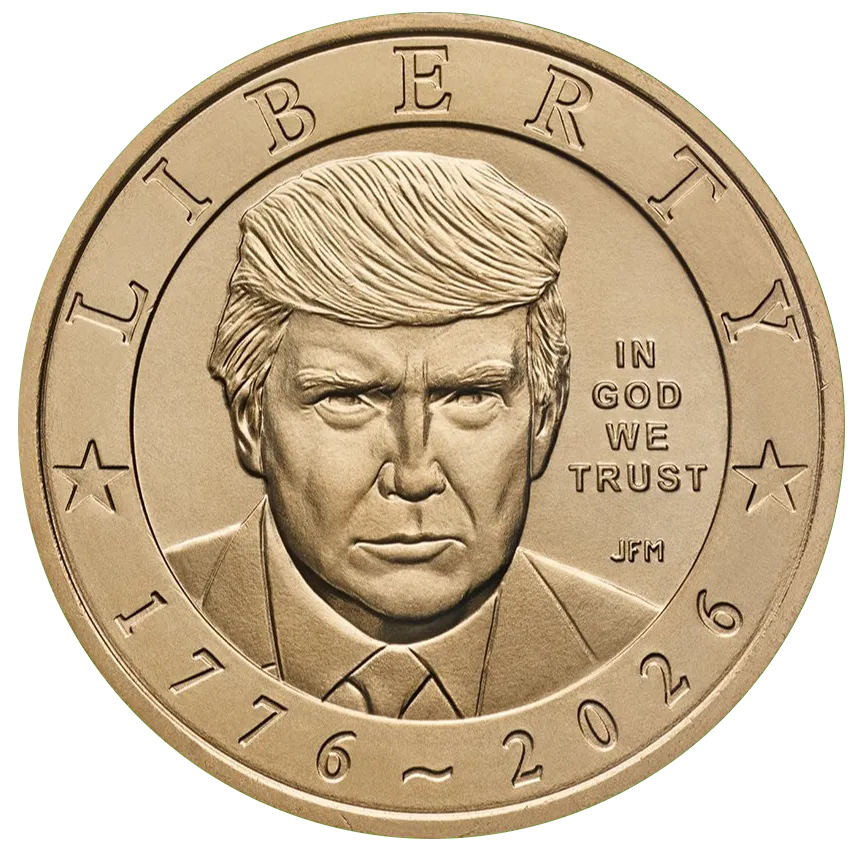
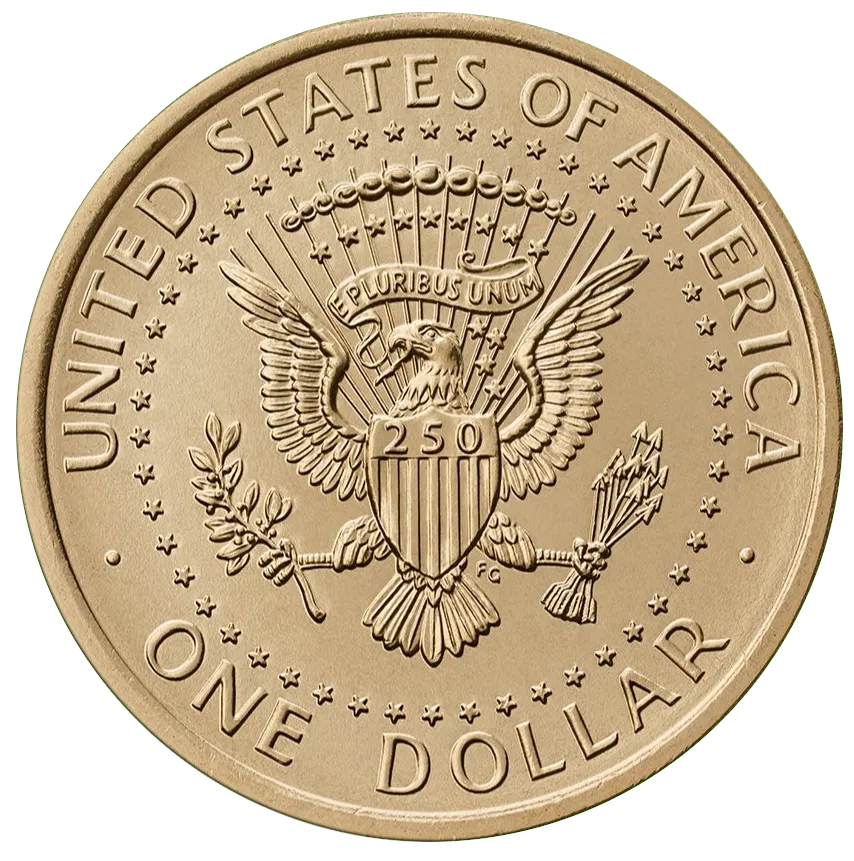
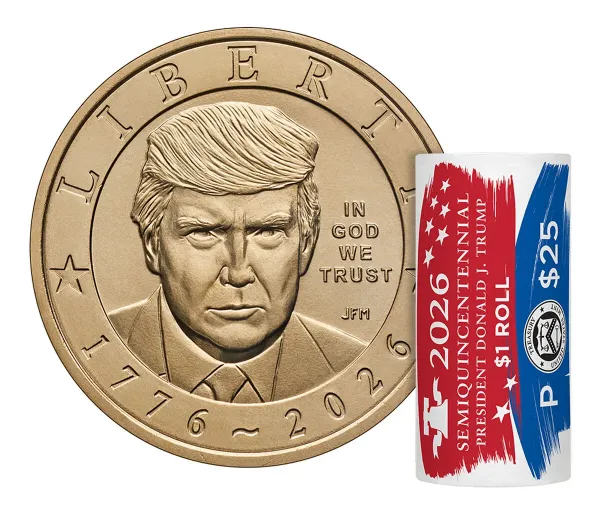
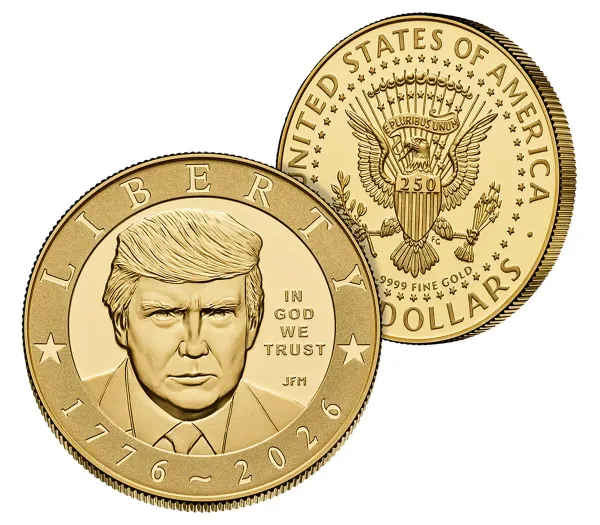
The obverse portrait is the work of Chief Engraver Joseph Menna, adapted from an official White House photograph by Daniel Torok, with LIBERTY arcing above, IN GOD WE TRUST at right and the dual date 1776 ~ 2026 in the lower field. The reverse revives former Chief Engraver Frank Gasparro’s rendering of the Presidential Seal: an eagle holding an olive branch and arrows, a beak banner reading E PLURIBUS UNUM, and a shield altered to carry the number 250, ringed by UNITED STATES OF AMERICA and ONE DOLLAR.
The route to that design was unusual. The Citizens Coinage Advisory Committee removed the coin from its February agenda after a majority of members chose not to review it, while the Commission of Fine Arts recommended candidate designs in January. Treasury unveiled the final design in July, and a federal lawsuit against the coin was voluntarily dismissed by its plaintiff the same month, without any ruling on the statutory questions it raised.
Same size as the golden dollars, none of the gold
Physically, the Trump dollar is a conventional modern golden dollar. It is struck in manganese brass, 6% zinc, 3.5% manganese, 2% nickel and the balance copper, the alloy that gives Sacagawea, Native American and Presidential dollars their color. It weighs 8.100 grams and measures 1.043 inches (26.49 mm) across.
The one physical departure is the edge. Native American and American Innovation dollars carry incused edge lettering; the Trump dollar’s edge is plain, according to the Mint’s specifications as reported by CoinNews. Every piece so far has come from Philadelphia, and none carries a mintmark.
| Coin | Metal | Mint and mintmark | How it reaches collectors | Quantity |
|---|---|---|---|---|
| Standard 2026 Trump $1 | Manganese brass | Philadelphia, no mintmark | 25-coin rolls and 100-coin bags | 20.5 million struck through September |
| July 4th privy mark Trump $1 | Manganese brass | Philadelphia, no mintmark | Mixed at random into the same rolls and bags | 250,000 |
| 2026-W $250 gold proof | 1 oz .9999 gold | West Point, W | Single proof coin, one per household, from November 5 | Not announced |
Trump dollar rolls and bags, and how fast they went
The Mint sold the Semiquincentennial President Donald J. Trump 2026 $1 coin in two formats, both opening at noon ET on September 2: a 25-coin roll, product code 26SQRP, at $61, and a 100-coin bag, product code 26SQBP, at $154.50. Product limits were set at 150,000 rolls and 50,000 bags, with an initial limit of two of each per household. Both were filled from Philadelphia.
Demand did the rest. The bags were gone in under an hour, and the rolls lasted less than seven and a half hours. By the Mint’s first sales report, 148,524 rolls and 49,604 bags had sold, 99% of both limits and roughly 8.67 million coins in total, according to CoinNews.
That price structure is where most “Trump coin price” searches end up. A roll works out to about $2.44 per coin and a bag to about $1.55, against a face value of $1. The premium paid for packaging and handling does not change what the coin is worth as money, and the Mint’s product page now lists both formats as unavailable, with a reminder option for anyone hoping for a restock.
Trump dollar July 4th privy mark value
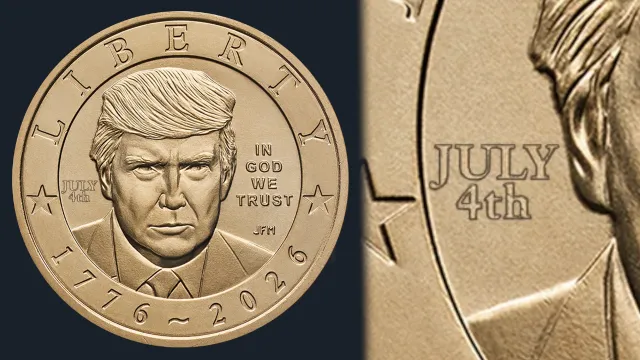
On July 4, 2026, the Philadelphia Mint struck 250,000 Trump dollars bearing a small JULY 4th privy mark, then mixed them at random into the rolls and bags. They were never sold as a separate product. The mark sits on the obverse in the open field to the left of the portrait, directly above the five-pointed star near the rim, set in two lines with JULY above 4th. On the standard coin, that space is blank. Privy marked coins carry no mintmark and the same circulating finish.
The arithmetic gives the hunt its shape. Spread across a maximum of 8.75 million coins in rolls and bags, 250,000 privy marked pieces works out to roughly one coin in 35, or about seven per ten rolls and three per bag on average. The Mint has not confirmed that distribution is even, and because rolls are machine wrapped, the coins visible at either end reveal nothing about what is inside.
The first examples surfaced before public sales opened. CAC announced on August 26 that Heritage Auctions numismatist Rene Alvarenga had found one in an Advanced Delivery roll; it was graded MS64 and is to be donated to the American Numismatic Association. PCGS separately certified an advance release submission with its First Discovery label and gave the variety its own catalog number.
What a privy marked Trump dollar is worth remains an open question. No established price guide had published reliable figures for it by late October. The closest precedent is the 2026 Declaration of Independence quarter, which also carried a July 4 privy mark on 250,000 coins. Early sales of that quarter reached as high as $2,650 before settling near $200 within three weeks, and ungraded examples were reportedly trading around $100 to $200 roughly two months on, according to eBay data compiled by CoinNews. A dollar sold only through collector channels may behave differently from a quarter released into bank shipments, but the lesson holds: the premium tends to be highest in the first days and in the top grades, and collectors should check completed sales rather than asking prices before buying or selling.
20.5 million struck, and the final number still open
The Philadelphia Mint struck 9 million Trump dollars in July, 7.4 million in August and 4.1 million in September, for a total of 20.5 million through the third quarter, according to the Mint’s production figures as reported by CoinNews. Denver has struck none.
That total is already more than twice the 8.75 million coins the rolls and bags could hold, and the gap has a messy explanation. On launch day the Mint told the public on social media that the coins were also in circulation and to check their change, yet its own product page states that the coins in the collector rolls and bags have never been placed into circulation. The Mint has not published how many Trump dollars have reached commerce, or by what route.
The final mintage cannot be known until striking stops. The coin’s legal authority runs to December 31, 2026, and the next monthly production report should show whether output is still slowing.
The gold coin is a separate coin
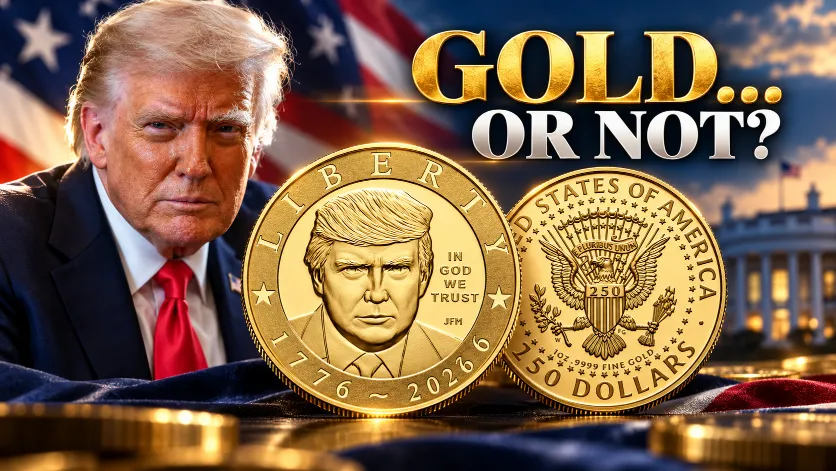
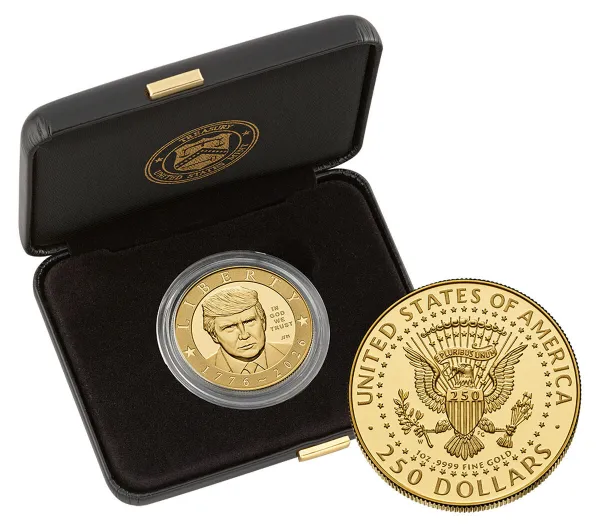
The Trump dollar’s designs also appear on a different product: a one ounce, .9999 fine 24 karat gold proof coin with a $250 face value, struck at West Point with a W mintmark. It goes on sale at noon ET on November 5, under product code 26SQG, with a limit of one per household. Its reverse reads 250 DOLLARS and 1 OZ. .9999 FINE GOLD in place of ONE DOLLAR. The Mint has announced neither a mintage nor a final price; like its other gold products, the coin will be priced on the Mint’s gold pricing grid close to launch.
The two are easy to confuse in search results, and they should not be. The Trump $1 coin is base metal sold in rolls and bags at a modest premium over face; the gold proof is a bullion priced collector coin with no overlap in metal, mint or market.
A one year coin with a long tail
The Trump dollar will be struck for one year and then stop, which is why the basic facts matter now. It is legal tender at $1, it is made of the same manganese brass as every golden dollar since 2000, and its final mintage will not be settled until December’s production numbers arrive. For collectors, the real story sits inside the wrappers: 250,000 privy marked coins scattered across rolls and bags that sold out on the first day, and a market that has yet to decide what they are worth. For everyone else, the U.S. Mint Trump coin is exactly what its reverse says it is, one dollar.
Frequently asked questions
Is the Trump dollar coin legal tender?
Yes. The U.S. Mint treats the 2026 Trump $1 coin as legal tender with a face value of $1, regardless of what a collector paid for it. Legal tender can be used to settle debts, taxes and public charges, but federal law generally leaves private businesses free to decide which forms of payment they accept. A lawsuit challenging the coin was dismissed in July 2026 without a ruling on the underlying legal questions.
How many Trump dollars have been minted?
The Philadelphia Mint struck 20.5 million Trump dollars from July through September 2026: 9 million in July, 7.4 million in August and 4.1 million in September. Of those, 250,000 carry a July 4th privy mark. The final mintage has not been set, because the coin can be struck until December 31, 2026.
What is the Trump coin made of?
The Trump $1 coin is struck in manganese brass: 6% zinc, 3.5% manganese, 2% nickel and the balance copper. That is the same gold colored alloy used for Sacagawea, Native American and Presidential dollars. It contains no gold. A separate $250 Trump proof coin, released November 5, is struck in one ounce of .9999 fine gold.
What size is the Trump $1 coin?
The Trump dollar measures 1.043 inches (26.49 mm) in diameter and weighs 8.100 grams, the same as other modern golden dollars. Unlike Native American and American Innovation dollars, it has a plain edge with no edge lettering.
When was the Trump $1 coin released?
The U.S. Mint released the 2026 Trump $1 coin in collector rolls and bags on September 2, 2026, at noon ET. Striking began at the Philadelphia Mint in July 2026, and a limited number of Advanced Delivery rolls reached graders and dealers in late August, before public sales opened.
Where can I buy the Trump $1 coin?
The U.S. Mint sold the coin in 25-coin rolls for $61 and 100-coin bags for $154.50, but both are listed as unavailable on the Mint’s website as of late October 2026, with a reminder option for any restock. Collectors can still buy single coins, rolls and graded examples from coin dealers and on the secondary market, usually at a premium over the Mint’s issue price.
Is the Trump $1 coin sold out?
Yes, at the Mint. The 100-coin bags sold out in under an hour on September 2, 2026, and the 25-coin rolls in under seven and a half hours. The Mint’s first sales report showed 148,524 rolls and 49,604 bags sold, 99% of the product limits, and the Mint has not announced a restock.