
Mexico will become the first country to host the FIFA World Cup three times when the tournament opens on June 11 at Mexico City’s Estadio Banorte, and the Banco de México is meeting the occasion with the most ambitious commemorative coin program the country has issued in decades. Twelve coins. Three metals. Four designs each. And one quiet historical first: Mexico has never struck a 25 peso coin before this series.
The bimetallic circulating pieces entered banks on May 13, 2026. The precious metal Proof issues, silver and gold, are being released directly through the central bank and a short list of authorized distributors in the weeks running up to kickoff.

A program built around the host cities
Of the twelve coins, nine are dedicated to the three Mexican host cities: Mexico City, Guadalajara, and Monterrey. Each city appears in all three metals, bimetallic 20 pesos for circulation, one ounce silver 10 pesos in Proof, and quarter ounce gold 25 pesos in Proof. A fourth, nationally themed design built around Mexico’s biodiversity and heritage completes each metal set.
The program reached its final shape in two legislative stages. The first decree, signed by President Claudia Sheinbaum and published in the Diario Oficial on June 6, 2025, authorized the nine host city coins, three gold, three silver, three bimetallic. A second decree on March 10, 2026 added the three generic México pieces. The two step structure explains why the México national design surfaced later than the host city imagery, and why early reporting often described the program as a three coin issue rather than a twelve coin one.
The host city framing matters because Mexico is hosting only three matches in this expanded sixteen city tournament, eleven games go to the United States and two to Canada, and the coin program is, in part, a way for Banco de México to plant a national flag in a competition where the country’s share of the action is comparatively small.
The bimetallic 20 pesos, already in circulation
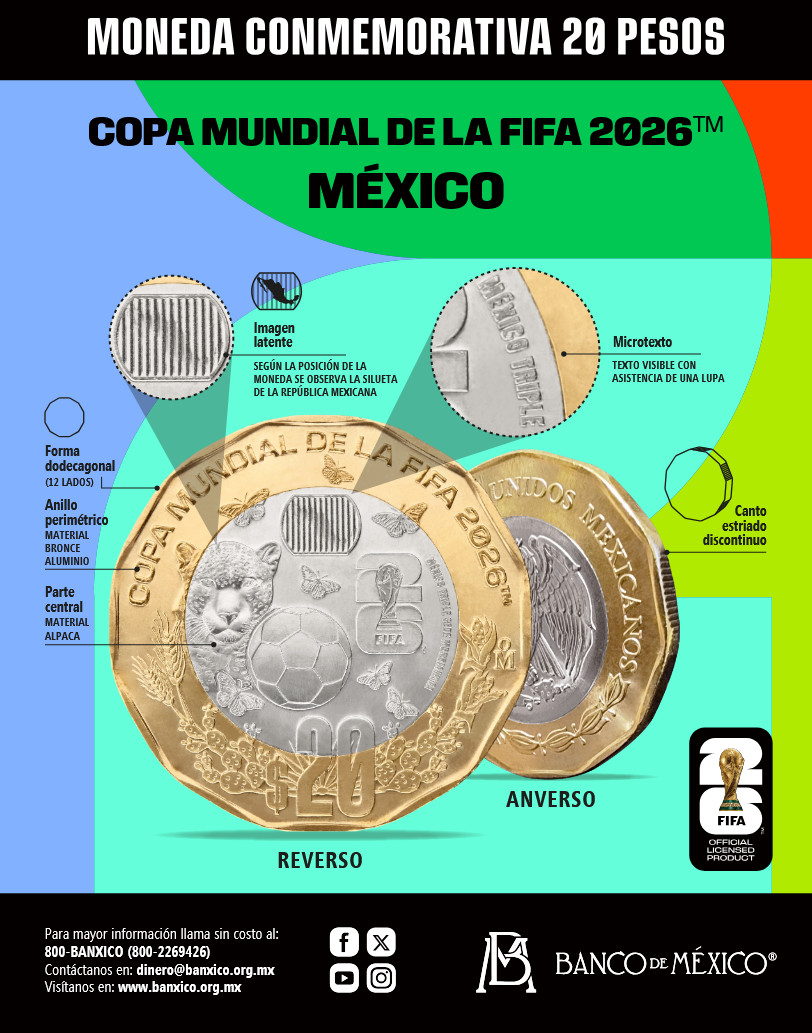
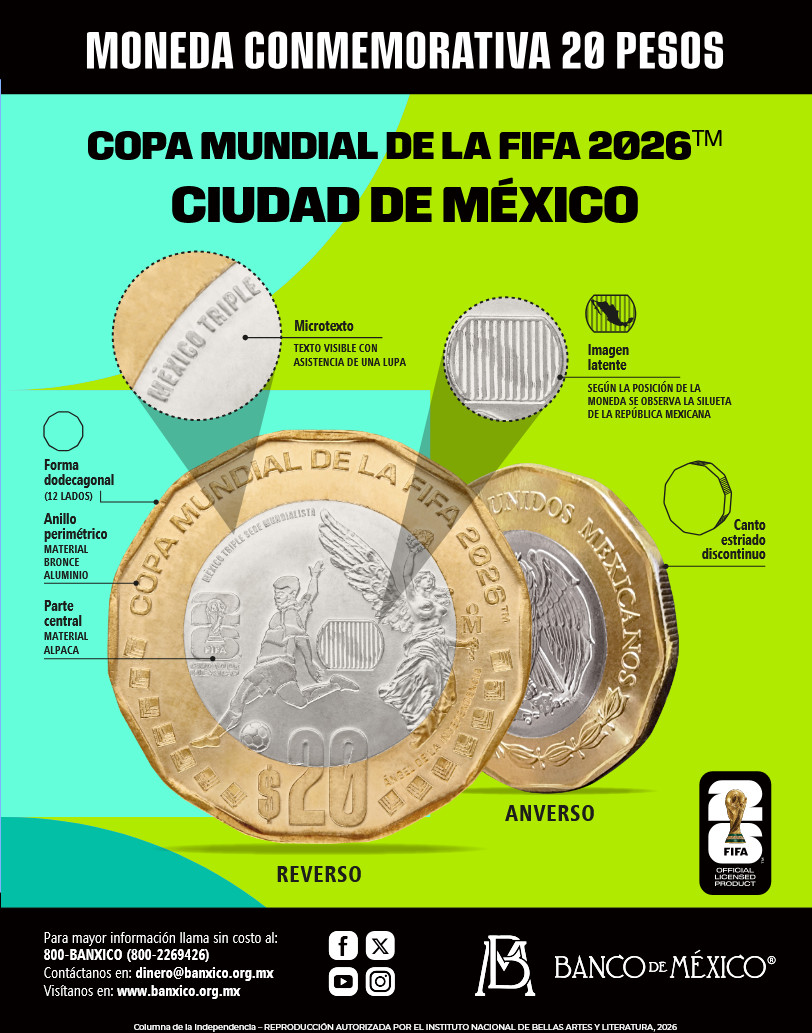
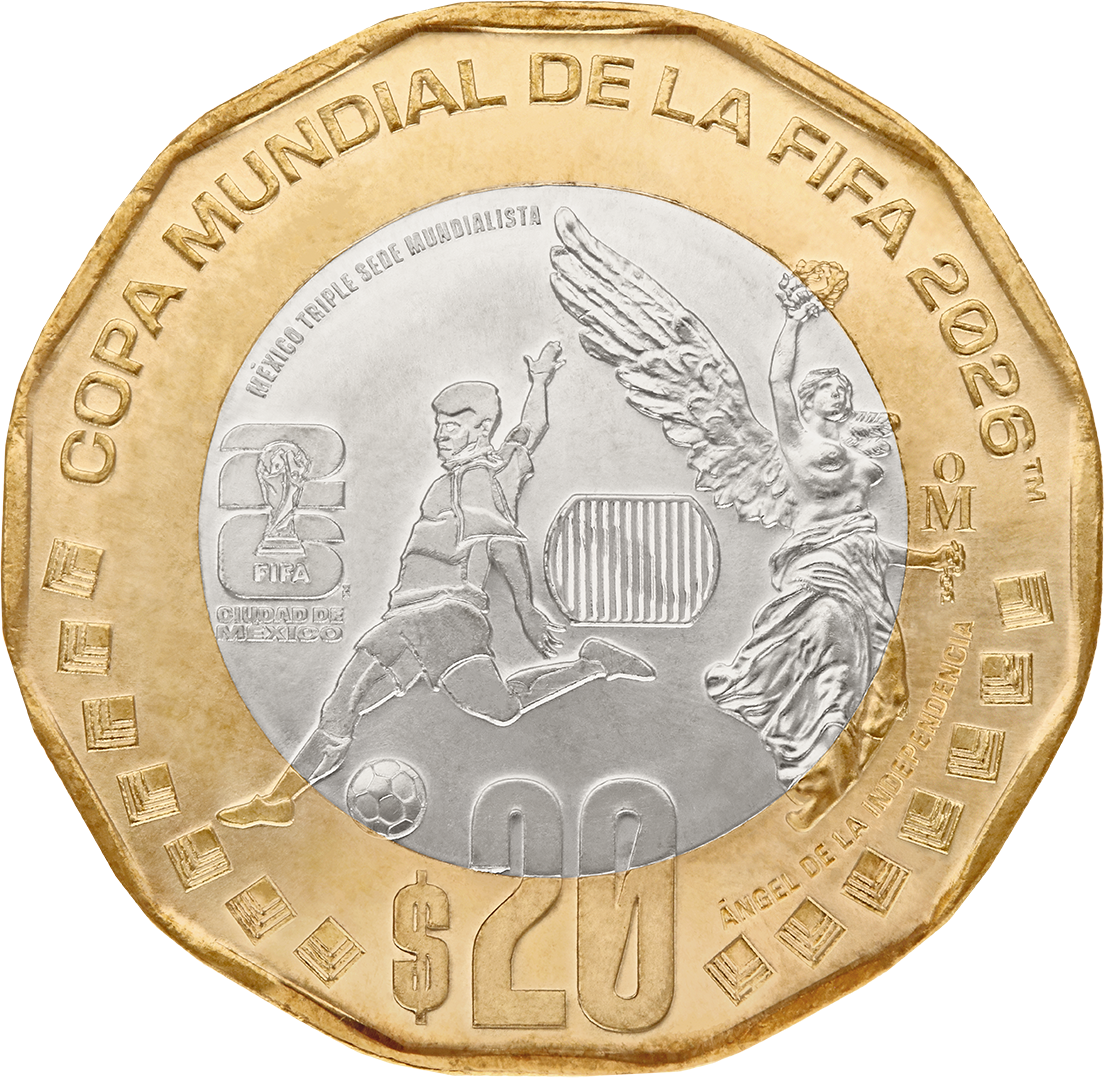
The four circulating coins share the standard C1 specification: 30 mm across, twelve sided, 12.67 grams, with an alpaca silver core in a bronze aluminum ring. The obverse carries the National Coat of Arms beneath ESTADOS UNIDOS MEXICANOS. The reverses do the storytelling.
The Mexico City reverse depicts a footballer with the Angel of Independence, the Columna de la Independencia, reproduced under authorization from the National Institute of Fine Arts and Literature. Guadalajara’s reverse pairs a player with the Minerva sculpture by Pedro Medina Guzmán, the centerpiece of the Glorieta de la Minerva traffic circle. Monterrey’s design works the Fuente El Crisol, the Cerro de la Silla mountain silhouette, and a football caught in a net into a single composition along the Paseo Santa Lucía. The fourth, generic Mexico reverse leans into national iconography: a jaguar and a football at center, the silhouette of the Mexican Republic as a latent image, monarch butterflies scattered across both the core and the ring, with agave, nopales, wheat, and corn arranged along the lower border.
Every circulating coin carries a security feature unique to this program, a microtext reading MÉXICO TRIPLE SEDE MUNDIALISTA, “Mexico Triple World Cup Host,” paired with a latent image of the country’s outline. The microtext is a kind of declaration in miniature: this is the first time any single nation has hosted the men’s World Cup three times.
Customers of participating banks can order the bimetallic coins in unlimited quantities; non customers may exchange cash for up to 150 pieces per branch visit. Banxico has also said the coins should begin appearing in everyday change.

The Proof silver and gold, collector issues
The Proof program runs in parallel. Each host city design and the national design are struck in one ounce .999 silver at 10 pesos face value (40 mm, 31.103 grams) and in quarter ounce .999 gold at 25 pesos face value (23 mm, 7.776 grams). Distribution is split between Banco de México’s domestic and international channels, with secondary market specialists carrying the international allocation.
A note on a small national milestone: the 25 peso denomination is new. Mexico’s modern commemorative gold has historically used 20 , 50 , 100 , and 200 peso face values, and the 25 peso comes into the catalogue purely for this program. By the framing of both the Diario Oficial decree and Banxico’s own announcements, this is the first time Mexico has struck a coin at that denomination.
The Proof designs also diverge from the circulating series in places where the larger format allows it. The Mexico City silver coin moves away from the Angel of Independence and instead depicts a smiling axolotl framed by the Templo Mayor, the Metropolitan Cathedral, the Monument to the Revolution, and the Palace of Fine Arts, four landmarks reproduced under authorization from the National Institute of Anthropology and History and the National Institute of Fine Arts and Literature. The same axolotl and skyline composition carries onto the gold. The Guadalajara silver and gold pieces replace the bimetallic’s Minerva sculpture with an agave farmer working among the plants, with the Arches of Zapopan rising behind him, a different reading of Jalisco’s identity, weighted toward the agricultural roots of the region rather than its civic monuments. Monterrey’s Proof designs retain the Fuente El Crisol but reframe the composition around a single footballer set against the Cerro de la Silla.
The Mexico generic Proof reverse keeps the jaguar and football centerpiece but consolidates the surrounding flora, marigolds, poinsettias, and monarch butterflies, into a tighter composition than the busy circulating reverse can hold.
The pricing is being set by international precious metal markets rather than by Banxico decree, and authorized distributors are listing the silver Proofs around €190 per coin in pre order and the gold Proofs at roughly €1,960. Mintage figures circulating in the trade are 30,000 per design in silver and 10,000 per design in gold, though the official Banxico technical sheets list only the Proof quality, diameter, and fineness, not the mintage cap.

What this means for the issue’s collector profile
Mexico’s World Cup coinage has a track record. The 1985–86 silver and gold issues from the country’s second hosting are still pursued by collectors of world football coinage, and the gold examples, particularly those graded by the major services, trade at multiples of intrinsic. The 1970 program, and the larger Centenario gold tradition that overlapped with it, have followed similar arcs.
Whether the 2026 series follows that arc will depend on two things that are still unsettled: the final mintage caps, which Banxico has not formally published, and how aggressively the gold pieces are taken up by the international precious metals trade as bullion plus rather than as a numismatic collectible. A 25 peso quarter ounce gold at .999 fineness is, before anything else, a sound piece of small format bullion in a year of strong gold prices, and the design premium over melt may compress more quickly than it would in a slower market.
For now, the bimetallic pieces are doing the public facing work. They are in circulation, they carry the microtext that names the moment, and they will pass through ordinary hands across Mexico for the duration of the tournament and well beyond. The Proof issues are doing the cabinet work, twelve coins, four cities and one nation, three metals, one tournament, and one quiet first for the Mexican mint catalogue.
Mexico’s third World Cup begins on June 11. Its coins are already here.