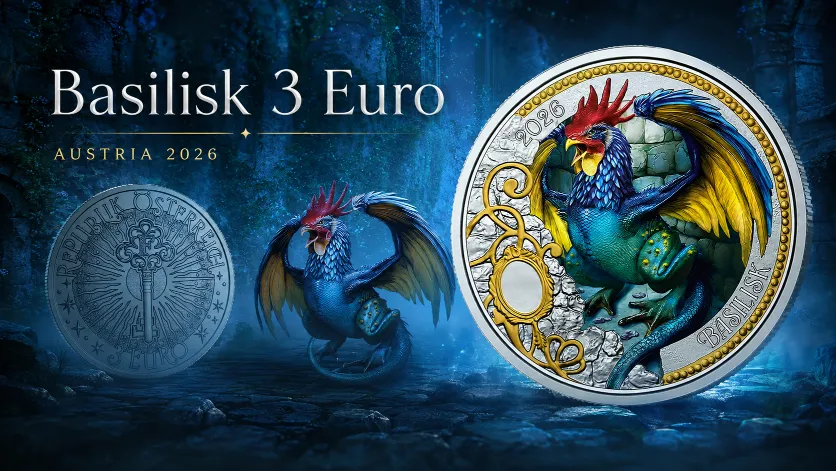
The Austrian Mint, Münze Österreich, has announced the fourth coin in its twelve part Mythical Creatures series, and this one comes with a Vienna address. The 3 Euro The Basilisk Coin goes on sale on 9 September 2026 at 16.80 euros, struck in uncirculated quality to a mintage of 65,000 pieces, with a colour printed rendering of the crowned king of serpents filling the reverse.
What sets the issue apart from the trolls, elves and sea creatures that surround it in the series is that the basilisk on this coin is not a generic monster. The golden mirror printed at the lower left is a direct reference to a legend attached to a real house in Vienna’s first district, and to a morning in June 1212 that Viennese schoolchildren still hear about.
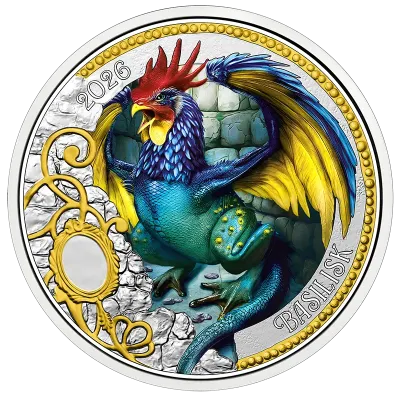
3 Euro Basilisk Coin Design and UV Effect
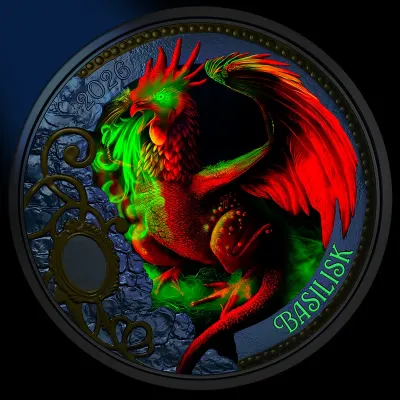
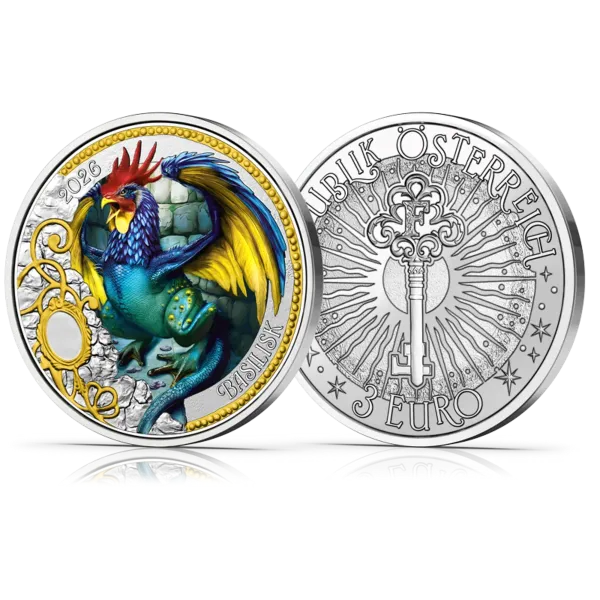
The reverse is dominated by the creature itself, and the designers have committed fully to the medieval hybrid rather than the classical snake. The basilisk has the head and wings of a cockerel, the legs of a toad and hindquarters that taper into a serpent’s tail. It rears from behind a broken stone wall, wings spread, in the vivid colour print that has become the visual signature of the series. At the lower left sit a gold printed ornament and the mirror, and a decorative gold band runs around the rim.
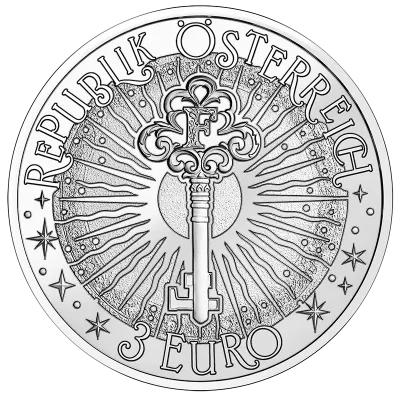
The obverse turns away from the monster entirely. An intricately decorated key carrying the letter F, for fantasy, occupies the centre, set against a sun rendered as a silhouette and recessed into a circular relief with a subtle texture. Stars scatter across the field and around the edge, and the lettering is deliberately irregular. It is the quieter side of the coin, and it does the work of framing the series rather than the individual creature.
Then there is the party trick. Every coin in the series is printed with ultraviolet reactive inks, and under a black light the basilisk stirs, the colours take on a sicklier glow and the mirror shines. The Austrian Mint sells a matching UV torch separately at 9.90 euros. Whether that counts as an accessory or a required tool is a question the series has been posing since the Troll arrived in 2025.
Design credit goes to Rebecca Koini, Anna Schlindner and Nina Schwarzer.
The Vienna Basilisk Legend of Schönlaterngasse
The mirror is the tell. According to the Viennese legend, on the morning of 26 June 1212, a servant working for a baker on what is now Schönlaterngasse climbed down into the courtyard well and found a basilisk at the bottom. The creature’s breath was foul enough to sicken anyone who approached, and its gaze was said to kill outright or turn the unlucky to stone. People had been disappearing.
The solution was not a sword. A baker’s apprentice had himself lowered into the well in a basket, carrying a mirror, and turned the creature’s own weapon back on it. Versions of the tale differ on the ending, with some accounts having the basilisk struck down by its own reflected gaze and others having it burst apart on the spot, but every telling agrees on the instrument. The monster was defeated by being shown itself.
The house at Schönlaterngasse 7 has been known as the Basiliskenhaus ever since. Its facade carries a painted account of the episode, inscribed in 1932 using a text that dates back to 1577, which makes the legend a documented piece of Viennese civic folklore several centuries before it reached a coin die. For a series that could easily have stayed in the generic fantasy register, anchoring the fourth issue to a specific address in the Innere Stadt is a genuinely good editorial decision.
What Is a Basilisk? From Pliny to the Chamber of Secrets
The word itself comes from the Greek basilískos, a diminutive of basileús, meaning king. Pliny the Elder, writing in the Naturalis Historia, described a small and extraordinarily venomous serpent marked on the head with a white crown, and credited it with a single natural enemy, the weasel, whose scent alone was thought sufficient to finish it. There was no cockerel in Pliny’s account, and no toad. Those arrived later, as medieval Europe rebuilt the creature into the hybrid that now appears on the coin, hatched from a hen’s egg incubated by a snake or a toad.
The deadly gaze survived every revision, and so did the question of how to beat it. J. K. Rowling’s basilisk in Harry Potter and the Chamber of Secrets keeps the same rule and the same loophole, where a direct look is fatal and an indirect one merely petrifies. Eight centuries after the Vienna well, the mirror logic is still doing the heavy lifting.
The Austrian Mint Mythical Creatures Series: All Twelve Coins
Mythical Creatures runs to twelve 3 euro coins issued between 2025 and 2028, each carrying a UV reactive design and each priced at 16.80 euros with an uncirculated mintage of 65,000. The Troll opened the run in 2025, followed by the Hippocampus and the Elf, with the Basilisk fourth and the Unicorn also scheduled for 2026. The Griffin, Phoenix, Sea Serpent and Werewolf follow in 2027, and the Centaur, Mermaid and Dragon close the series in 2028.
Running alongside the coins is a collector album written by the Austrian children’s author Thomas Brezina, In the Garden of Mythical Creatures, which houses all twelve coins and threads them into a puzzle driven story. The album is available in German only, which is worth knowing before ordering from outside the German speaking market.
3 Euro Basilisk Coin Specifications
| Issue | 3 Euro The Basilisk Coin (Product No. 28082) |
| Issue date | 9 September 2026 |
| Series | Mythical Creatures, coin 4 of 12 |
| Face value | 3 euro |
| Alloy | Copper alloy, given as CuNi 25 on the series specification page |
| Weight | 16.00 g |
| Diameter | 34.00 mm |
| Quality | Uncirculated |
| Mintage | 65,000 |
| Designers | Rebecca Koini, Anna Schlindner, Nina Schwarzer |
| Issue price | 16.80 euros, including 20 percent VAT |
| Packaging | None, supplied without packaging |
Is the 3 Euro Basilisk Coin Worth Collecting?
At 16.80 euros with a mintage of 65,000, this is not a coin that will be chased. It is a series coin, priced for children and for parents buying a birthday or communion gift, and the Austrian Mint has been open about that audience. But the mint has done something here that more ambitious programmes often fail to do, which is give a low denomination novelty coin a real reason to exist. The mirror on the reverse is not decoration. It points to a well, an address and a date, and to a story Vienna has been telling itself since at least 1577. Collectors who buy the coin and never switch on a UV torch will still have that.
Frequently Asked Questions
When does the 3 Euro Basilisk Coin go on sale? 9 September 2026, direct from Münze Österreich and through Austrian Mint dealers.
How much does the 3 Euro Basilisk Coin cost? 16.80 euros including 20 percent Austrian VAT. The matching UV torch is a separate 9.90 euros.
What is the mintage of the 3 Euro Basilisk Coin? 65,000 pieces in uncirculated quality, the standard mintage for every coin in the series.
Do you need a UV lamp to see the design? No. The colour printed basilisk is fully visible in daylight. Ultraviolet light activates the glowing effect and the shine on the mirror, but the coin reads as a finished design without it.
How many coins are in the Mythical Creatures series? Twelve, issued between 2025 and 2028, beginning with the Troll and closing with the Dragon.