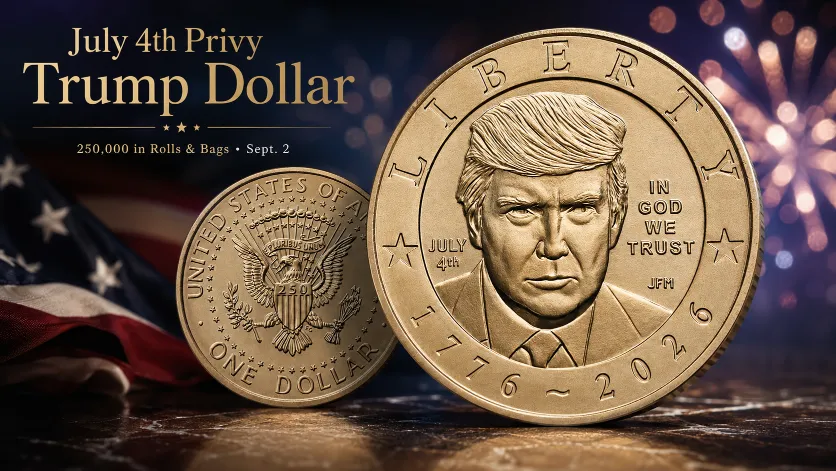
Rolls and bags of the 2026 Semiquincentennial President Donald J. Trump $1 Coin go on sale from the United States Mint on September 2 at noon EDT. Sitting in the middle of the August 27 announcement, between the product codes and the design credits, is the paragraph that changes the character of the whole release: 250,000 of these Trump dollars were struck on the Fourth of July at the Philadelphia Mint carrying a special “July 4th” privy mark, and the Mint will intersperse them at random through the same rolls and bags everyone else is buying.
That single paragraph turns a straightforward product launch into a search. It also answered, within twenty four hours, a question the hobby had been asking since the coin surfaced in a grading holder nobody expected.
How the July 4th Privy Trump Dollar Was Discovered
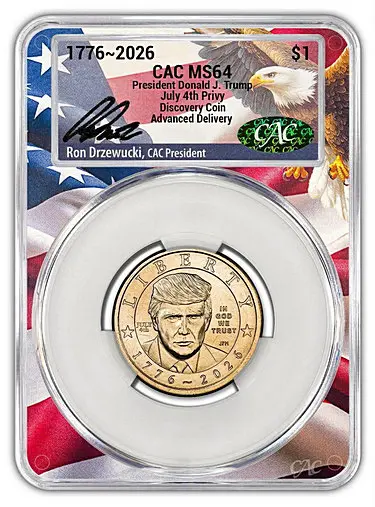
On August 26, CAC Grading announced that Heritage Auctions numismatist Rene Alvarenga had found an unannounced July 4th privy Trump dollar inside an Advanced Delivery roll. CAC certified the piece MS64 and labelled the holder with three descriptors that will follow the coin permanently: “July 4th Privy,” “Discovery Coin,” and “Advanced Delivery.” According to CAC, Heritage intends to donate the coin to the American Numismatic Association.
The timing could hardly have been better staged. The ANA’s 2026 World’s Fair of Money was running that week at the David L. Lawrence Convention Center in Pittsburgh, which put a previously undocumented modern variety in front of the hobby’s largest annual gathering on the day it was announced.
What the discovery did not come with was context. As CoinWeek noted at the time, the Mint’s live product information gave no mintage for the privy dollar and no explanation of how it would be distributed. Collectors had a certified coin, a photograph, and no program behind it. The Mint’s press release the following morning supplied both missing pieces at once: a figure of 250,000, and a distribution channel that runs straight through the numismatic products going on sale September 2.
What the July 4th Privy Mark Looks Like on the Trump Dollar
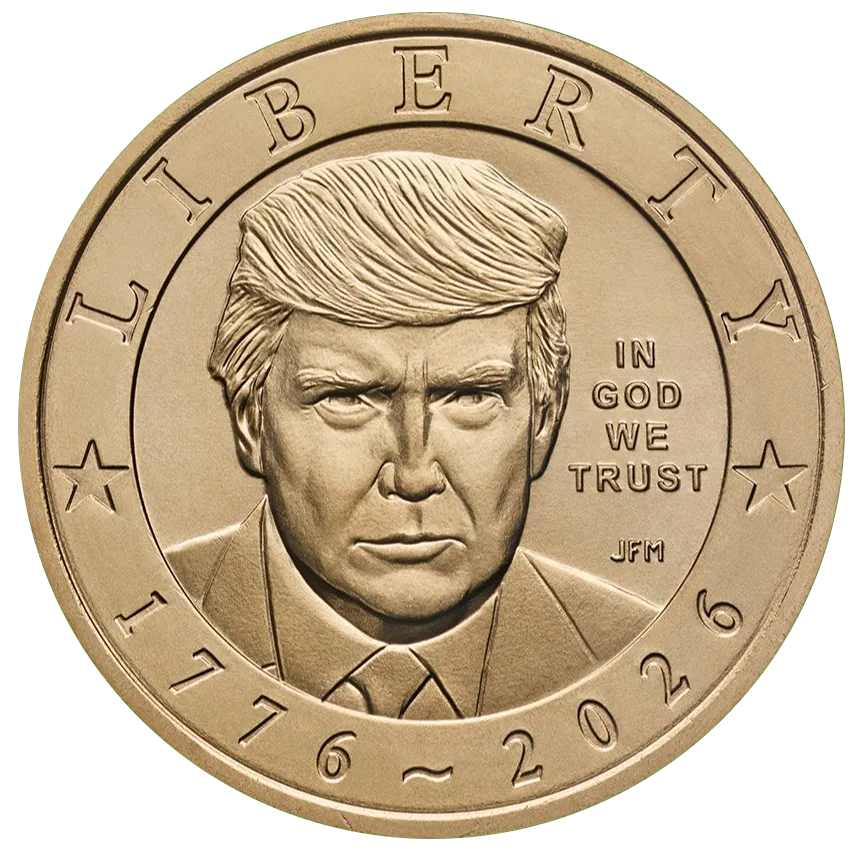
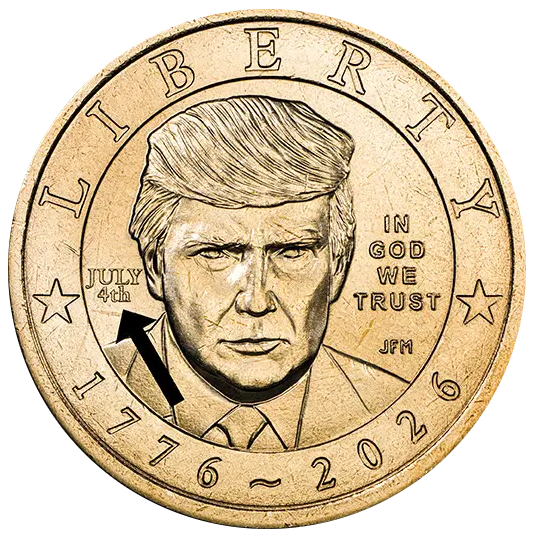
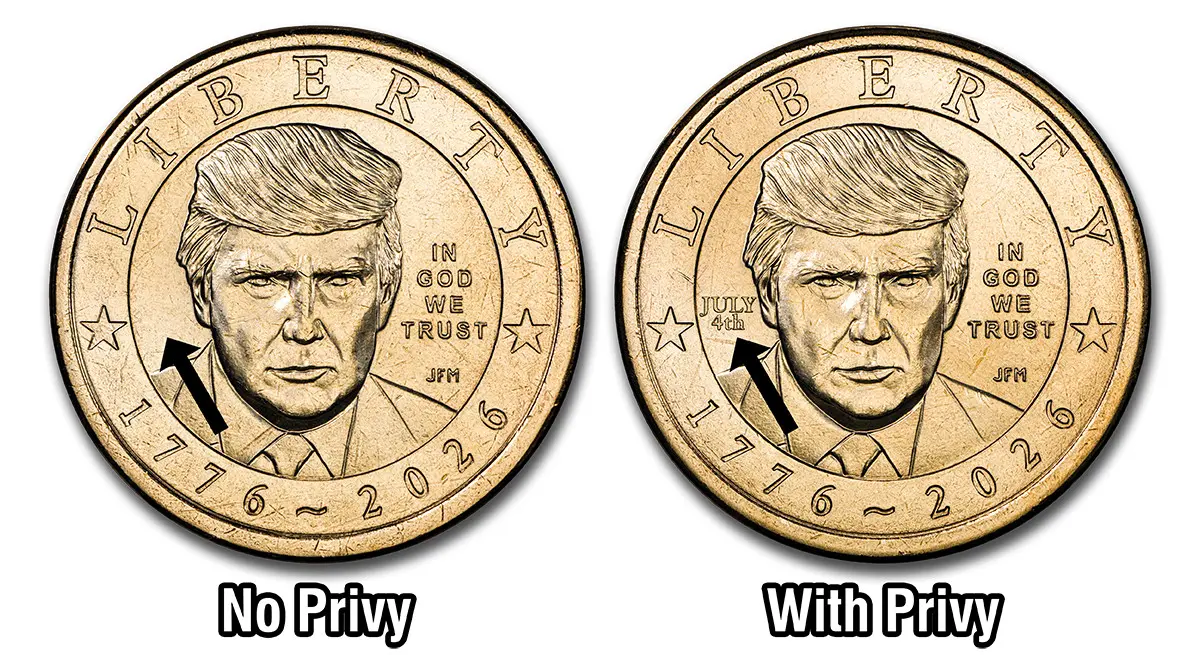
The marking sits on the obverse, in the open field to the left of the portrait. CAC’s images show a small two line inscription reading JULY above 4th, positioned directly above the five pointed star in the lower left field and recessed into an area that is entirely blank on the standard coin. The rest of the obverse is unchanged: LIBERTY arcing above the portrait, IN GOD WE TRUST at right, and the dual date 1776 ~ 2026 across the lower field. CAC’s photographs show no corresponding change to the reverse.
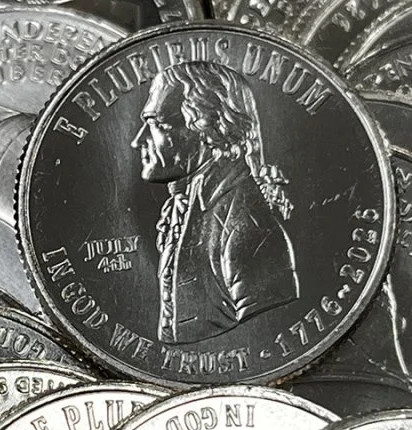
Like the standard coin, the privy pieces carry no mint mark and a circulating finish. The Mint describes them as first of their kind, though that phrasing deserves a qualifier: 2026 has already seen the addition of multiple privy marks to multiple coins, both in the circulating and numismatic ranges of the US Mint. The Declaration of Independence quarter-dollar has also seen a July the 4th privy mark added to a small amount of those coins. And multiple coins have seen the Liberty Bell 250 privy mark added to the design for this semiquincentennial year. Although the mint statement is not entirely inaccurate as there has been a significant amount of controversy surrounding the release of this singular coin.
How Many Trump Dollars Have Been Struck?
There is a confirmed production figure, and it is not a mintage limit. The Mint’s monthly circulating coin production report shows the Philadelphia Mint striking 9,000,000 of the coins in July 2026, with Denver reporting none. July was the first month of production, so that 9 million is also the year to date total.
Set the published figures side by side and they resolve into a tidy arrangement. The two products can hold 8,750,000 coins if both sell to their limits. The Mint has struck 9,000,000. The difference is 250,000, which is precisely the number of privy coins.
The Mint has not explained that gap, and the obvious reading needs stating carefully, because it is inference rather than fact. The privy coins are not additional to the rolls and bags, they sit inside them. A 25 coin roll holds 25 coins, so a roll containing a privy piece holds 24 standard coins and one marked one. If the Mint struck 8,750,000 standard coins, enough to fill every roll and bag to its limit, and then struck 250,000 privy coins on the Fourth of July, each marked coin displaces a standard one at packing. The products still ship 8,750,000 coins, and roughly 250,000 standard pieces are left over with nowhere announced to go. That reading fits every published figure. It is not the only one that would.
What none of this establishes is a final mintage. The product page lists the mintage limit as None, which is the Mint declining to set a cap rather than a statement that 9 million is the end of it. The authorizing legislation runs to December 31, 2026, leaving four months of production capacity, and earlier Mint statements pointed toward further numismatic availability in the late autumn, which would need coins. August production figures publish around late September and will show whether the presses ran again.
It’s worth keeping three numbers separate, because most coverage collapses them: coins struck, which is 9 million so far; coins offered through these two products, which is 8,750,000 at most; and final mintage, which nobody will know until the year closes and the Mint reconciles its figures.
One thing the production report does not mean is that these coins are headed for circulation. The Federal Reserve no longer orders dollar coins for general circulation, and the Mint strikes them for collector products alone. The Trump dollar appears in the circulating production report because it is struck to circulating quality, not because it is going to a bank near you. The Mint’s own product page puts it plainly: the coins have circulating finishes and have never been placed into circulation, though they remain legal tender.
How Rare Is the July 4th Privy Trump Dollar?
Both available denominators give almost the same answer, which is reassuring. Against the 9,000,000 coins struck in July, 250,000 privy pieces work out to one coin in 36. Against the 8,750,000 the two products can hold, the ratio is one in 35. Either way the practical figure is the same: roughly seven privy dollars for every ten rolls sold, or around three per bag.
Those numbers are arithmetic, not a distribution rate. The Mint has not said the privy coins are spread evenly, has not confirmed that both product types receive them in proportion, and has not stated whether every one of the 250,000 will pass through these two products. And we need only look to the distribution of the July the 4th quarter dollar coins to see how inconsistently these can be grouped. As some individuals found multiple Privy Marked coins in a single roll and even hundreds of coins in a single box, whereas other people found absolutely nothing at all
The July 4 Privy Quarter Set the Precedent, Not the Blueprint
The Mint has already run this play once in 2026. Ahead of Independence Day it struck 250,000 Declaration of Independence quarters with a July 4 privy mark and no mint mark, then mixed them randomly into bulk shipments bound for the Federal Reserve. The result was a nationwide hunt through pocket change, amplified by bounties from both NGC and PCGS for the first verified finds.
The same figure appears here, attached to a completely different mechanism. The quarter was free to look for and impossible to buy. The dollar is the reverse: nobody will find one in change, because the Mint has placed them inside a product that costs $61 for a roll or $154.50 for a bag. The hunt has moved from the coffee shop till to the checkout page, and the entry fee is no longer a quarter.
What the Quarter’s Price Curve Suggests About the Privy Dollar’s Value
The quarter also supplies the clearest available picture of what happens to a privy mark premium once supply catches up with excitement, and the curve is steep.
CoinNews sampled eBay completed listings three times. Across 34 listings from June 30 to July 2, while the first finds were still trickling out of bank rolls, figures ran from $800 to $2,650. By July 5 the range had fallen to $355 to $1,000. By July 24, a review of 54 listings found $165 to $300.27, most of them clustered near $200, and every price in that final sample came in below the floor of the sample three weeks earlier. Graded coins held their ground better: five MS66 examples sold on July 24 between $727 and $1,060, at a point when raw pieces were struggling to clear $300. Two months on, ungraded examples change hands for something in the region of $100 to $200. That remains several hundred times face value, and it is also a fall of roughly 90 percent from the early highs.
Whether the Trump dollar follows the same line depends on three things pulling in different directions.
The first is speed. The quarter’s supply arrived slowly, coin by coin, as roll hunters worked through bank boxes, and the premium survived as long as it did because nobody could buy one directly. The dollar has no such friction. Its supply arrives in a single moment at noon on September 2, into the hands of buyers who already know exactly what to look for. If an early premium exists at all, it may have days rather than weeks.
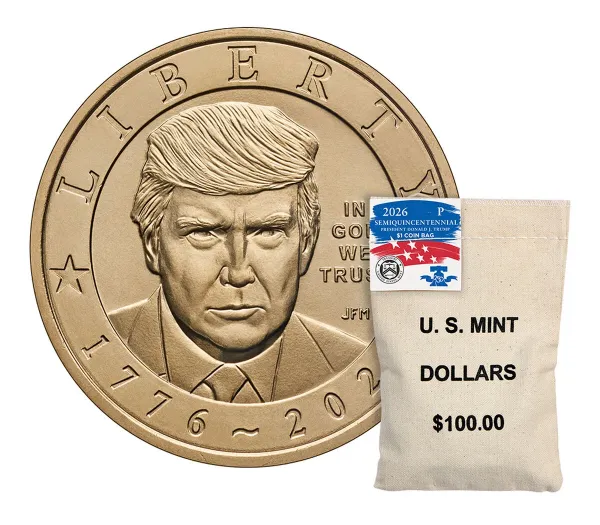
The second is cost, and it works the other way. A privy quarter cost a quarter to find, so any price above face was clear profit and sellers could undercut one another indefinitely. A privy dollar costs $61 or $154.50 to search for. That gives the market a floor the quarter never had.
The third is concentration. The quarters went into a circulating mintage running into the tens of millions, which put the odds of pulling one at hundreds to one. Inside the Mint’s own products, the dollar ratio is closer to one in 35. A variety that is an order of magnitude easier to find is a variety that reaches saturation faster.
None of that is a forecast, and the quarter’s own trajectory is a reminder of how quickly early figures stop meaning anything. What the quarter does establish is the shape of the thing: a short window in which scarcity is assumed rather than measured, followed by a longer correction once the hobby learns how common the coin actually is. The dollar’s window opens September 2.
| 25 Coin Roll (P) | 100 Coin Bag (P) | |
|---|---|---|
| Product code | 26SQRP | 26SQBP |
| Price | $61.00 | $154.50 |
| Contents | 25 circulating quality $1 coins | 100 circulating quality $1 coins |
| Product limit | 150,000 | 50,000 |
| Mintage limit | None | None |
| Initial Household order limit | 2 | 2 |
Both products go on sale September 2 at noon EDT. The household limit of two per product carries a wrinkle of its own: the press release describes it as applying for the first 24 hours after the on sale time, while the product page states that it remains in place until 2 p.m. ET on Thursday, September 3. Those two statements are two hours apart, and the product page is the more specific of the two.
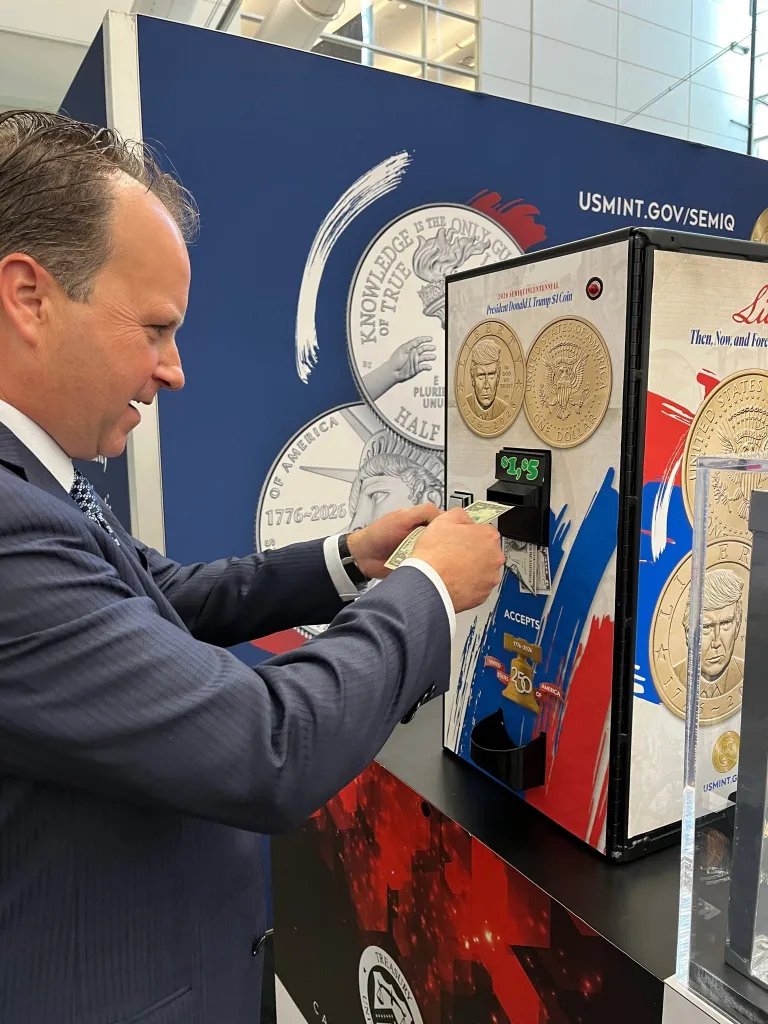
There was one channel that asked no premium at all, and it has already closed. At the Mint’s booth during the ANA World’s Fair of Money in Pittsburgh, a kiosk wrapped in Semiquincentennial livery dispensed the standard coin at face value, to a maximum of five per person. A header panel carried enlarged renderings of both sides of the coin “2026 Semiquincentennial President Donald J. Trump $1 Coin,” and the sign above the bill slot listed the accepted notes as $1 and $5, so a single five dollar bill bought the maximum. The machine held no privy pieces(as far as we know), only the regular issue, and the show closes on August 29. For anyone standing on that bourse floor, the 2026 Trump dollar was briefly worth exactly one dollar.
The Mint also notes that its rolls are wrapped by automated machine rather than by hand, so there is no guarantee which side of a coin will be visible at either end of a roll. For anyone hoping to spot a privy mark without breaking the wrapper, that is the end of the idea.
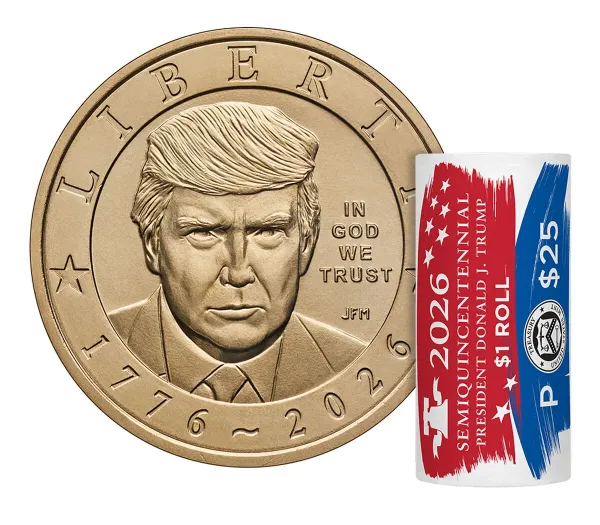
2026 Trump $1 Coin Designs and Specifications
The obverse portrait of President Donald J. Trump is the work of United States Mint Chief Engraver Joseph Menna, who based it on an official White House photograph taken by Daniel Torok.
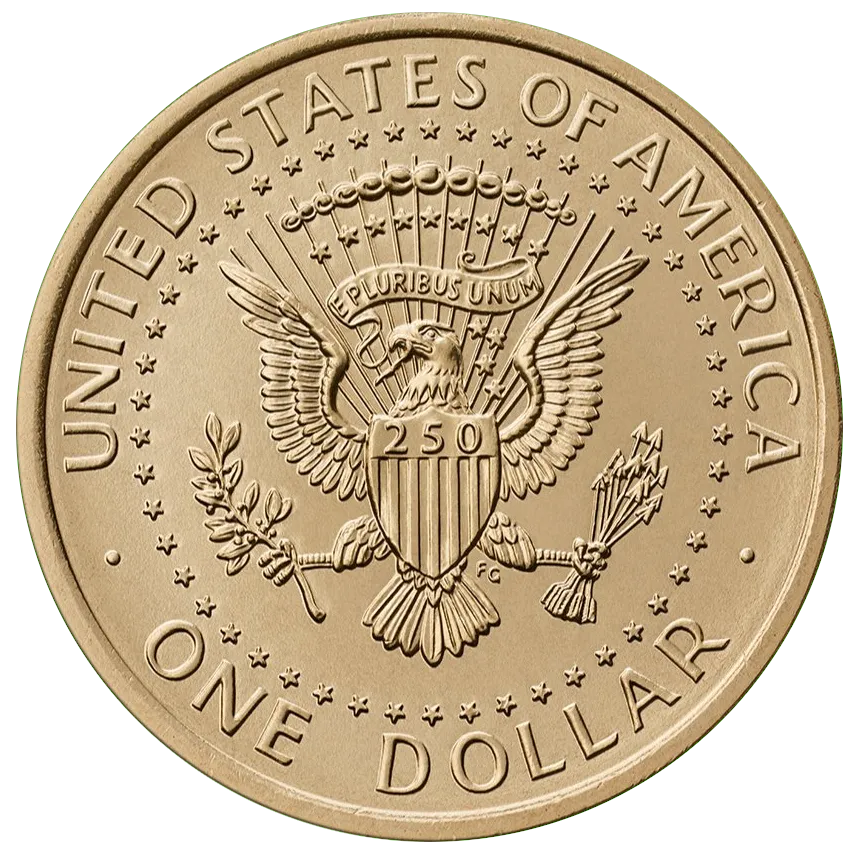
The reverse is older, and its credit is posthumous. The Presidential Seal design, an eagle holding an olive branch and a bundle of arrows with a shield on its breast and E PLURIBUS UNUM on a banner in its beak, was designed and sculpted by former Mint Chief Engraver Frank Gasparro, whose heraldic eagle has served the Kennedy half dollar since 1964. The shield here carries the added inscription 250 for the Semiquincentennial, alongside UNITED STATES OF AMERICA and ONE DOLLAR.
| Specification | Detail |
|---|---|
| Denomination | $1 |
| Finish | Circulating |
| Composition | 6% zinc, 3.5% manganese, 2% nickel, balance copper |
| Weight | 8.100 grams |
| Diameter | 1.043 inches (26.49 mm) |
| Edge | Plain |
| Mint | Philadelphia |
| Mint mark | None |
The authority for the issue comes from 31 U.S.C. §5112(y)(1)(C) and the Circulating Collectible Coin Redesign Act of 2020 (Public Law 116-330), under which the Secretary of the Treasury may mint and issue a new $1 coin for a single year beginning January 1, 2026, in recognition of the nation’s Semiquincentennial.
What the July 4th Privy Trump Dollar Means for Collectors
For a coin that has attracted more commentary on its portrait than on its numismatics, the July 4th privy is the first genuinely collectible thing about it. It creates a variety with a documented discovery, a named finder, a certified first example headed to the ANA, and a supply figure the Mint has now stated on the record before a single roll has shipped. That combination is rare in modern American coinage, where varieties usually announce themselves months after the fact and nobody can agree how many exist.
The unresolved question is what happens when 250,000 marked coins meet a hobby that has spent all year learning to hunt for them. The July 4 quarter took a nationwide search and a pair of grading service bounties to sort itself out. This one starts at noon on September 2, with a two coin household limit and a countdown clock, and the only way to look is to buy first.
Frequently Asked Questions
When does the 2026 Trump dollar go on sale? Rolls and bags go on sale from the United States Mint on September 2, 2026 at noon EDT. A household order limit of two per product applies at launch, and the product page states it remains in force until 2 p.m. ET on Thursday, September 3.
How much do the Trump dollar rolls and bags cost? A 25 coin roll (product code 26SQRP) is $61.00. A 100 coin bag (product code 26SQBP) is $154.50. Both contain circulating quality coins struck at the Philadelphia Mint.
What is the July 4th privy mark on the Trump dollar? It is a small two line inscription reading JULY above 4th, placed in the open obverse field to the left of the portrait and directly above the five pointed star in the lower left. That area is blank on the standard coin.
How many July 4th privy Trump dollars were made? The U.S. Mint states that 250,000 were struck on the Fourth of July at the Philadelphia Mint. They carry no mint mark and a circulating finish, and the Mint will intersperse them through the rolls and bags.
How many 2026 Trump dollars were made? The Philadelphia Mint struck 9,000,000 in July 2026 and Denver struck none, according to the Mint’s monthly production figures. That is the confirmed total to date, not a final mintage: the Mint lists no mintage limit and the authorization runs to December 31, 2026.
How rare is the July 4th privy Trump dollar? Against the 9,000,000 struck in July, 250,000 marked pieces work out to about one coin in 36. Against the 8,750,000 the two products can hold, it is one in 35. The Mint has not confirmed that the distribution is even.
What is the July 4th privy Trump dollar worth? No sales exist yet, since the coins reach collectors on September 2. The closest guide is the July 4 privy quarter, which fell from a $800 to $2,650 range in early July to roughly $165 to $300 by late July, and to about $100 to $200 raw today.
Is the 2026 Trump dollar made of gold? No. Despite the golden colour, the alloy is 6% zinc, 3.5% manganese, 2% nickel, with the balance copper. The coin weighs 8.100 grams and measures 26.49 mm.
Does the 2026 Trump dollar have a mint mark? No. Both the standard coin and the July 4th privy version are struck at Philadelphia without a mint mark. The absence of a P is intentional, not an error.