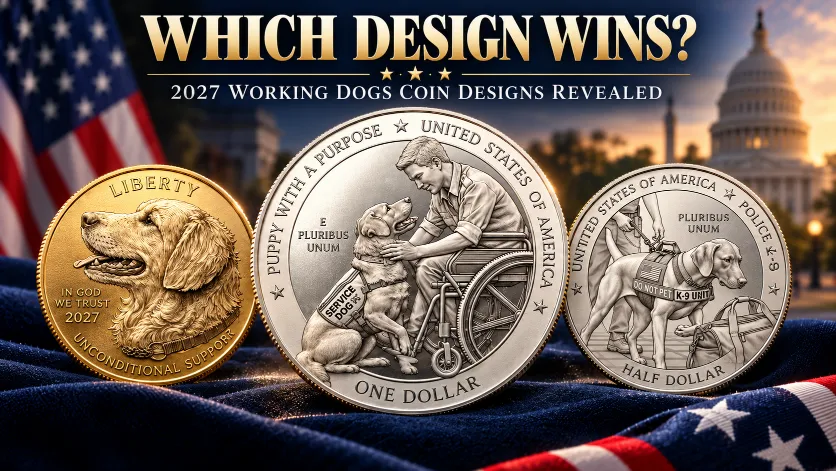
The 2027 Working Dogs commemorative coins now have their faces. On September 21, 2026, representatives of the United States Mint, America’s VetDogs, and the Guide Dog Foundation unveiled the final designs at a ceremony at the White House, completing a review process that began with nearly 60 concepts and ended with six sides spread across a $5 gold coin, a silver dollar, and a cupro-nickel clad half dollar. Each denomination takes a different branch of the working dog family: therapy dogs on the gold, guide and service dogs on the silver, and military and police K-9s on the half.
For collectors who followed the February design reviews, the more telling story is what survived the process. Every one of the six final designs matches the recommendation of the Citizens Coinage Advisory Committee, including the committee’s small but pointed edits. Two proposed wording changes from the Commission of Fine Arts, by contrast, did not make it onto the final artwork. The program is authorized under the Working Dog Commemorative Coin Act, Public Law 118-109, and its surcharges support America’s VetDogs.
Three coins, three kinds of work
The structure of the program was set by Congress and refined with the sponsor. America’s VetDogs worked with the Mint on the candidate designs, which were culled from nearly 60 concepts to 28, 14 obverses and 14 reverses, before going to the Commission of Fine Arts on February 19 and the CCAC on February 24. The final pairings, as they appear in the Mint’s line art, are summarized below.
| Coin | Theme | Obverse | Reverse | Maximum mintage | Surcharge |
|---|---|---|---|---|---|
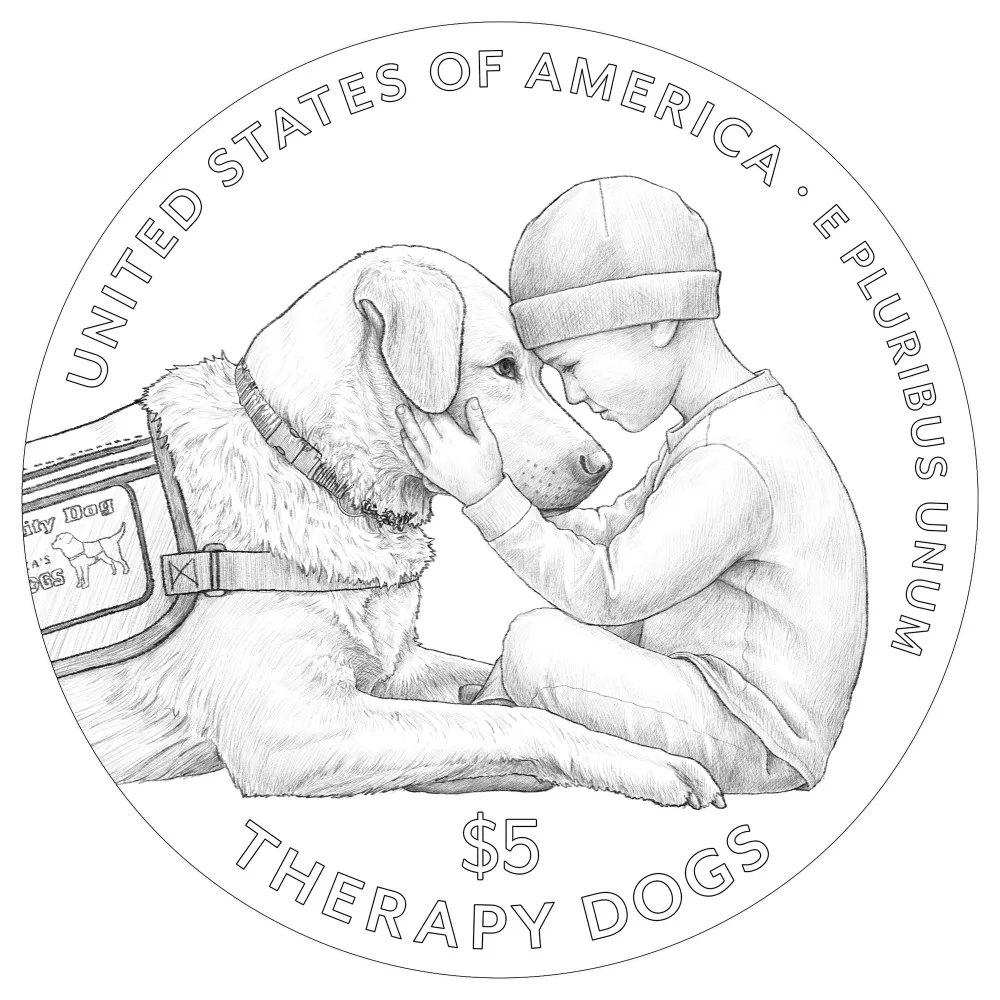
| $5 gold | Therapy dogs | Therapy dog portrait, UNCONDITIONAL SUPPORT | Child and therapy dog, THERAPY DOGS | 50,000 | $35 |
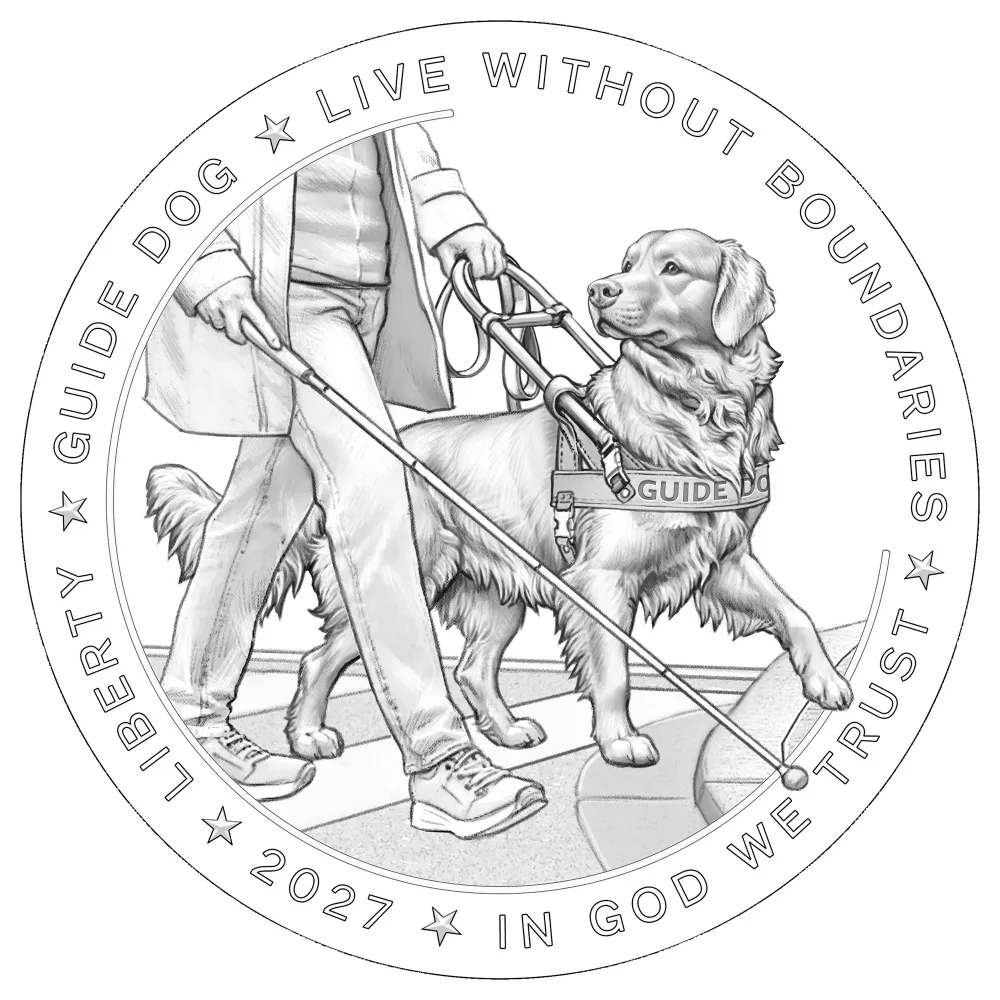
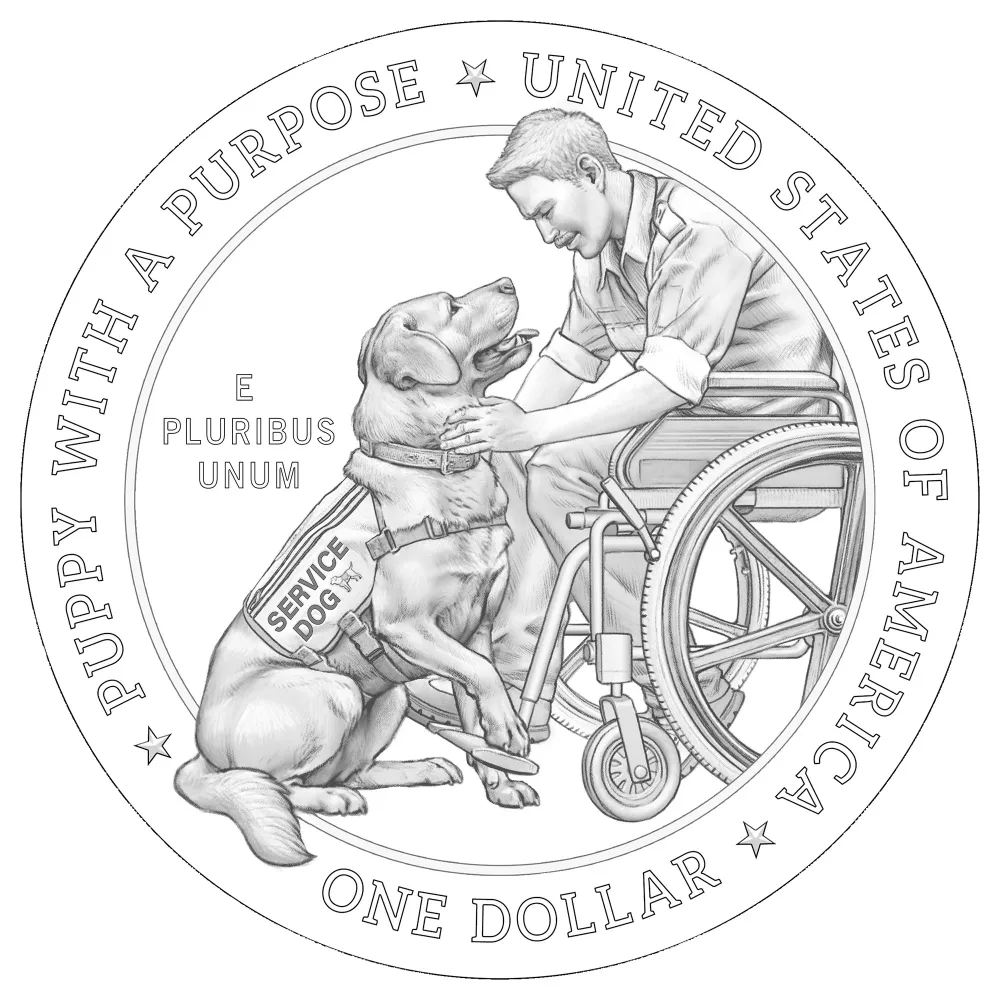
| $1 silver | Guide and service dogs | Guide dog at a crosswalk, LIVE WITHOUT BOUNDARIES | Labrador and veteran in a wheelchair, PUPPY WITH A PURPOSE | 500,000 | $10 |
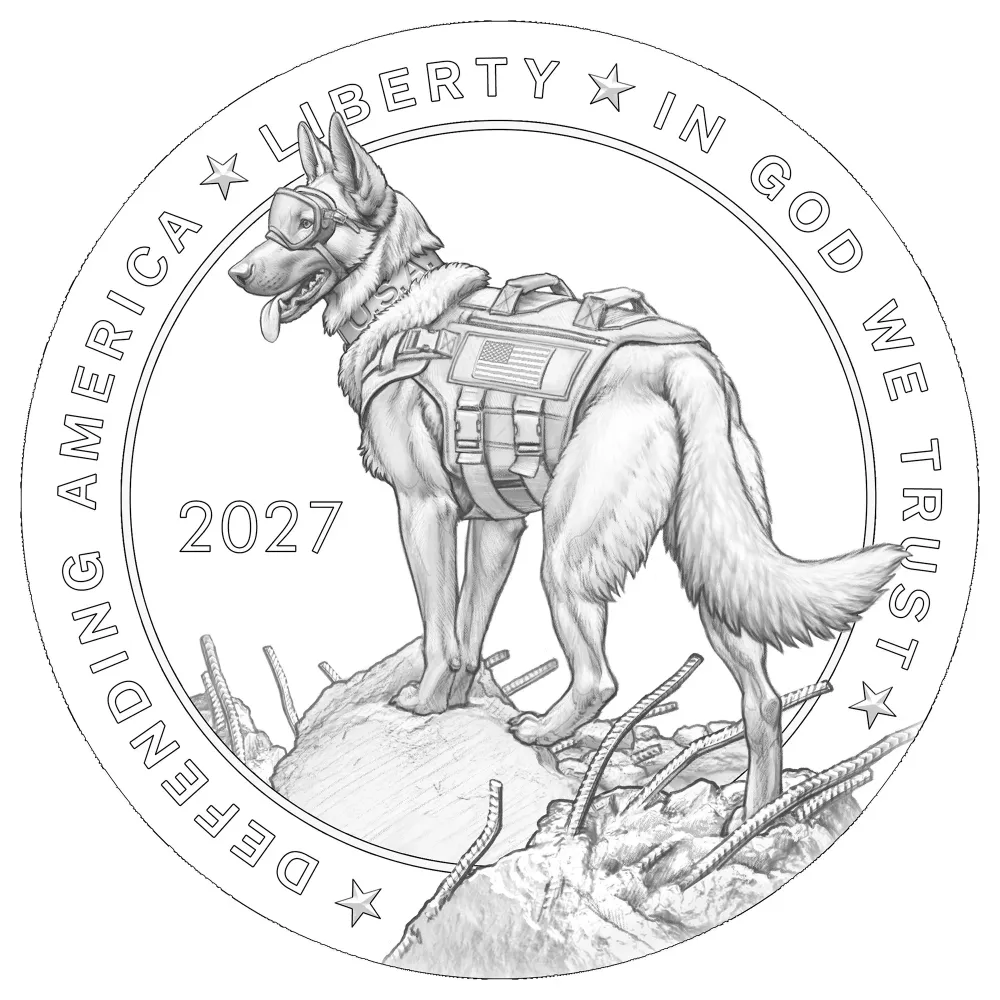
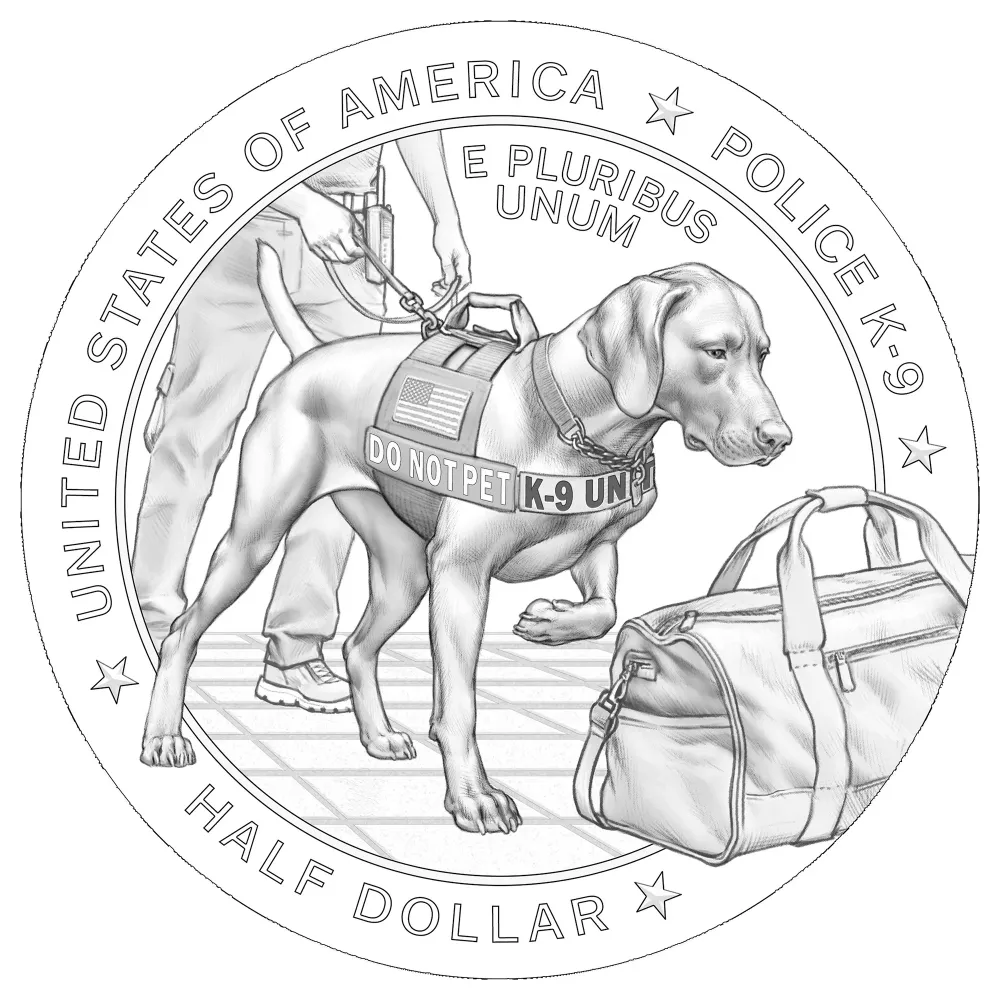
| Half dollar, cupro-nickel clad | Military and police K-9s | German Shepherd on rubble, DEFENDING AMERICA | Pointer and duffel bag, POLICE K-9 | 750,000 | $5 |
Mintage limits and surcharges are as set by the authorizing law, and all three coins can only be issued during 2027.
The gold: comfort, minus the heart
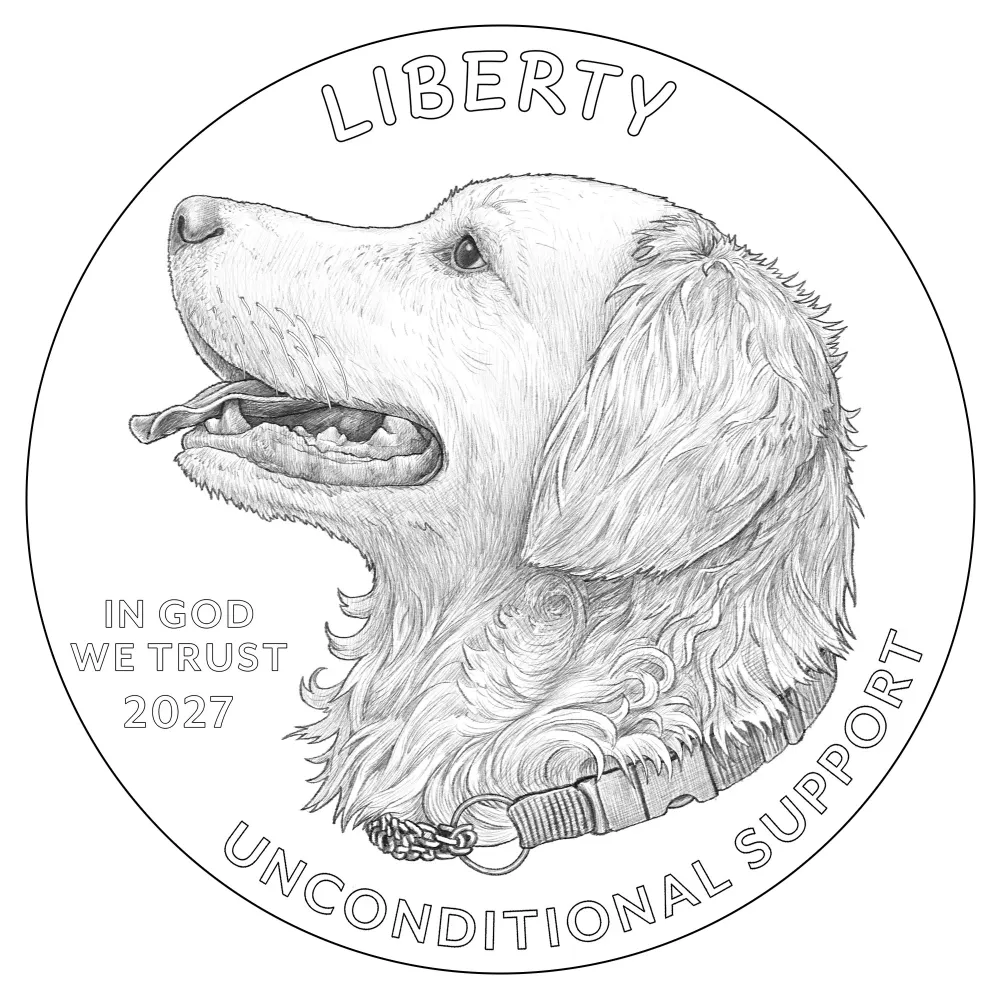
The $5 gold obverse is the simplest of the six designs, and deliberately so. A therapy dog is shown in profile, head lifted and mouth open, with LIBERTY, IN GOD WE TRUST, 2027 and UNCONDITIONAL SUPPORT arranged around it. It matches the portrait design reviewed as O-02, which both the CFA and the CCAC preferred. America’s VetDogs had favored a busier candidate, O-06, showing a therapy dog holding a set of keys as its handler reached out. During the CCAC discussion, several members, including Peter van Alfen, who chaired the meeting, worried that on a coin this small those keys could easily read as drool.
The reverse is where the committee’s editing hand shows most clearly. A young child in a knit cap sits face to face with a therapy dog in its working vest, the two almost touching foreheads, with $5 and THERAPY DOGS below. In February this design carried a heart symbol between child and dog. The CCAC voted unanimously to remove it, with members calling it superfluous, and asked for the rather childlike lettering to be replaced with something more befitting a United States coin. The heart is gone from the final line art. What remains is a quieter image, and arguably a stronger one, since the gesture now carries the sentiment on its own.
The silver dollar: the guide and the veteran
The silver dollar was the least contested coin in the program, and the final designs reflect that. The obverse shows a golden retriever guide dog in harness pausing at a crosswalk, alerting its visually impaired handler to a raised curb, framed by GUIDE DOG and LIVE WITHOUT BOUNDARIES. Both America’s VetDogs and the CCAC recommended it in February. The CFA had gone a different way, borrowing a portrait from the gold portfolio instead.
The reverse had the rare distinction of pleasing everyone. A Labrador retriever sits with a veteran in a wheelchair, the two leaning into one another, under PUPPY WITH A PURPOSE. The CFA endorsed it but suggested changing the word on the dog’s vest from SERVICE to VET. That change was not made. The vest on the final artwork still reads SERVICE DOG, which keeps the design honest to the dogs themselves: the program honors service dogs broadly, and the veteran on the coin is one of the people they serve.
The half dollar: police K-9s and a duffel bag
The half dollar produced the most disagreement in February, and it is the one coin where the sponsor did not get its way. America’s VetDogs had preferred a service member with his K-9 on the obverse and a police officer with a patrol dog on the reverse. Neither was chosen.
Instead, the obverse carries the CCAC’s pick: a German Shepherd in a protective canine vest and goggles, standing on broken concrete and exposed rebar, with DEFENDING AMERICA running along the left rim. The setting reads unmistakably as a disaster site, which widens the coin’s scope from the battlefield to search and rescue.
The reverse, favored by both the CFA and the CCAC, shows a German Shorthaired Pointer in its classic pointing stance, nose toward a duffel bag on an airport floor, with its handler behind it and POLICE K-9 along the border. Here too a CFA edit fell away. The commission had wanted the DO NOT PET wording removed from the dog’s harness, but the final artwork keeps DO NOT PET alongside K-9 UNIT. That is the outcome the VetDogs representative argued for in February, on the grounds that the phrase is standard on real working dog gear. Anyone who has walked through an airport security line will recognize the scene instantly, and that recognition is the point.
How the review panels fared
Laid side by side, the scorecard is unusually clean. The CCAC’s recommendation carried on all six sides. America’s VetDogs saw its preferred design chosen on three sides, the gold reverse and both sides of the silver dollar, while the CFA’s preferences prevailed where they overlapped with the committee’s, on the gold obverse, the silver dollar reverse and the half dollar reverse. The CFA’s more inventive proposals, such as flipping a gold obverse into the reverse role and rewording both vests, were set aside.
The final design choice rests with the Secretary of the Treasury, and the advisory panels only recommend. Recommendations are not always followed, which is what makes a clean sweep worth noting. For a program built around dogs trained to do exactly what is asked of them, the review process behaved with some of the same discipline.
Where the 2027 Working Dogs coins go from here
Pricing and release dates have not been announced. The Mint says the on-sale date will appear on its 2027 Product Schedule, with orders taken through its commemorative coins page. Each denomination is expected in proof and uncirculated finishes, and CoinNews reports that a three-coin proof set is also planned. For America’s VetDogs, the stakes are practical: placing a single assistance dog costs the organization more than $50,000, yet it provides its dogs free of charge to veterans, active-duty service members, and first responders with disabilities.
The 2027 Working Dogs commemorative coins arrive with an advantage few commemoratives enjoy, a subject almost no collector feels neutral about. The designs lean into that without tipping into sentiment, and the review process trimmed away most of what might have. Whether the program sells through its 50,000 gold coins will depend on pricing still to come, but the coins themselves already tell their story plainly. That is harder to achieve than it looks.
Frequently asked questions
What are the 2027 Working Dogs commemorative coins? The 2027 Working Dogs commemorative coins are a three-coin U.S. Mint program authorized by the Working Dog Commemorative Coin Act, Public Law 118-109. It comprises a $5 gold coin honoring therapy dogs, a silver dollar honoring guide and service dogs, and a cupro-nickel clad half dollar honoring military and police K-9s. The final designs were unveiled at the White House on September 21, 2026.
What do the final designs show? The $5 gold coin pairs a therapy dog portrait inscribed UNCONDITIONAL SUPPORT with a child sharing a quiet moment with a therapy dog. The silver dollar pairs a golden retriever guide dog at a crosswalk with a Labrador and a veteran in a wheelchair. The half dollar pairs a German Shepherd on rubble inscribed DEFENDING AMERICA with a German Shorthaired Pointer checking a duffel bag at an airport.
When can I buy the Working Dogs coins? Not yet. The U.S. Mint has said the on-sale date will be published on its 2027 Product Schedule, and orders will be taken through the commemorative coins section of usmint.gov once the program opens. The coins can only be issued during calendar year 2027.
How much will the 2027 Working Dogs coins cost? The Mint has not announced prices. What is known is that every coin carries a surcharge built into its price: $35 on each $5 gold coin, $10 on each silver dollar, and $5 on each half dollar.
How many Working Dogs coins will be minted? The authorizing law caps production at 50,000 $5 gold coins, 500,000 silver dollars, and 750,000 clad half dollars across proof and uncirculated finishes. These are maximums, not production targets, and final mintages depend on demand.
Where does the surcharge money go? After the Mint recoups its production and associated costs, surcharge proceeds go to America’s VetDogs. The nonprofit trains and places guide and service dogs with veterans, active-duty service members, and first responders with disabilities at no cost to them, although each placement costs the organization more than $50,000.
Did the Mint follow the CCAC’s recommendations? Yes, on all six sides. Every final design matches the Citizens Coinage Advisory Committee’s February 2026 recommendation, including its call to remove the heart from the gold reverse. Two Commission of Fine Arts wording changes, swapping SERVICE for VET on the silver dollar vest and dropping DO NOT PET from the half dollar harness, were not adopted.
Is the Working Dogs half dollar made of silver? No. The half dollar is a cupro-nickel clad coin, and only the $1 coin in the program is struck in silver. The half dollar is a collector issue sold in proof and uncirculated finishes and is not a circulating coin.