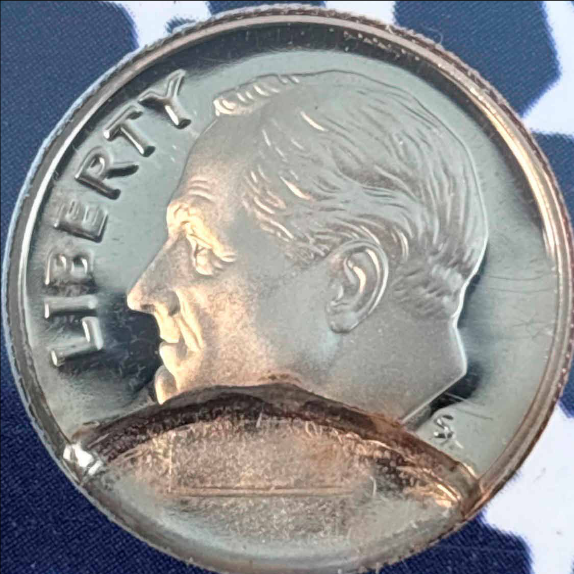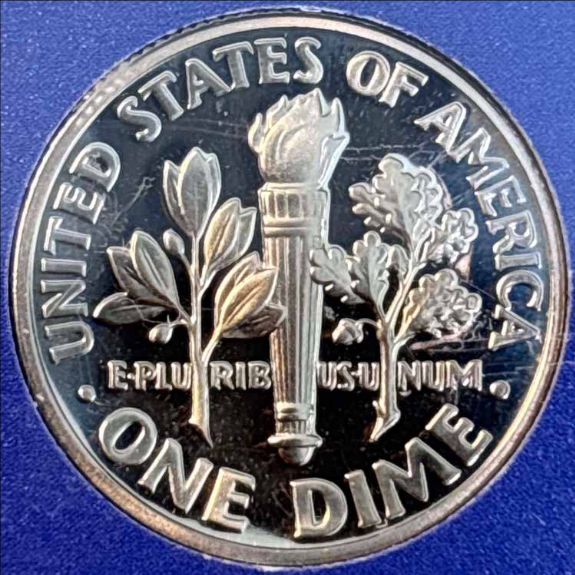
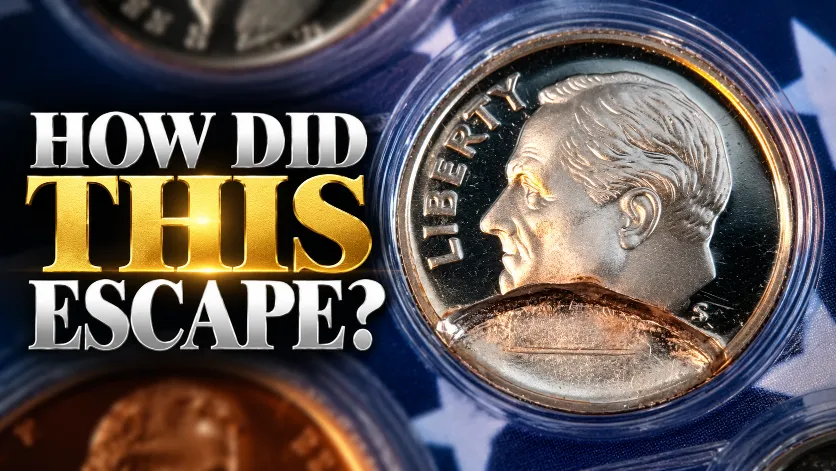
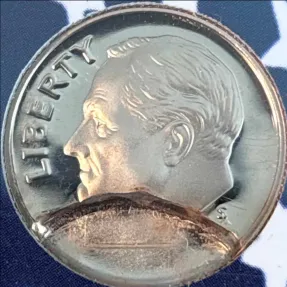
A major mint error has turned up somewhere collectors have long assumed one could not exist: inside an original, government sealed United States Mint proof set. The coin is a 2004-S clad proof Roosevelt dime carrying a 25% obverse indent from a stray planchet, and it still sits in the hard plastic lens the Mint sealed it into 22 years ago. Writing in issue 97 of Mint Error News, veteran error specialist Mike Byers, who now owns the set, calls it the only major mint error known in a sealed U.S. Mint proof set.
That is a large claim, and Byers makes it carefully. In 50 years as a professional numismatist specializing in errors, he says he has never seen another proof major error still in its government sealed holder. Mint error specialists he consulted had never heard of one either, and a search of auction records turned up nothing. For a hobby that has spent more than half a century cracking open proof sets, that silence is the story.
The coin
Proof coins are the most carefully made pieces the U.S. Mint produces. Blanks are polished, dies are specially prepared, each coin is struck more than once at slow speed, and the finished pieces are inspected and handled individually before packaging. Errors of any kind are rare. Major striking errors on proofs are rarer still, and the few that reach the market almost always do so loose, having left the Mint by some route other than a sealed set.
This dime did not take another route. At some point during its striking at San Francisco in 2004, a second planchet slipped partly over the dime blank between the dies. When the obverse die came down, it drove that interloper into the dime rather than striking design into it. The result is a smooth, curved depression covering roughly a quarter of the obverse, sweeping across the lower part of Roosevelt’s portrait beneath his chin and neck, while the rest of the design keeps its full proof finish. Byers notes that a 25% indent on a proof dime would rank as an extremely rare error even on its own.
What makes it remarkable is everything that happened next. A coin with a missing quarter of its design passed through the Mint’s proof inspection, was seated in the five-coin lens beside its proper companions, and was sealed shut.
A set that kept its secret
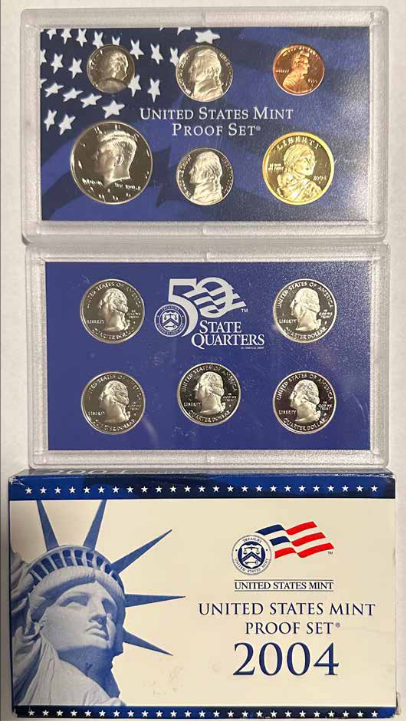
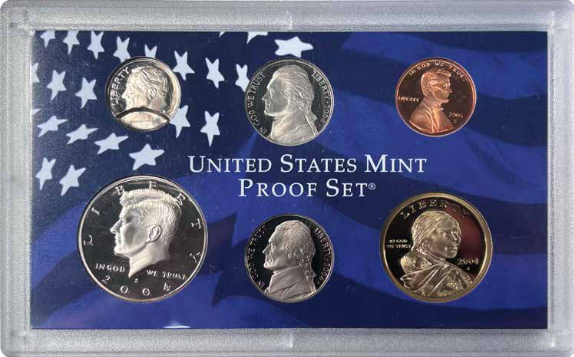
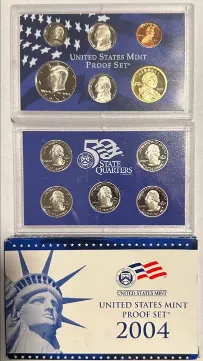
The 2004 United States Mint Proof Set was an 11-coin issue, sold for $22.95, pairing the Lincoln cent, both Westward Journey nickels (Peace Medal and Keelboat), the Roosevelt dime, the Kennedy half dollar and the Sacagawea Golden Dollar in one lens with the year’s five state quarters, Michigan, Florida, Texas, Iowa and Wisconsin, in a second. The Mint set no household order limit, and the sets were produced to meet demand.
Byers’ photographs show the complete package intact: both lenses, the printed outer box with its Statue of Liberty artwork, and the dime in its original position in the upper left corner of the lens, its indent plainly visible through the plastic. For 22 years it sat, presumably, in someone’s drawer or safe deposit box among millions of identical sets that offered no surprise at all.
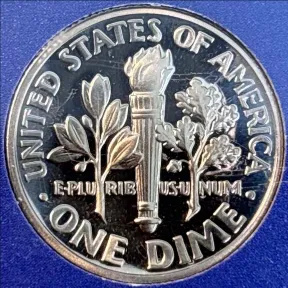
From a Pittsburgh bourse floor
The set resurfaced at the 2026 ANA World’s Fair of Money in Pittsburgh, held in late August, where a dealer bought it. Recognizing that it needed a specialist’s eye, the dealer contacted Byers, who has handled a large number of proof errors over his career. Byers says he knew on sight that it was unique and bought it immediately.
He then went looking for a precedent. U.S. proof sets have been issued in government sealed hard plastic holders since 1968, which gives the hobby nearly six decades of sets to draw on. None of the specialists Byers spoke to knew of another major striking error in a sealed set, and auction archives held no record of one.
Why the distinction matters
Collectors will rightly point out that famous errors do exist in original proof sets. The 1990 No S Lincoln cent and the No S Roosevelt dimes are prized precisely because they are found in sealed Mint packaging. Those, however, are die errors: a mintmark left off the die, repeated on every coin that die struck. Byers’ claim is narrower and specific. It concerns a striking error, a one-off mechanical accident during the strike itself, the kind proof quality control is designed to catch before a coin is ever packaged.
The sealed lens matters for a second reason. Errors are among the most frequently faked coins in the hobby, and an indented proof sitting loose in a flip invites questions about its origin. A coin that has never left the Mint’s own seal carries its provenance with it. The lens is, in effect, the certificate.
What it means for collectors
There is a quiet irony in how this piece will be valued. In most of the hobby, a coin earns its standing once it is removed, authenticated and encapsulated. Here, the seal is the point, and breaking it to slab the dime would erase the very thing that makes it singular.
For error collectors, proof specialists and anyone drawn to unique numismatic objects, this 2004 proof set is that rare thing: a sealed proof set mint error with a clear origin, an unbroken chain back to San Francisco, and, at least for now, no known peer. It also hands every collector with a shoebox of old proof sets a reason to look a little more closely through the plastic.
Frequently asked questions
What is the sealed proof set mint error found in 2004? It is a 2004-S clad proof Roosevelt dime with a 25% obverse indent caused by a stray planchet, still sealed inside its original 2004 U.S. Mint proof set. Error specialist Mike Byers, who owns it, describes it as the only major mint error known in a sealed U.S. Mint proof set. It was announced in issue 97 of Mint Error News.
What is an indent error on a coin? An indent forms when a second planchet partly overlaps a blank between the dies at the moment of striking. The die presses the overlapping planchet into the coin, leaving a smooth depression with no design where the stray blank sat. On this dime the indent covers roughly a quarter of the obverse, across the lower part of Roosevelt’s portrait.
Aren’t there other errors found in sealed proof sets, like the No S coins? Yes, but they are a different type of error. Coins such as the 1990 No S cent are die errors, where the mintmark was missing from the die itself and every coin it struck shares the flaw. The 2004-S dime is a major striking error, a one-off accident during the strike, and Byers and the specialists he consulted know of no other striking error of this kind in a sealed set.
How was the error discovered? A dealer bought the sealed set at the 2026 ANA World’s Fair of Money in Pittsburgh and contacted Mike Byers, who specializes in major mint errors. Byers purchased it immediately after seeing it. He then checked with other error specialists and searched auction records, finding no comparable example.
What coins come in a 2004 U.S. Mint proof set? The standard 2004 proof set holds 11 coins: the Lincoln cent, the Peace Medal and Keelboat nickels, the Roosevelt dime, the Kennedy half dollar, the Sacagawea dollar, and the five 2004 state quarters for Michigan, Florida, Texas, Iowa and Wisconsin. It sold from the Mint for $22.95. The coins are housed in two sealed plastic lenses inside a printed outer box.
Has the error dime been graded? Byers’ report does not mention grading, and the dime remains in its original sealed lens. Removing it for certification would mean breaking the government seal, which is the feature that makes the piece unique.
How long have U.S. proof sets come in sealed plastic holders? U.S. proof sets have been issued in government sealed hard plastic holders since 1968, according to Byers. That gives the hobby close to six decades of sealed sets in which no other major striking error has been reported.
Should I check my old proof sets for errors? It costs nothing to look through the plastic, and that is the safest way to do it, since opening a sealed set destroys its original packaging. Major errors in sealed sets are, on current evidence, extraordinarily rare, so a careful look is worthwhile but expectations should stay modest.