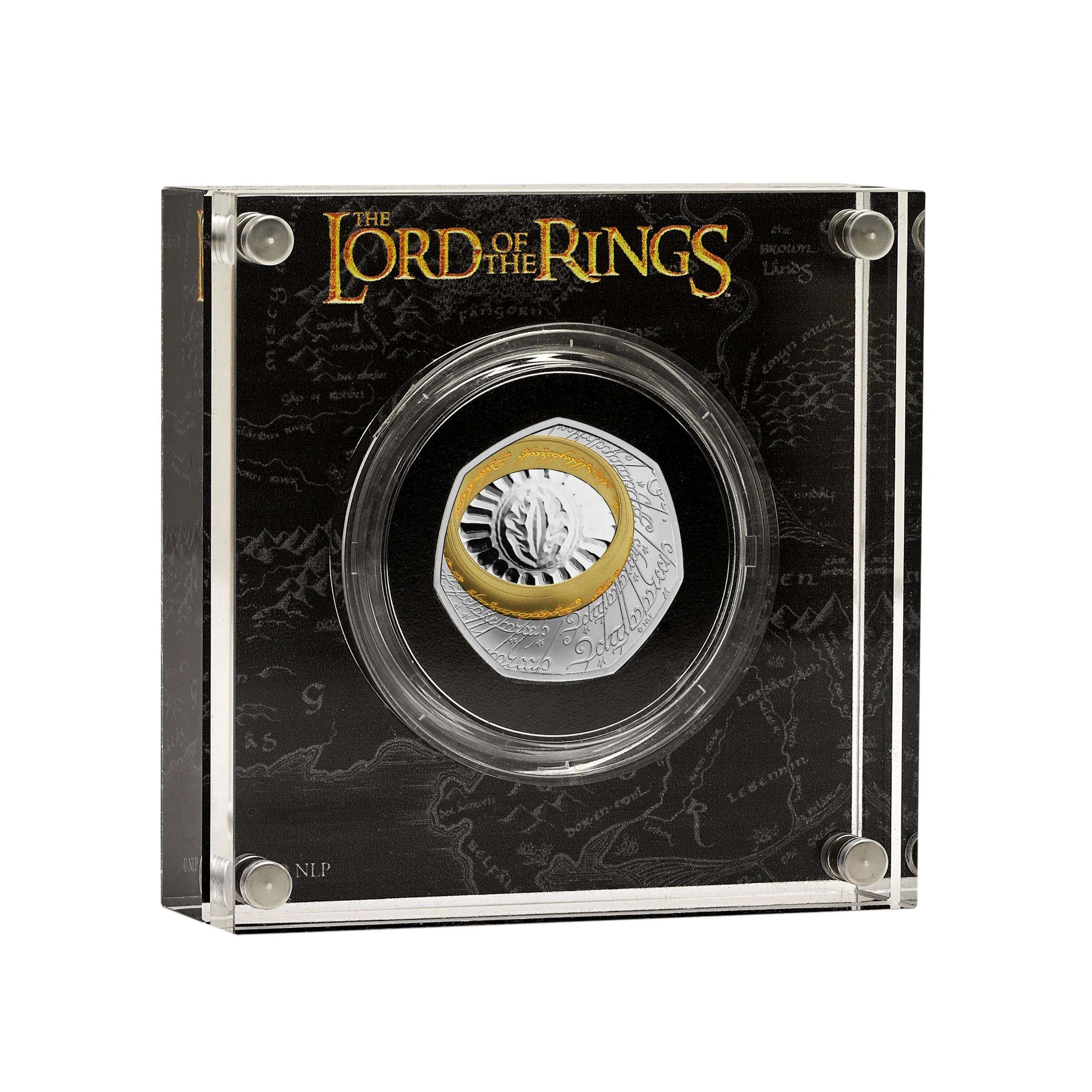
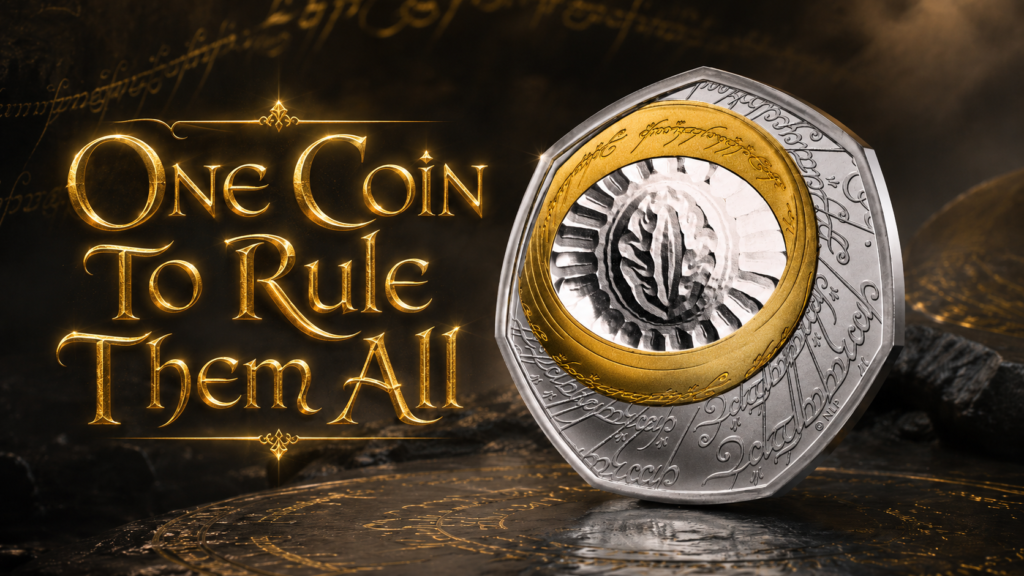
Twenty five years after Peter Jackson took an unfilmable book and turned it into one of the great achievements of modern cinema, the Royal Mint has done something almost as audacious. It has put the One Ring on a fifty pence piece, and on some of the editions, it has engineered the surface so precisely that when you tilt the coin under a lamp, the Eye of Sauron appears as a projection of light on the wall beside it.
That is not a marketing flourish. That is what the coin literally does. And as far as the Royal Mint is concerned, it is the first time any UK coin has done it.
The 2026 fifty pence, designed by Royal Mint coin designer Thomas T. Docherty, launched on 20 May 2026 and opens a three year, seven coin programme tied to the staggered 25th anniversaries of The Fellowship of the Ring (2001), The Two Towers (2002), and The Return of the King (2003). The series is produced under licence from Warner Bros. Discovery Global Consumer Products and New Line Productions, but the coin itself was struck in Llantrisant, forged, as the Mint cannot resist pointing out, not in the fires of Mount Doom but in Wales.
The Coin
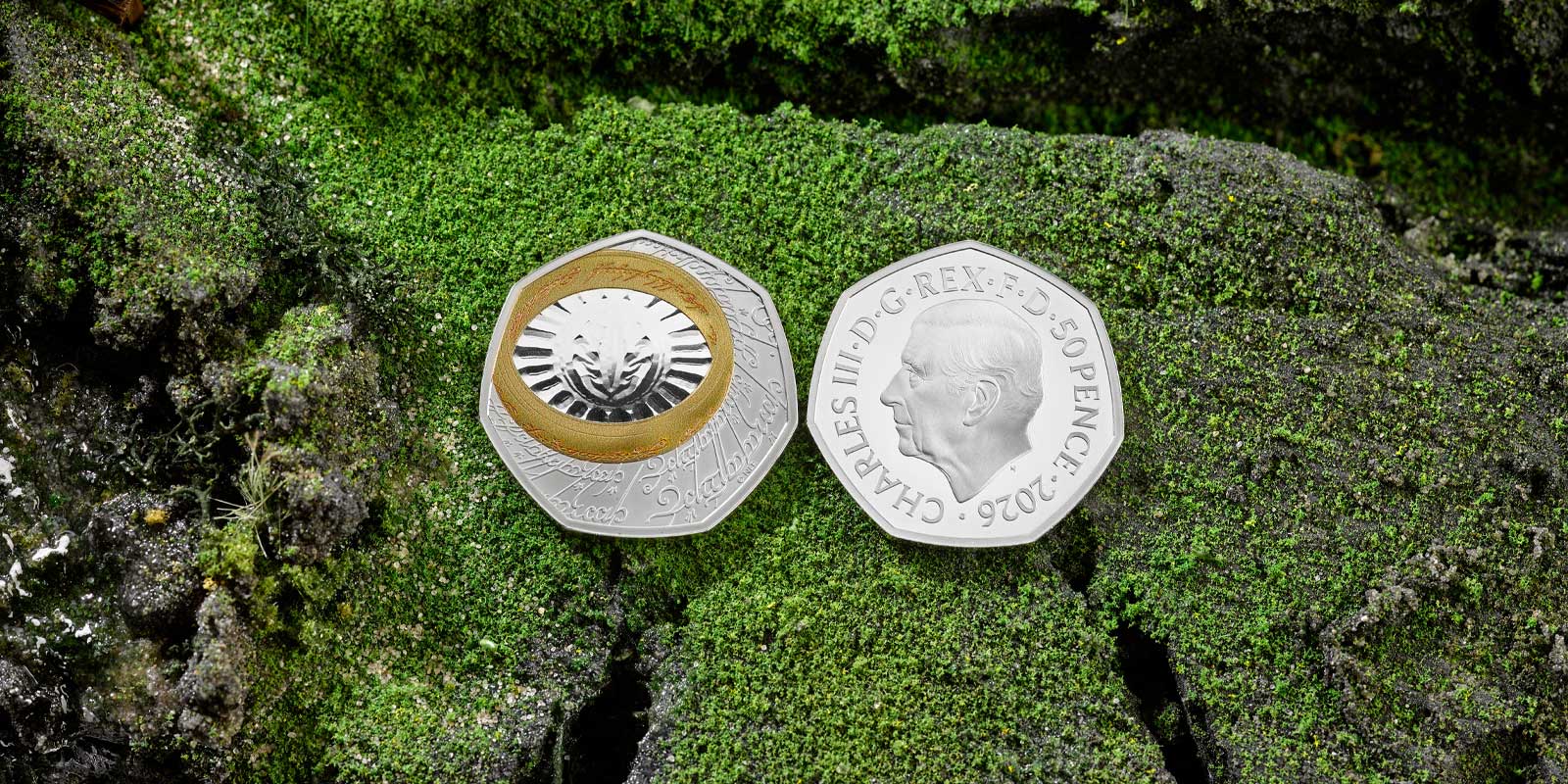
The reverse design centres on the One Ring rendered in detail, encircled by the famous verse rendered in Tolkien’s Elvish script and the Black Speech: “One Ring to rule them all, One Ring to find them, One Ring to bring them all and in the darkness bind them.” Everyone knows the line. Almost no one ever expected to find it on a piece of British circulating form coinage. The obverse carries the definitive Charles III coin portrait sculpted by Martin Jennings, with the standard “CHARLES III · D · G · REX · F · D · 50 PENCE ·” legend, the King and the Dark Lord, sharing one piece of metal. Whoever signed off on that pairing deserves a quiet drink.
The physical specifications are reassuringly familiar, the long running UK 50p standard, an equilateral curve heptagon, 27.3 millimetres across, plain edge. What is not familiar is the editions table.

The One Ring 50p — Editions at Launch
| Edition | Price | Mintage | Status at Launch |
|---|---|---|---|
| Brilliant Uncirculated | £15.00 | Unlimited | In stock |
| Brilliant Uncirculated Colour (Royal Mint Exclusive) | £25.00 | 20,000 | In stock |
| Silver Proof Colour | £92.50 | 7,500 | Available to order |
| Gold Proof (22-carat) | £2,420.00 | 100 | Sold out |
Read those numbers from the bottom up, because that is where the story is. A 22 carat gold proof, struck to a hundred pieces, issued at £2,420, and listed as No Longer Available on the Royal Mint’s own product page within the launch window. One hundred coins, gone before the launch day was properly over. That is not “limited demand cycle” or “compressed sellout curve.” That is collectors with deep pockets and very fast fingers, and it tells you exactly what kind of pressure the Royal Mint was sitting on when this coin opened at 9 a.m. on 20 May.
Move up the table and the picture softens. Seven thousand five hundred silver proofs at £92.50 is the comfortable middle band for a licensed Royal Mint silver proof, enough to satisfy serious collectors, scarce enough to matter on the secondary market in five years. Twenty thousand coloured BUs at £25, a Royal Mint Exclusive, is generous: anyone who genuinely wants one should be able to get one. And at £15, the cupro nickel Brilliant Uncirculated is the version that will end up in most fans’ hands. The coloured editions, picked out in what the Mint calls glittering gold print, are where the eye will linger. The caustic optical feature appears on the silver and gold tiers, the editions where, per the Mint’s own product copy, the reverse is enhanced by the new technology.
The Innovation
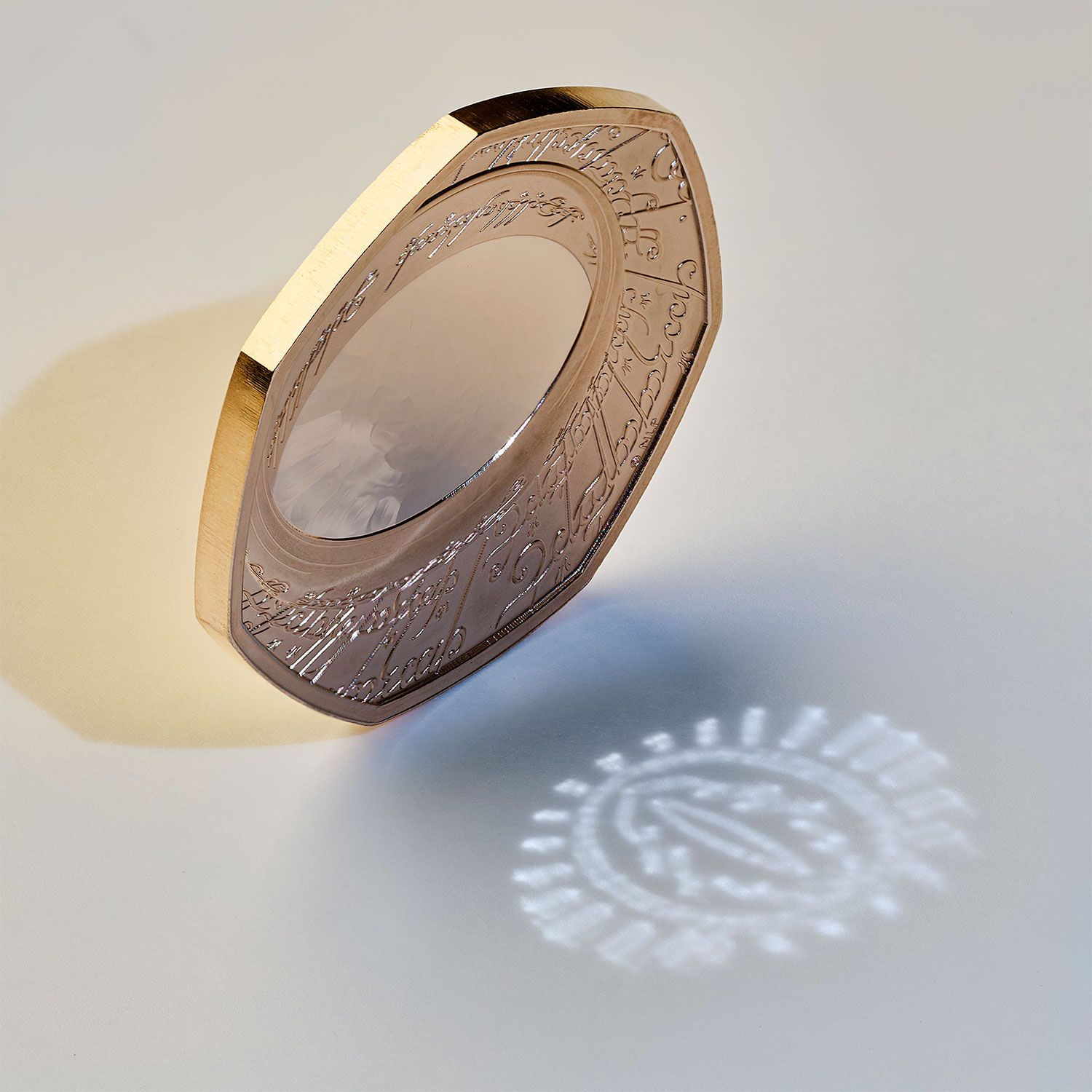
Caustic optics is the thing every collector reading this is going to want explained, so let’s explain it. The technique sculpts the surface of an object with an array of microscopic curves, placed so precisely that incoming light is bent into a coherent image on a flat surface beyond the object itself. Jewellery houses have used it. Decorative applications have used it. Nobody, until now, has used it on a coin you can buy from a national mint over the counter.
Pick this 50p up under a direct light source. Tilt it toward a wall. The Eye of Sauron resolves out of the negative space at the centre of the Ring, projected onto whatever surface you’ve aimed at. The first time it works, you laugh. The second time, you start showing it to people.
Docherty, the designer, has spoken with what sounds like genuine pride about why this technology met this subject and worked. The Eye of Sauron is depicted in flames on screen; the caustic effect lets it be depicted in light on the coin. The Ring itself supplies the negative space the projection needs, a frame that, in his words, “naturally houses that image in the ring.” He called it an “alignment of the stars,” and it is hard to argue with him. Of all the franchises the Mint could have chosen for its first caustic experiment, picking the one with a giant flaming eye at its heart was nearly too obvious to miss.
What deserves saying out loud is that this is a brave choice on a £15 commemorative. The caustic projection is the whole point, and you cannot experience it in a coin album, or behind a slab, or in any photograph that does it justice. The headline feature lives outside the coin. You have to handle the thing, in real light, in your real hands, for the feature to do what it does. That is either the most charming design decision the Royal Mint has made in years, or the kind of bet that quietly fades from collector conversation if the projection turns out to be temperamental. Right now, with the gold edition sold out and the silver moving briskly, the bet is paying off.

The Collection
Seven coins, three years. Two commemoratives for each of the three films, plus this initial One Ring launch piece. The Two Towers gets its anniversary treatment in 2027. The Return of the King follows in 2028. Subscribers can lock in the full set now, with each coin dispatched and charged on its individual release date, and a complimentary cardboard case to house the collection, which the Royal Mint has marketed, with what one can only describe as full commitment to the bit, under the slogan “Keep it Secret, Keep it Safe.”
The packaging features the map of Middle earth, with each coin’s housing designed to work either standalone or as a tile in the larger seven coin set when complete. It is the kind of detail that suggests the Mint actually wanted these to look right on a collector’s shelf, not just to sell out of a warehouse.
The collection follows the Royal Mint’s 2023 J.R.R. Tolkien £2, a quieter, more literary tribute that honoured the author fifty years after his death. Where that coin pointed inward to the books, this one points outward to the films that made Middle earth a global phenomenon. Different audience. Different generation, almost. But the same shelf, in the same collections, in roughly the same hands.

What It Means
Here is the honest assessment.
The caustic feature is real, it is novel, and on examples that work the way the Royal Mint says they work, it is genuinely delightful. The 2026 One Ring 50p is the first UK coin to do this, and that “first” carries weight regardless of where the franchise series goes from here. If the technology holds up over time, if a slabbed example still projects cleanly in 2036, this coin becomes the prototype piece for everything the Mint tries next with optical engineering. That is a future worth watching.
If the effect ages poorly, or if it never quite works on a meaningful fraction of the issue, then the coin becomes a fascinating experiment, the kind collectors will swap stories about for years. Either outcome is more interesting than another perfectly competent franchise 50p.
For the wider Lord of the Rings collection, demand was never going to be the question. Royal Mint licensed pop culture series have a reliable audience, and the Tolkien franchise sits at the top of the licence pile. The question is whether the remaining six coins will lean into the same risk taking spirit, or whether the One Ring 50p turns out to be the bold opener of a programme that gets steadily safer.
Right now, the One Ring is a fifty pence piece, the Eye of Sauron lives in a focused beam of light, and a hundred 22 carat gold proofs are already in the hands of collectors who moved faster than everyone else. The hobbits will have feelings about all of this. So, frankly, will the rest of us.