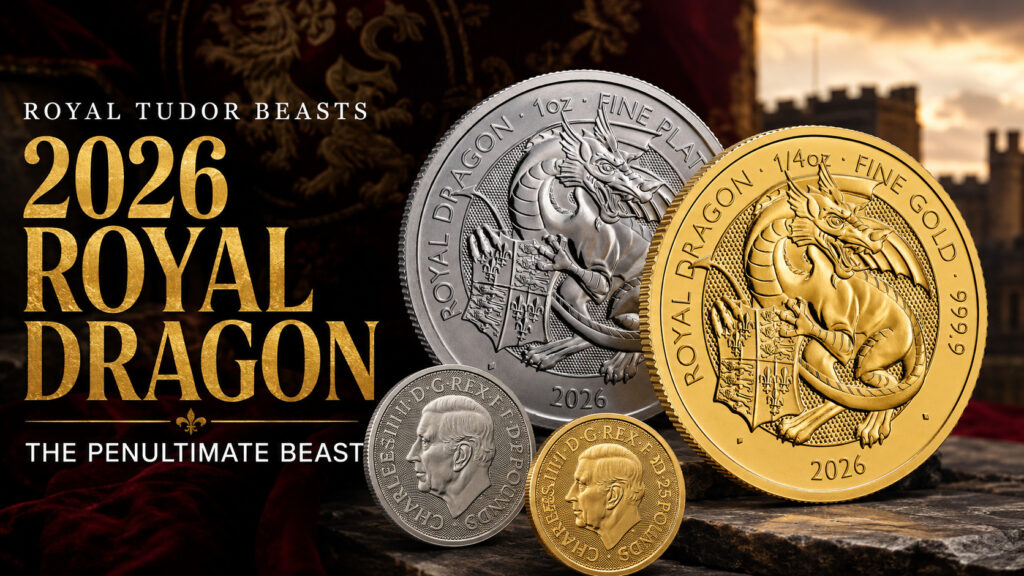
The Royal Mint has released the Royal Dragon, the ninth of ten bullion coins in its Royal Tudor Beasts collection and the penultimate beast in a series that has been unfolding for several years. It arrives across the full bullion range, gold, silver and platinum, led by a one ounce platinum striking listed from £1,610.65 and a one ounce gold from £3,625.25.
For collectors who have followed the series from the Seymour Panther onward, this is the release that brings the set within reach of completion. For everyone else, it is a clean, security enhanced bullion coin carrying one of the oldest and most recognisable symbols in British heraldry, and a sign that the Tudor story now has just one beast left to tell.
The beast

The collection draws on the ten stone guardians that line the Moat Bridge at Hampton Court Palace, commissioned by Henry VIII to mark his marriage to his third wife, Jane Seymour, and to reinforce the legitimacy of the Tudor line. Real beasts and mythical creatures alike, they represent the lineage of the king and his queen, and the Royal Mint has reproduced them in partnership with Historic Royal Palaces, the charity that cares for the site.
There are, in fact, two dragons among the Moat Bridge beasts, and it is worth keeping them straight. This ninth coin is the Royal Dragon, not the earlier Tudor Dragon issued previously in the same series. The Royal Dragon stands on the sinister side of the bridge and supports a shield bearing France modern and England quarterly, the quartered royal arms, marking it as a guardian of the crown’s authority rather than a badge of Welsh descent. Four legged and reptilian, it is the kind of figure the Tudor imagination built from rumour and report rather than observation, and all the more striking for it.

The design
The reverse is the work of David Lawrence, the illustrator and sculptor who has designed every coin in the collection. His Royal Dragon is a contemporary interpretation of the heraldic creature rather than a literal copy of the weathered stone, rendered against a background that evokes the grandeur of the Tudor period. That background does double duty: it carries a surface animation that functions as a built in security feature, an increasingly standard safeguard on the Mint’s bullion lines. The reverse carries the inscriptions ROYAL DRAGON, the metal and weight, the 999.5 fineness on the platinum striking, and the year 2026.
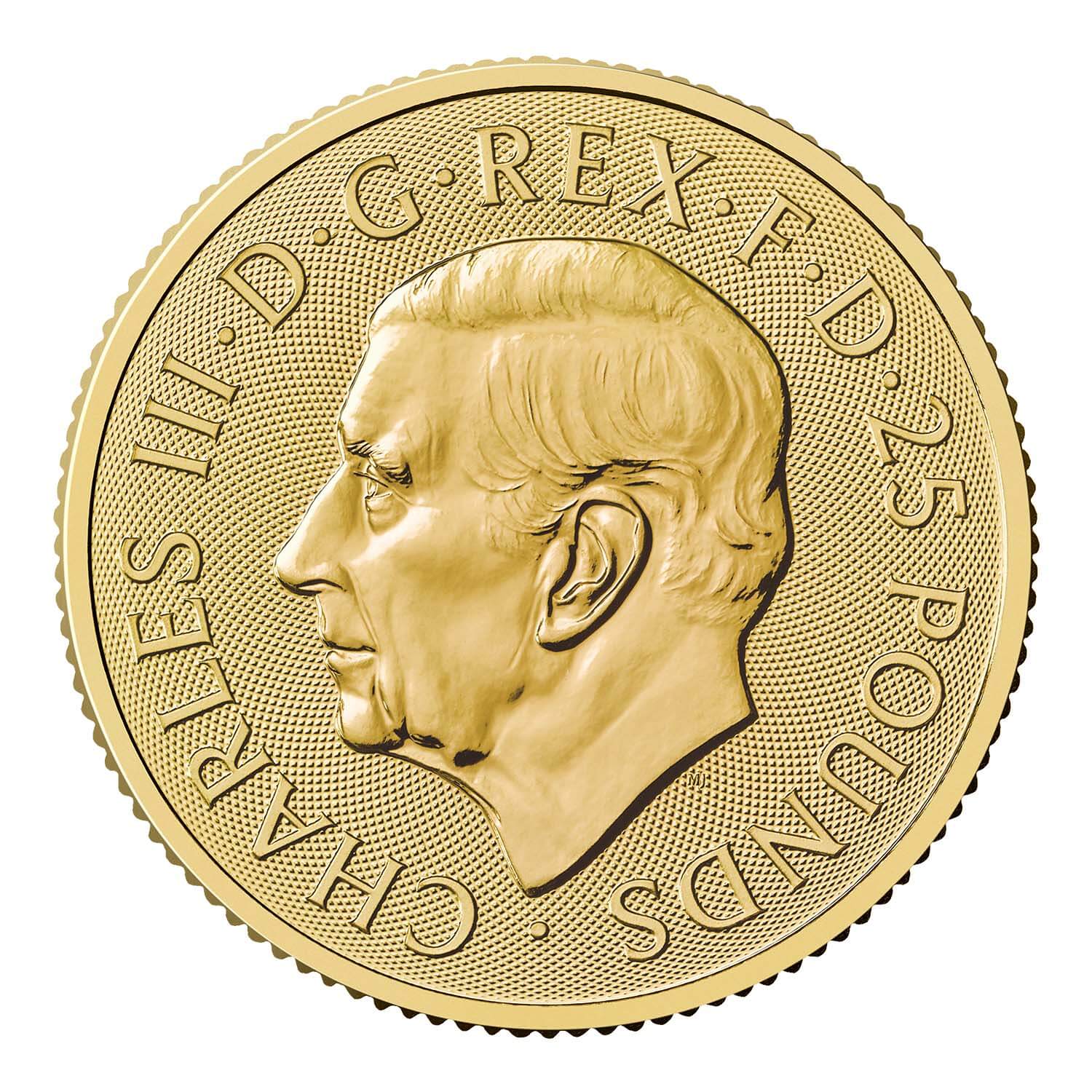
The obverse uses the official coinage portrait of King Charles III by Martin Jennings, inscribed CHARLES III · D · G · REX · F · D · 100 POUNDS. It is the same effigy now standard across the Mint’s range, and here it anchors the coin to the reigning monarch while the reverse looks back five centuries.
The range
The Royal Dragon is available across metals and sizes, at the listed launch prices below. As with all bullion, these figures move with the spot market; the premiums and weights, not the headline numbers, are the durable part.
- One ounce platinum (£100 denomination, 999.5 fine, 32.69mm, single coin capsule, product code RTRD26PC), from £1,610.65
- One ounce gold, from £3,625.25
- Quarter ounce gold, from £948.54
- Ten ounce silver, from £693.94
- Two ounce silver, from £138.21
Each is struck to bullion standard and packaged individually in a single coin capsule. The two ounce silver, at well under two hundred pounds, is the natural entry point for collectors who want the design without committing to the heavier metals; the platinum and the large silver pieces are aimed squarely at the set builders and the bullion buyers.

What happens next
Nine beasts down, one to go. The Royal Dragon’s arrival means the Royal Tudor Beasts collection is now a single release short of the full ten, and the pressure that builds at the end of any long heraldic series, the desire to complete the bridge, so to speak, is starting to tell. Collectors who have been assembling the set in one metal will be watching for the tenth and final beast.
For the set builder, the Royal Dragon is a necessary piece and a welcome one: a recognisable symbol, a competent security feature, and a design that holds its own against the eight that came before. For the bullion buyer with no interest in the Tudor dynasty at all, it is simply a well struck coin in the metal of your choice, backed by the Mint’s standard guarantees. Either way, the story carved into Hampton Court’s Moat Bridge is nearly told, and after this dragon, only one guardian remains to cross.