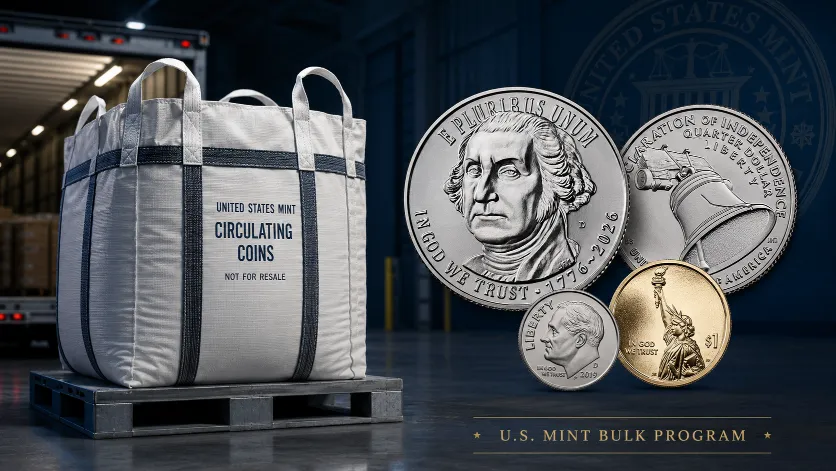
The United States Mint is recruiting. In a July 23 announcement, the Mint invited businesses, financial institutions, coin dealers, organizations and other interested purchasers to apply to its Circulating Bulk Purchase Program, the channel that supplies dimes, quarters, half dollars and dollar coins directly from the Mint rather than through the usual Federal Reserve distribution route.
What makes the announcement worth reading twice is the product list attached to it. Every 2026 Semiquincentennial circulating issue now sits among the program’s current and anticipated offerings, alongside the ongoing Native American and American Innovation dollar series. For anyone who has spent the first half of this year trying to find America’s 250th anniversary coinage in change, the Mint has just published a direct line to the source. The catch, as always, is the minimum order.
Which Coins Are Available Through the Bulk Program
The Semiquincentennial group covers the full 2026 circulating program: the Emerging Liberty dime, the Enduring Liberty half dollar, the President Donald J. Trump dollar, and all five Semiquincentennial quarters, honoring the Mayflower Compact, the Revolutionary War, the Declaration of Independence, the U.S. Constitution and the Gettysburg Address.
Two denominations are conspicuously absent. Pennies and nickels are not offered through the program, and the Mint gives no explanation for the exclusion in either the press release or its bulk program documentation.
The Mint is also explicit that the Semiquincentennial material is finite. These are anniversary issues tied to a designated production year, and the Mint states plainly that they will not continue beyond it. Whatever moves through this channel in 2026 is what there will be.
How Much Does a Bulk Bag of Coins Cost?
This is where the program separates the curious from the qualified. Purchases are made by the bulk bag, and a bulk bag is not a numismatic quantity. Buyers pay face value plus a processing fee that varies by denomination, and the disparity in that fee is one of the odder details in the program’s fine print.
Circulating Bulk Purchase Program minimums and pricing, 2026:
| Denomination | Coins per bag | Face value | Processing fee | Total per bag |
|---|---|---|---|---|
| Dime | 500,000 | $50,000 | 10% ($5,000) | $55,000 |
| Quarter | 200,000 | $50,000 | 3% ($1,500) | $51,500 |
| Half dollar | 100,000 | $50,000 | 10% ($5,000) | $55,000 |
| Dollar | 140,000 | $140,000 | 8.5% ($11,900) | $151,900 |
Quarters carry a three percent fee. Dimes and half dollars carry ten. A single bag, sitting on its steel pallet, weighs roughly 2,615 pounds all in. The Mint’s own documentation notes that these circulating bulk bags are also referred to as ballistic bags, which tells you most of what you need to know about how the material is handled.
Fulfillment reads like freight logistics rather than retail. Approved purchasers coordinate a pickup appointment, arrange a carrier, submit the truck for inspection and clear the driver in advance. Orders release only once the electronic funds transfer has landed, the shipment is staged and the clearances are confirmed.
Availability, Inventory and Sellouts
The Mint attaches an unusually candid set of caveats. Inventory depends on production requirements, circulating coin demand and available supply. Availability is not promised for any full calendar year. Products can sell out or disappear from the channel without notice.
That is a meaningful qualifier for a program now advertising anniversary coinage with a hard production window. Applying does not secure product, and being enrolled does not reserve it.
What the Bulk Program Means for Collectors
The program is open to individuals as well as businesses, and it is worth being clear about what that means in practice. A collector could technically buy a bag of Gettysburg Address quarters. It would cost $51,500, arrive by appointment on a pallet, and contain 200,000 coins.
The realistic audience is the trade: dealers, banks, credit unions, armored carriers and wholesalers with the capital and the loading dock to match. For everyone else, the significance is downstream. Bulk bags are where dealer rolls come from, and a wider pool of approved purchasers means more 2026 Semiquincentennial material broken down into original rolls and small lots on the retail market over the coming months. The Mint’s stated goal, that coins actually reach businesses, collectors, institutions and the public, depends entirely on that second step happening.
How to Apply to the Circulating Bulk Purchase Program
Applicants contact the Mint’s bulk program team at Numismatic_Bulk@usmint.treas.gov with “Circulating Bulk Purchase Program” in the subject line, supplying company name, address, contact name, phone number and email. Approved purchasers are then contacted to coordinate a pickup appointment, and full program terms are published on the Mint’s bulk program page.
The Bottom Line
The Circulating Bulk Purchase Program is not new, and the July announcement changes none of its mechanics. What it changes is who knows about it, at precisely the moment when the coinage flowing through it happens to be the most collected circulating issue in a generation. The Mint has spent 2026 producing anniversary coins that most Americans will never encounter in a cash drawer. This is the Mint pointing at the loading dock and saying the door is open, provided you arrive with a truck.