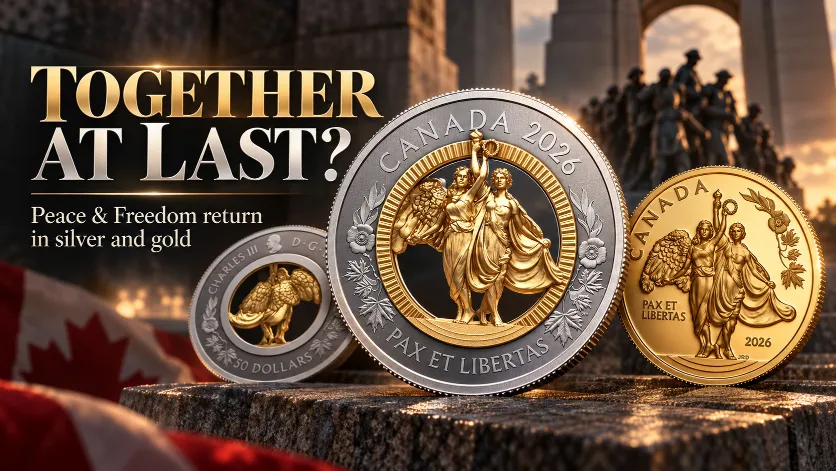
A century ago this January, British sculptor Vernon March learned that his model had beaten the field to become Canada’s National War Memorial. He would not live to see it finished. Now the Royal Canadian Mint has marked that 1926 selection with the Allegories of Peace and Freedom coin, issued in two very different forms: a 1,700 piece multidimensional fine silver coin with gold plated cast figures, and a 275 piece, 1 oz pure gold proof that translates the same design into engraving.
The pair continues the Mint’s Multidimensional Allegory line, and for the first time in that series the two figures who crown March’s arch, Peace and Freedom, appear together on one coin. For collectors who have followed the line since 2023, the 2026 release also brings the smallest silver mintage yet and a gold companion that the Mint describes as a new format for the series.
The figures above the arch
March’s winning design, which he called the Great Response of Canada, shows a column of bronze servicemen and women surging through a granite archway toward the peace that followed the First World War. According to The Canadian Encyclopedia, the competition drew 127 entries from across the British Empire, and two figures above the archway were meant to symbolize peace and freedom. Those two figures are the subject of this coin.
The story of how they were made is the part that gives the release its weight. The Mint notes that March was one of seven finalists invited in 1925 to submit scale models, that his proposal was chosen in January 1926, and that he died of pneumonia in 1930 with the statues still unfinished. Six of his siblings took up the work and completed the bronzes, including Peace and Freedom. The finished figures were cast in England and shown in London’s Hyde Park before being shipped to Canada, and King George VI and Queen Elizabeth dedicated the memorial in Ottawa’s Confederation Square on May 21, 1939. Less than four months later, Canada was at war again.
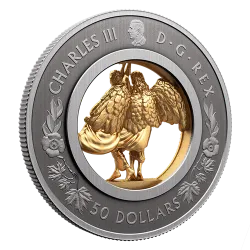
The Allegories of Peace and Freedom fine silver coin
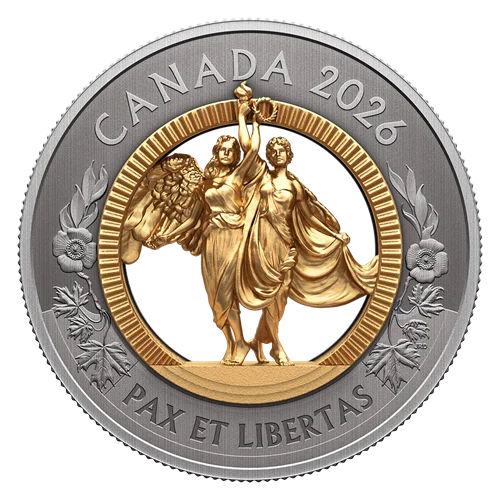
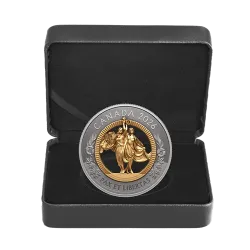
The silver edition is the fourth entry in the Multidimensional Allegory series, and like its predecessors it is built in two parts. An antiqued outer ring of 99.99% pure silver, weighing 104.63 g and measuring 65.25 mm across, carries the inscriptions CANADA 2026 and PAX ET LIBERTAS along with a wreath of poppies, laurel and maple leaves set against a stone motif borrowed from the memorial itself. Inside that ring sits an open core holding the cast figures, a separate 37.68 g of pure silver plated in yellow gold.
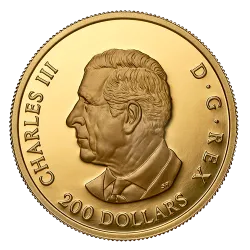
Because the core is open, the figures are sculpted in the round and read from either face. The Mint describes the result as a 360 degree view of the allegory, with the obverse continuing the reverse design around the effigy of King Charles III by Steven Rosati. Peace raises a laurel wreath; Freedom lifts a torch to light the way forward. The yellow gold plating against the antiqued silver rim is what separates the two figures from their setting, and it gives the piece the look of a small bronze under gallery light rather than a conventional coin.
The reverse is the work of Julien R. Duguay, a 3D artist and engraver at the Royal Canadian Mint. In the Mint’s copy, Duguay says his aim was to keep the spirit of the memorial while bringing his own interpretation to the classic figures, adding the wreath and stone details to tie the coin back to the site.
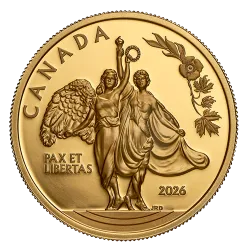
A gold edition, engraved rather than cast
The gold coin takes the opposite route to the same subject. Instead of a cast sculpture, it is a fully engraved 1 oz proof in 99.99% pure gold, 30 mm in diameter, with Peace and Freedom standing side by side beneath CANADA and above PAX ET LIBERTAS and the 2026 date, flanked by a bough of poppies, laurel and maple leaves.
The Mint is candid that the change of medium was more than a change of metal: reducing three dimensional figures to a 30 mm relief required adjustments to the composition, and the extra time the process took is one of the points it makes about the coin. That candour is worth reading as a statement of intent. The silver coin is a sculpture that happens to be legal tender. The gold coin is a portrait, closer in spirit to a medal, and the engraving has to do in relief what the cast does in space.
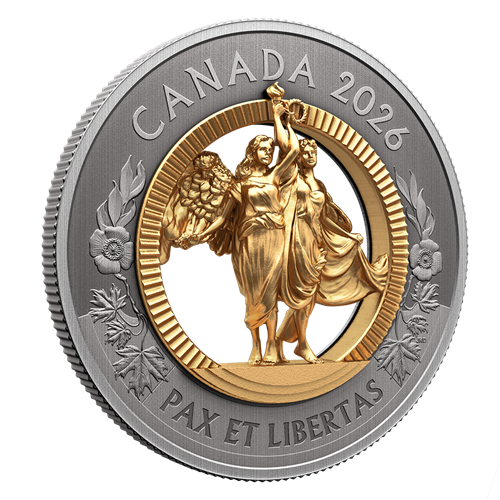
Editions at a glance
| Edition | Composition | Weight | Diameter | Finish | Face value | Mintage | Issue price |
|---|---|---|---|---|---|---|---|
| Multidimensional fine silver | 99.99% silver with gold plated cast | 104.63 g ring; 37.68 g cast | 65.25 mm | Antique | $50 | 1,700 | $1,239.95 CAD |
| 1 oz pure gold | 99.99% gold | 31.16 g | 30 mm | Proof | $200 | 275 | $8,259.95 CAD |
Both coins carry serrated edges and ship with a serialized certificate. The silver coin comes in a black Mint branded clamshell with a black beauty box; the gold coin is housed in a black lacquered wood case with a black beauty box.
A shorter run, and a series that sells out
Mintage is where the silver edition becomes a collector story as much as a commemorative one. The line began with the 2023 Allegory of Peace, which went on to win the Coin of the Year award in the Most Inspirational category, followed by the 2024 Allegory of Freedom and the 2025 Allegories of Justice and Truth, which was limited to 1,800 coins. The Mint states that every earlier Multidimensional Allegory coin has sold out, and the 2026 silver run of 1,700 is lower than last year’s.
The 2026 coin also closes a loop that the series opened. Peace and Freedom each had a year of their own in 2023 and 2024; this is the first time the Mint has placed them together, and it has done so with the monument that pairs them in bronze. For anyone who owns the first two coins, the 2026 issue reads less like a new subject than a reunion.
The gold edition sits in a different bracket entirely. At 275 pieces worldwide it is roughly one sixth of the silver mintage, and its issue price puts it well beyond the reach of most series collectors. Its role is to extend the allegory into a second format rather than to complete a set.
Conclusion
The Allegories of Peace and Freedom coin succeeds because the Mint has picked a subject with a genuine story behind it. A sculptor won a competition in 1926, died before his figures were cast, and left six of his siblings to finish the monument that a king would dedicate on the eve of another war. Cast in silver and engraved in gold a hundred years later, Peace and Freedom arrive as the most complete statement yet of what the Multidimensional Allegory series set out to do, and with 1,700 silver coins and 275 in gold, the window to own one is unlikely to stay open long.
Frequently asked questions
What is the Allegories of Peace and Freedom coin? The Allegories of Peace and Freedom coin is a 2026 Royal Canadian Mint issue honoring the Peace and Freedom figures atop Canada’s National War Memorial in Ottawa. It marks 100 years since British sculptor Vernon March’s design for the memorial was selected in January 1926. The coin is issued as a multidimensional fine silver coin and as a 1 oz pure gold proof.
How many of each coin were made? The fine silver edition has a mintage of 1,700 coins worldwide, and the 1 oz pure gold edition has a mintage of 275. The silver mintage is lower than the 1,800 coins issued for the 2025 Allegories of Justice and Truth.
How much do the coins cost? The fine silver coin has an issue price of $1,239.95 CAD and the 1 oz pure gold coin has an issue price of $8,259.95 CAD. Both are sold through the Royal Canadian Mint, and the Mint’s product pages list shipping to Canada and the United States only.
Is the silver coin solid silver, or is it plated? Both parts of the silver coin are 99.99% pure silver. The outer ring weighs 104.63 g and the cast figures in the open core weigh 37.68 g; only the cast figures are plated in yellow gold, while the ring has an antique finish.
What does multidimensional mean on this coin? The Peace and Freedom figures are cast as a separate sculpture set inside an open core in the outer ring, so they can be seen in the round from either side of the coin. The Mint describes this as a 360 degree view of the design, with the obverse continuing the reverse around the effigy of King Charles III.
Is the gold coin the same design as the silver coin? It shows the same subject, Peace and Freedom side by side with poppies, laurel and maple leaves, but it is engraved rather than cast. The Mint says adapting the three dimensional figures to a 30 mm proof coin required adjustments to the composition and extra time to complete.
Is this the first coin in the Multidimensional Allegory series? No. It is the fourth, following the 2023 Allegory of Peace, the 2024 Allegory of Freedom and the 2025 Allegories of Justice and Truth. It is the first coin in the series to show Peace and Freedom together, and the Mint states that all earlier coins in the series have sold out.
Who designed the Allegories of Peace and Freedom coin? The reverse was designed by Julien R. Duguay, a 3D artist and engraver at the Royal Canadian Mint, working from the original figures by Vernon March. The obverse carries the effigy of King Charles III by Canadian artist Steven Rosati.