
On November 18, 2025, in Kingston, Jamaica, a goalless draw was enough. Curaçao, an autonomous Caribbean territory of roughly 156,000 people inside the Kingdom of the Netherlands, became the smallest nation by population ever to qualify for a FIFA World Cup. The Royal Dutch Mint and the Central Bank of Curaçao have now marked the moment with a coloured silver 5 guilder, struck in prooflike quality at a strict mintage of 4,500 pieces.
The coin is a small object carrying a large story. It is also the kind of overseas-territory commemorative that does not usually attract international collector attention, until the news it commemorates rewrites a sporting record that had stood since Iceland’s qualification for Russia 2018.
The team and the moment
Curaçao’s national side is known on the island as The Blue Wave, Selekshon Nashional Di Futbòl in Papiamentu, the name that runs around the rim of the new coin. Under veteran Dutch manager Dick Advocaat, the team topped Concacaf Group B undefeated, finishing on twelve points and taking one of three direct Caribbean and Central American berths for the 2026 World Cup alongside Panama and Haiti.
The qualification itself was won without Advocaat on the bench. He had returned to the Netherlands days earlier for family reasons; his daughter’s illness would lead him to step down entirely in early 2026, return, step away again, and ultimately remain in the story as the coach who took the smallest nation in World Cup history to a tournament he is now set to attend at the age of seventy-eight, the oldest manager ever to lead a side at a World Cup.
Iceland, the previous record-holder, had roughly 350,000 people when it reached the 2018 tournament. Curaçao has fewer than half as many. The squad that clinched qualification drew heavily on the Dutch diaspora, players from clubs in England’s third tier, the Turkish second division, and the Saudi Pro League, held together by a coach whose CV includes the Netherlands at three World Cups and South Korea in 2006.

The coin
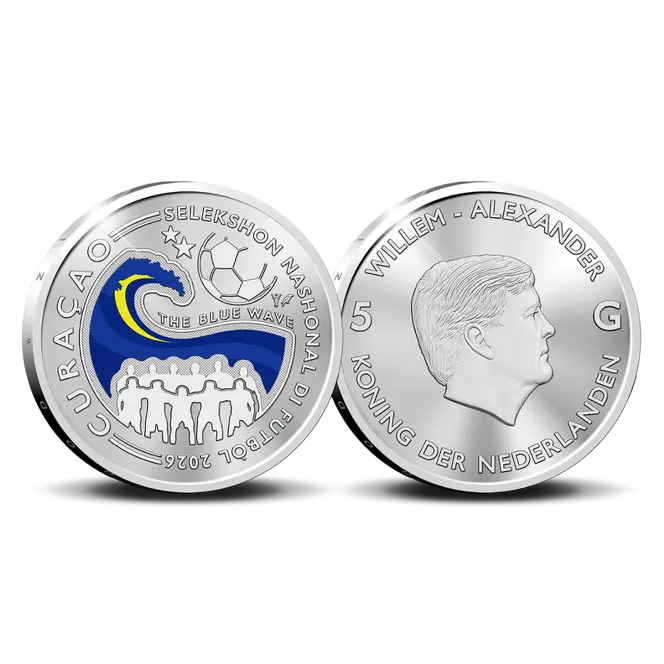
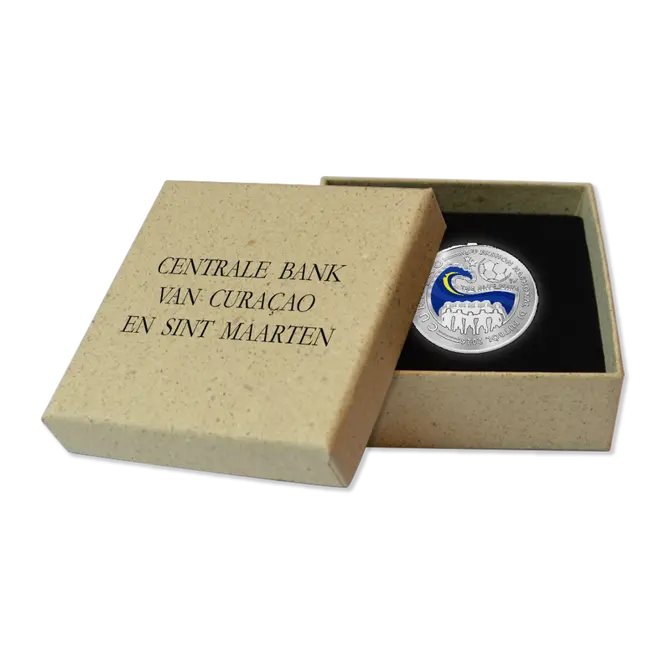
The obverse is given over entirely to The Blue Wave. The silhouette of the team is set across the lower field, and behind it rises a coloured blue wave, a direct visual rendering of the nickname and of what the island looked like in the weeks before qualification, as flags, façades, and cars across Curaçao went blue in anticipation. A football and two stars, the same stars that appear on the Curaçaoan flag, complete the design. Around the rim runs the inscription CURAÇAO – SELEKSHON NASHIONAL DI FUTBÒL 2026.
The reverse carries the en-profil portrait of King Willem-Alexander, the head of state for the Kingdom of the Netherlands, alongside the denomination, 5 G.
The piece is struck in sterling silver, .925 fine, 11.9 grams, 29 mm, to a prooflike finish, with the traditional Dutch edge inscription GOD ZIJ MET ONS (“God be with us”). Mintage is capped at 4,500. Issue price is €79.95 through the Royal Dutch Mint.
It is worth pausing on the denomination. The 5 guilder is no longer a circulating coin in Curaçao: on March 31, 2025, the Netherlands Antillean guilder was replaced by the new Caribbean guilder (XCG), shared with Sint Maarten and pegged to the US dollar. The legacy ANG denomination here is therefore a commemorative rather than monetary unit, a deliberate continuation of an issuing tradition for an island whose currency has, in the same calendar year, changed underneath it.
What collectors are actually buying
The numismatic case is straightforward. A mintage of 4,500 is low for any World Cup-related issue, and lower still for any sterling silver coloured coin from a Royal Dutch Mint program. World Cup commemoratives from larger countries typically run into the tens or hundreds of thousands. Curaçao’s first-ever World Cup coin runs to a number smaller than the average crowd at a Curaçaoan league match.
The broader case is less straightforward and more interesting. World Cup commemoratives from qualifying nations are a well-defined collecting niche, and the historical pattern is consistent: the coins from a nation’s first World Cup are the ones that hold and gain value, particularly when struck in precious metal at modest mintages. Curaçao’s first World Cup will only ever happen once.
Whether the team’s actual tournament performance, opening in Group E against Germany on June 14, then Ecuador, then Ivory Coast, affects secondary demand will be visible quickly enough. What is already true is that the issue is one of the few tangible, struck commemorations of a sporting record that may stand for a long time.

What happens next
Curaçao’s World Cup begins on June 14, 2026, against Germany. By then, the 4,500 prooflike examples of this coin will either still be available from the Royal Dutch Mint or they won’t. If history is any guide for first-time qualifiers issuing precious-metal commemoratives at small mintages, the answer will tilt toward the latter.
The bigger story this coin commemorates is harder to pin down in metal. A country of 156,000 people, a 78-year-old coach, a Dutch-trained squad drawn from the diaspora, and a goalless draw in Kingston, the kind of result that reshapes a record book and, on a small Caribbean island, turns straight into a coin within six months. The smallest nation ever to reach a World Cup, on the eve of a tournament hosted by the three largest in its confederation, has now done what every country that reaches this stage eventually does: minted the moment.