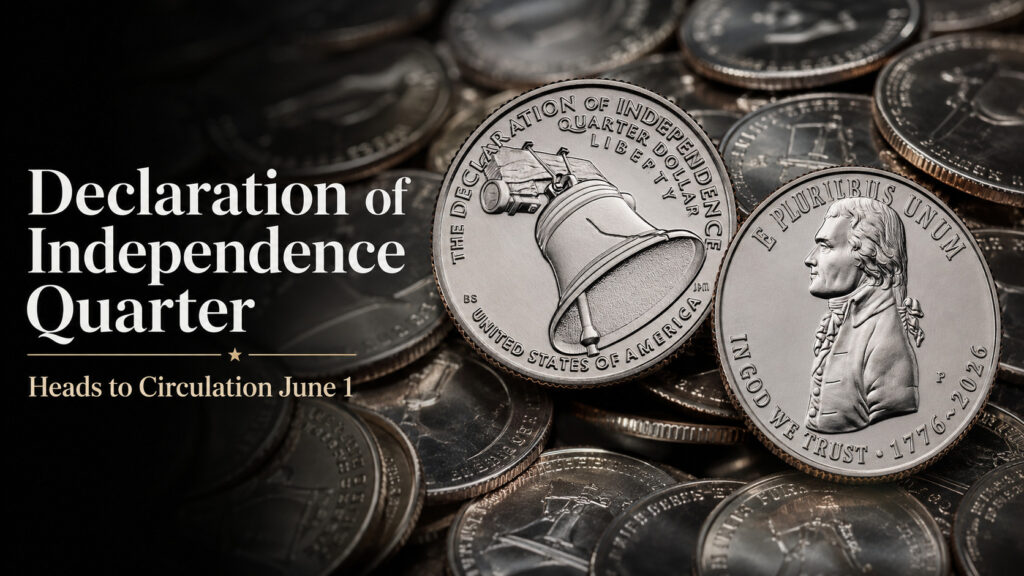
The U.S. Mint will begin shipping the third of its five 2026 Semiquincentennial quarters to the Federal Reserve on June 1, putting the Declaration of Independence Quarter into the hands of commercial banks, and from there into change drawers and coin folders, within days. The Mint announced the rollout on May 25.
For collectors tracking the one year only redesign program authorized by the Circulating Collectible Coin Redesign Act of 2020, this is the entry that links a Founding era image directly to a Founding era engraver. The Jefferson portrait on the obverse isn’t a new interpretation. It is adapted from an 1801 Indian Peace medal struck during Jefferson’s own presidency.

The Coin
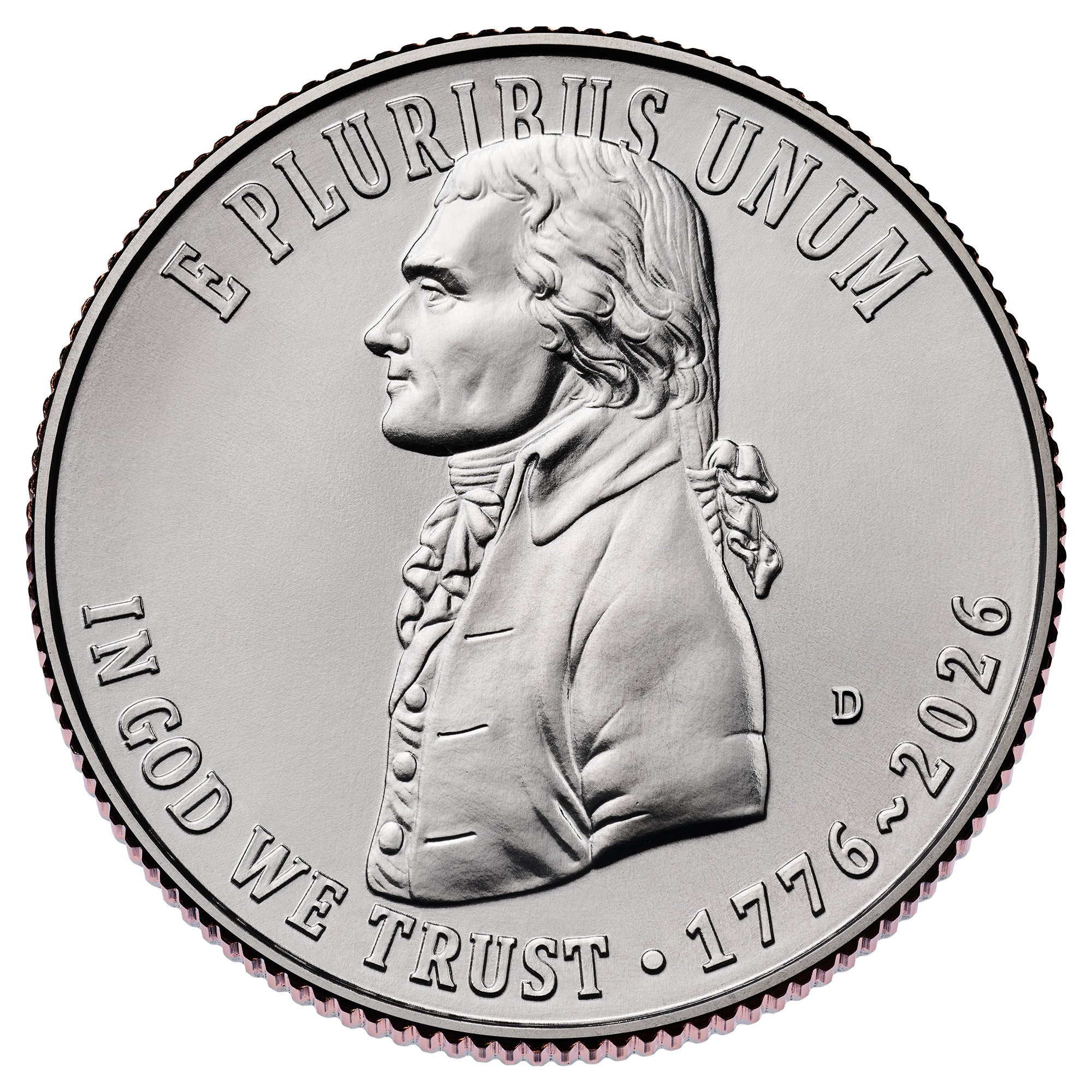
The obverse features Thomas Jefferson, author of the Declaration and the nation’s third president, in a profile drawn from the large size Indian Peace medal originally designed by the first U.S. Mint chief engraver, Robert Scot, with assistant engraver John Reich. The accompanying inscriptions are “E PLURIBUS UNUM,” “IN GOD WE TRUST,” and the dual date “1776 ~ 2026” that runs across the entire Semiquincentennial program.
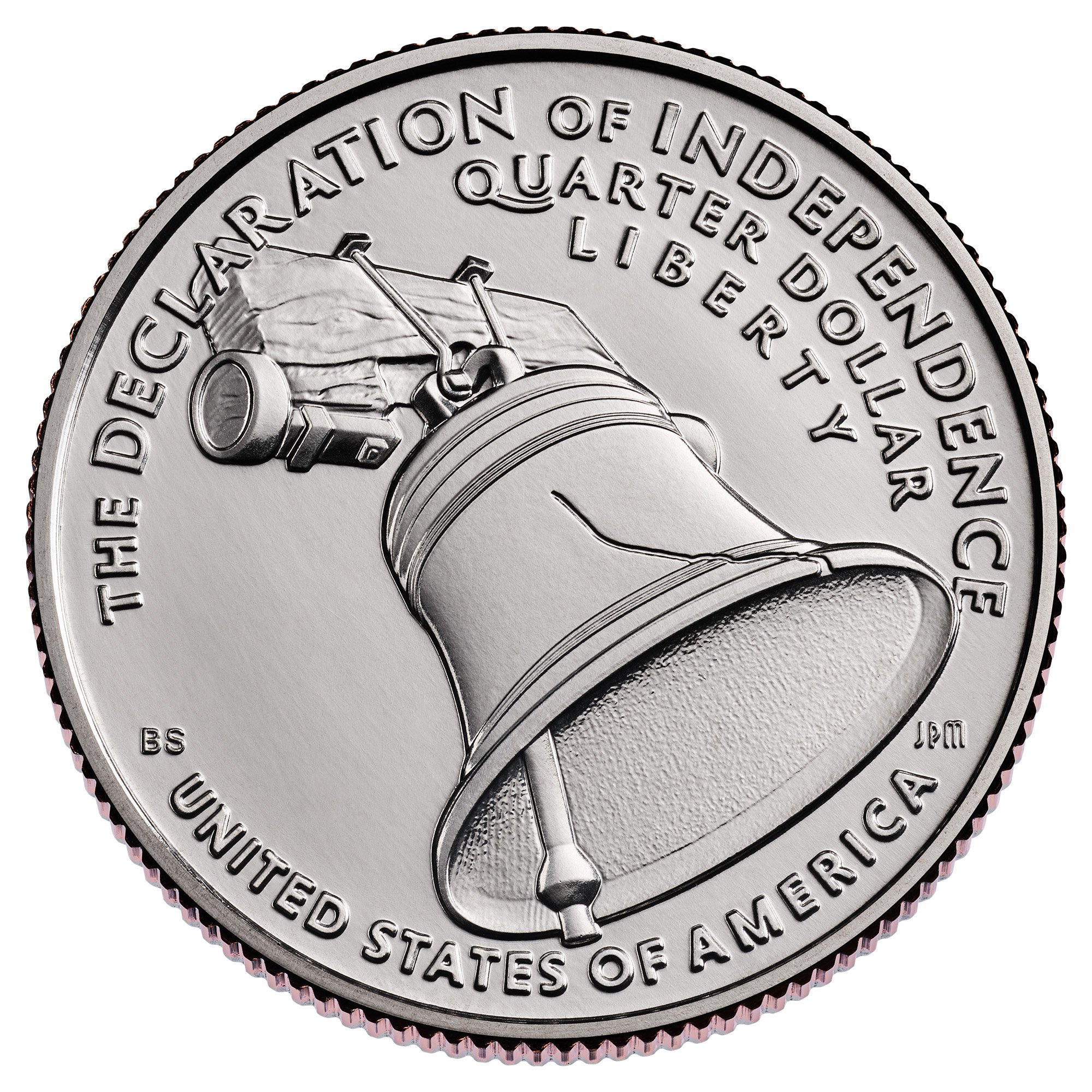
The reverse, the work of Artistic Infusion Program designer Ben Sowards and digitally sculpted by U.S. Mint Medallic Artist John P. McGraw, depicts the Liberty Bell mid ring. The Bell’s familiar crack is included, a deliberate choice, with the Mint framing the visible fracture as an echo of the fragility of the young nation at its founding. The reverse inscriptions are “THE DECLARATION OF INDEPENDENCE,” “QUARTER DOLLAR,” “LIBERTY,” and “UNITED STATES OF AMERICA.”
The Source Image
Sourcing the Jefferson obverse from Scot and Reich’s 1801 medal is the kind of editorial decision that rewards a second look. The Indian Peace medal program was already a Jefferson administration project when Scot, Britain trained, then late in his career as the Mint’s founding chief engraver, sat down to render the new president. Reich, his assistant, would later go on to redesign virtually the entire American silver and gold coinage between 1807 and 1817. The portrait that ends up on the 2026 quarter is, in other words, drawn from one of the foundational acts of American medallic art, executed by two of the men who built the early Mint.
The Mint’s quarter program has reached back into its own archives before. What is unusual here is the specificity, not a generic period portrait, but a documented working medal from the subject’s own presidency.

The Reverse and Its Hedge
The Liberty Bell reverse is built around a question the Mint addresses directly: did it ring in July 1776? Legend says yes; the historical record is less generous. The Bell had often been rung to summon Philadelphia residents for announcements and proclamations, but whether it sounded for the first public reading of the Declaration on July 8, or for the document’s adoption on July 4, remains an open question among historians.
Sowards’s design sidesteps the question by depicting the Bell ringing in principle, not in a documented moment. The crack does the heavier lifting. By treating the fracture as symbolic rather than incidental, the Mint folds two centuries of the Bell’s iconography into the design: it is at once the announcement bell of revolutionary Philadelphia and the damaged relic that became a national emblem in its own right.
McGraw’s digital sculpting follows the same disciplined approach he brought to the 2023 Jovita Idar quarter, clean modeling, controlled relief, the kind of execution that reads on a circulating planchet without losing detail under wear.
What It Joins, and What Comes Next
The Declaration of Independence Quarter is the third in the five coin Semiquincentennial series. It follows the Mayflower Compact and Revolutionary War quarters, which began shipping on January 5. Still ahead are the U.S. Constitution and Gettysburg Address quarters, completing a five part arc that the Mint has structured around documents and moments rather than around states or themes, a deliberate break from the geographic logic of the State Quarters, the America the Beautiful series, and the American Women Quarters that immediately preceded it.
For one year, every Semiquincentennial quarter, dime, nickel, and collectible cent and half dollar carries the “1776 ~ 2026” dual date. After 2026, the standard reverse returns. The five quarter designs will not be struck again.
The arithmetic for collectors is straightforward enough: five designs, one year, finite production, and a Federal Reserve pipeline that ensures genuine circulation rather than only collector channel availability. The historical arithmetic is more interesting. By drawing the Jefferson portrait directly from a Scot–Reich medal of 1801, the Mint has made the Declaration of Independence Quarter not just a commemorative of an idea but a small piece of the Mint’s own continuity with its founding era. Two centuries on, the institution that struck the Indian Peace medals is the same institution shipping these quarters to the Federal Reserve on June 1.
That is the kind of throughline a 250th anniversary program is supposed to produce. This one delivers it on a quarter.