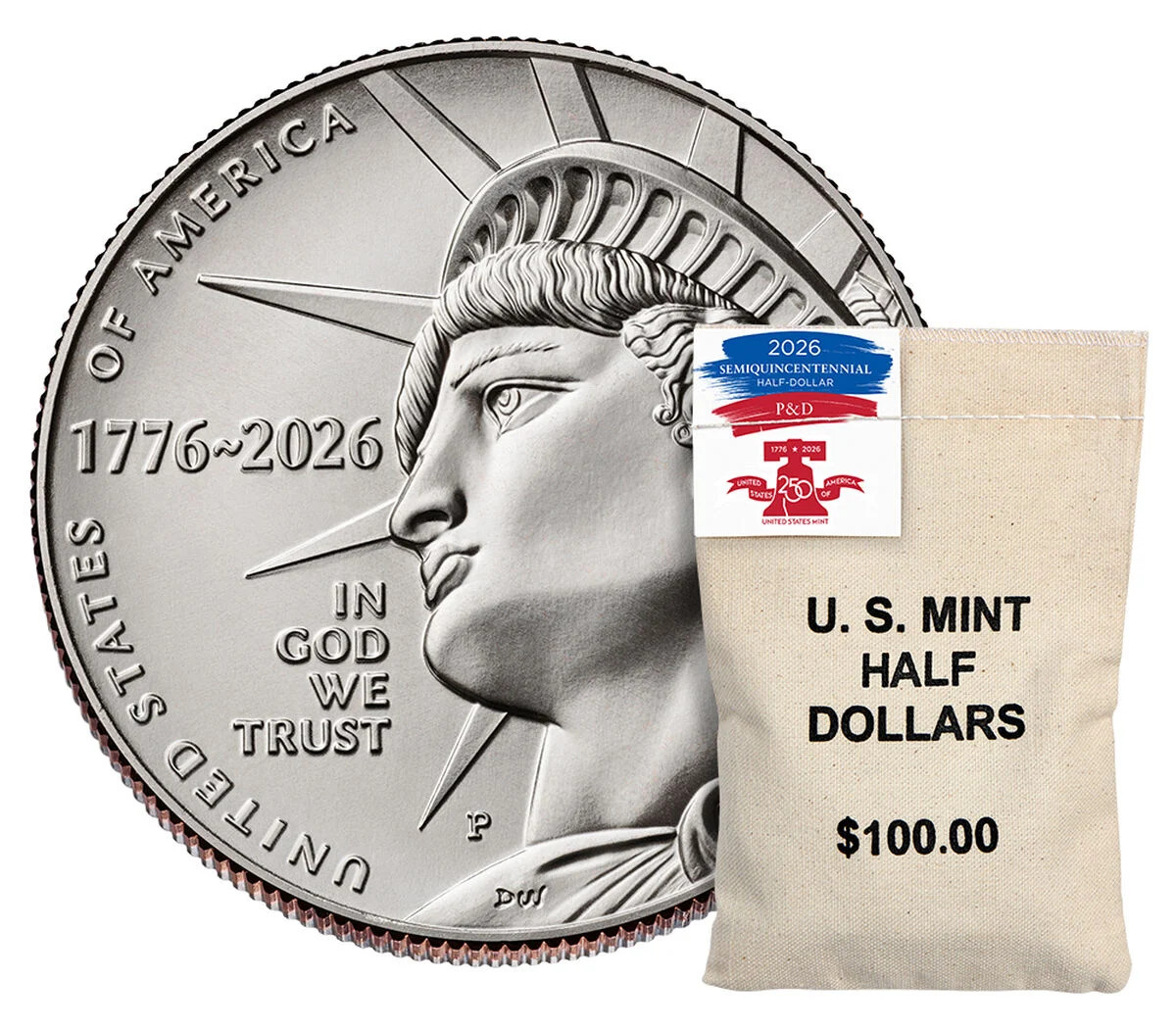
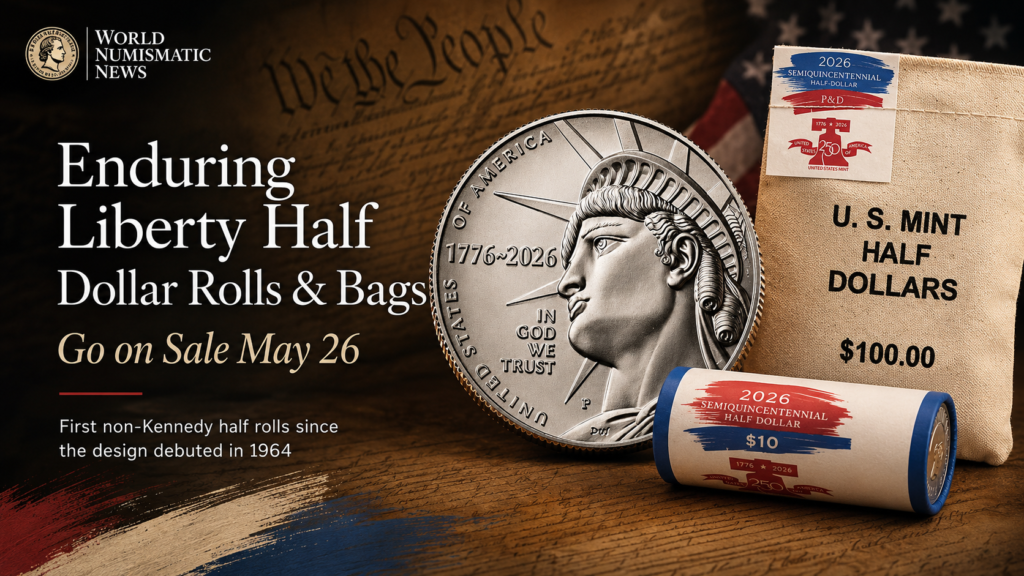
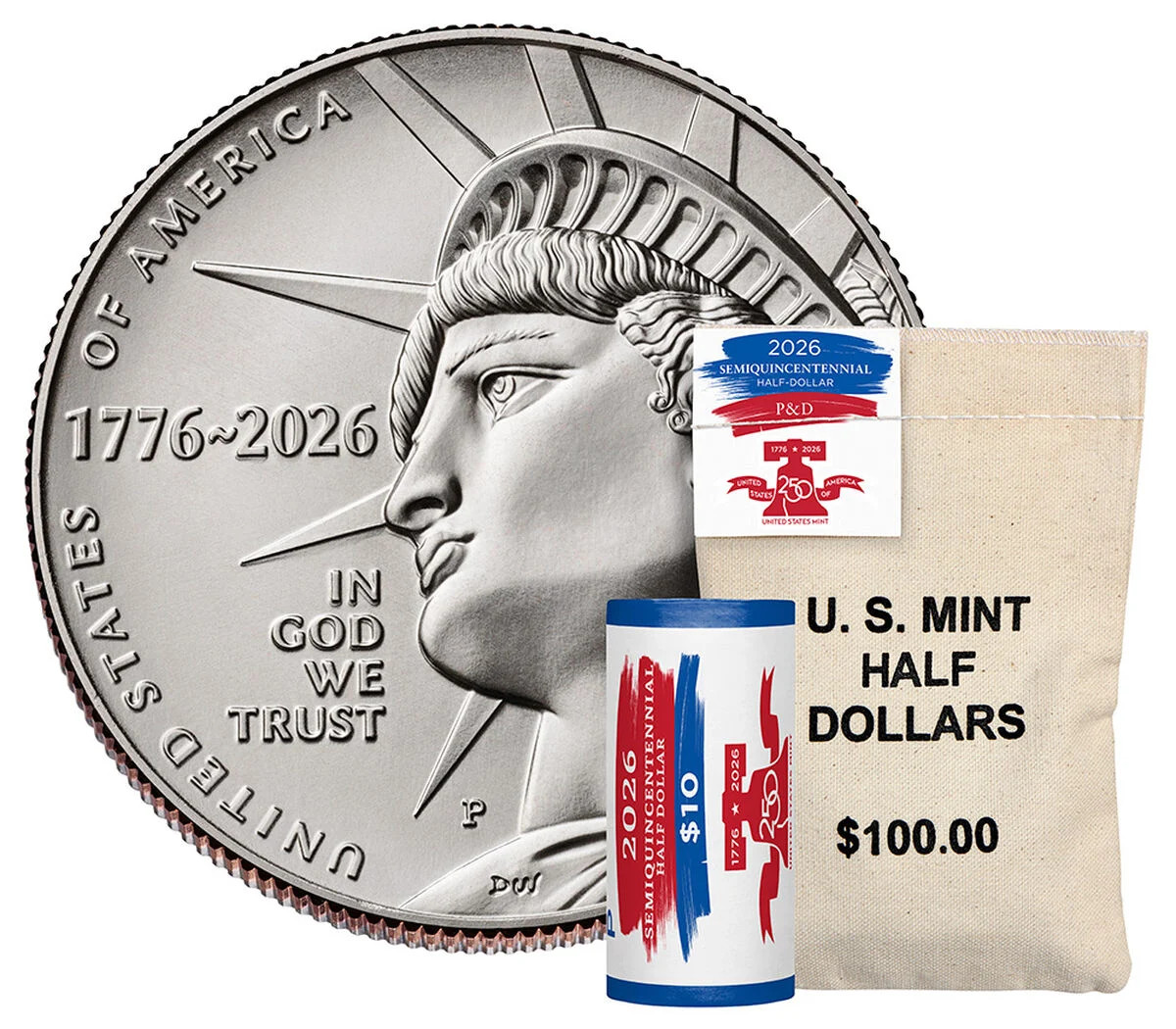
The U.S. Mint will open sales of the 2026 Enduring Liberty Half Dollar two roll sets and bags at noon Eastern on May 26, the agency confirmed in a May 20 announcement. The two roll set (item 26QRA) is priced at $60.00 and contains forty circulating quality coins, twenty struck in Philadelphia, twenty in Denver. The 200 coin bag (item 26QBB) is priced at $180.00 and carries a household order limit of two.
For collectors, the numbers are routine product mechanics. The release itself is not. This is the first time the U.S. Mint has offered circulating design half dollar rolls without John F. Kennedy on the obverse since the Kennedy portrait debuted in 1964, sixty two years of an effectively single design half dollar program, broken for one year by the Semiquincentennial redesign.
The Coin
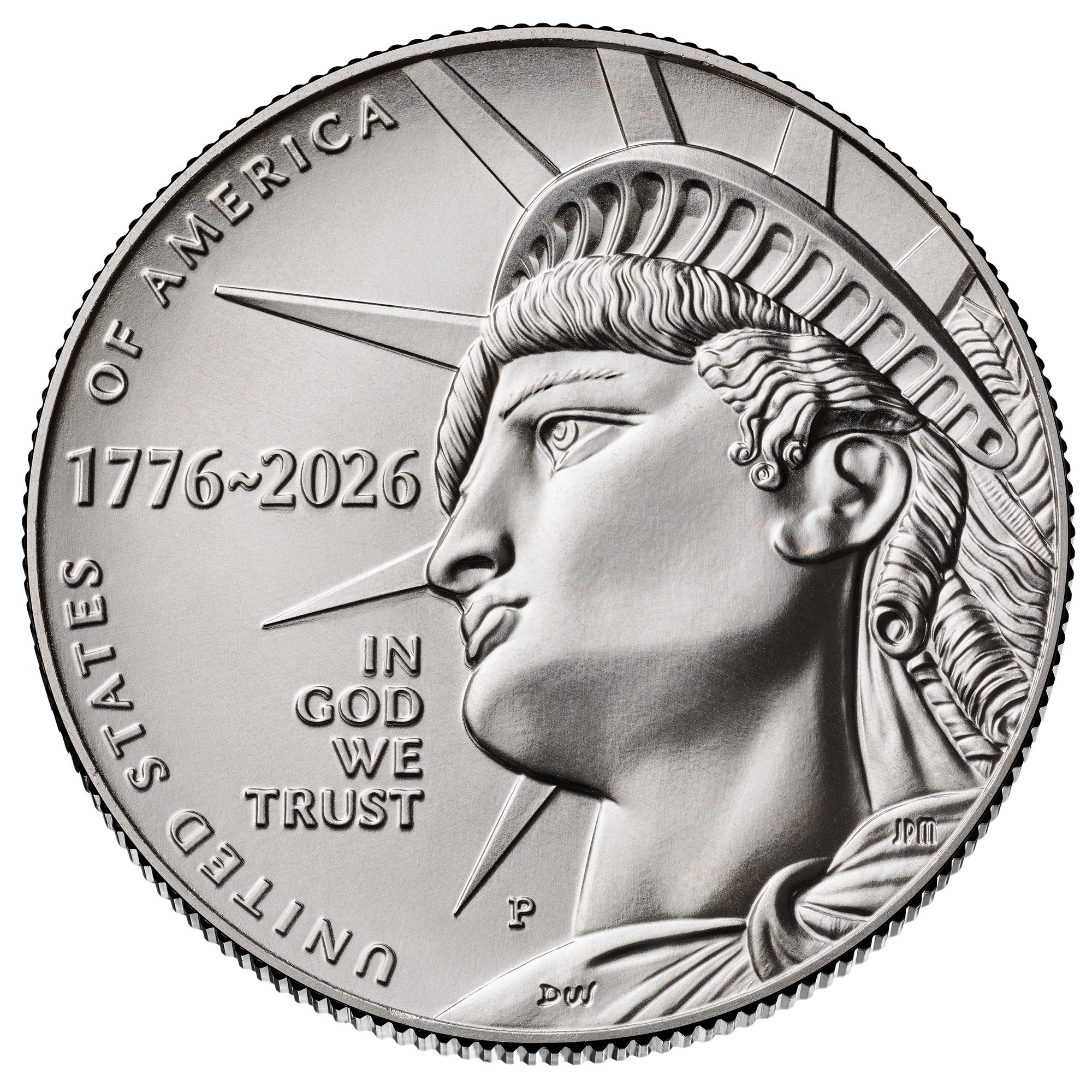
The Enduring Liberty Half Dollar’s obverse is a close up of the Statue of Liberty, her gaze directed outward. The design is the work of Artistic Infusion Program designer Donna Weaver, herself a former U.S. Mint sculptor engraver, and was sculpted by Medallic Artist John P. McGraw. The obverse inscriptions are “UNITED STATES OF AMERICA,” “IN GOD WE TRUST,” and the dual date “1776 ~ 2026” that runs across the entire 2026 program.
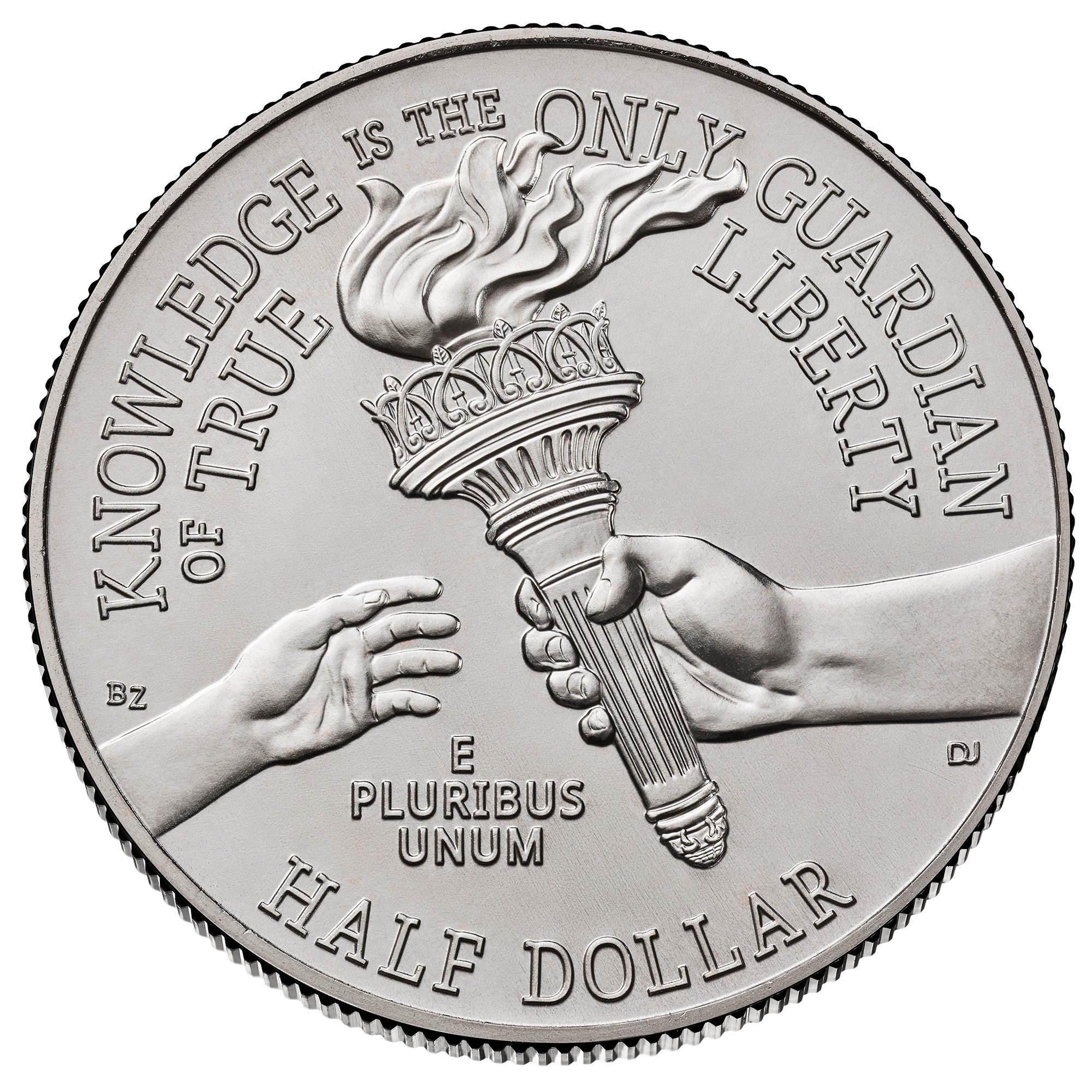
The reverse, by AIP designer Beth Zaiken and sculpted by Medallic Artist Darla Jackson, depicts Liberty handing her torch to a new generation, the flame trailing behind it. The reverse inscriptions are “E PLURIBUS UNUM,” “HALF DOLLAR,” and an unusually long motto for a circulating half: “KNOWLEDGE IS THE ONLY GUARDIAN OF TRUE LIBERTY.” The line is drawn from Thomas Jefferson, who used it in an 1820 letter and made it the conceptual foundation of the University of Virginia.
What Makes This Release Unusual
For sixty two years, every circulating design U.S. half dollar struck has carried Gilroy Roberts’s left facing portrait of Kennedy on the obverse and Frank Gasparro’s heraldic eagle on the reverse, both adapted, originally, from the 1961 Kennedy inaugural medal. The design entered circulation in March 1964, four months after the assassination, and has been the half dollar ever since. It outlasted the Franklin half dollar that it replaced. It outlasted the 90% silver composition it was first struck in. It outlasted every other circulating portrait that was on a U.S. coin in 1964.
The Enduring Liberty Half Dollar does not replace it. After 2026, Kennedy returns. But for one year, the half dollar program is doing something it has not done in a working collector’s lifetime, circulating a different design, with its own designer credits, its own iconography, and its own motto.
The Mint has chosen its Liberty carefully. Weaver’s obverse is not allegorical Liberty, not the seated figure of the early Republic, not the walking Liberty of 1916–47. It is Bartholdi’s Statue, the most internationally legible American symbol of the post 1886 era. The reverse, by contrast, returns to allegory: Liberty as a figure, the torch as the object passed, the flame as the implication of continuity. Read together, the two sides do the rhetorical work the Semiquincentennial program is designed to do, anchor the moment in a familiar monument while framing it as a relay rather than a reenactment.
The Product Mechanics
The Mint is offering two formats. The two roll set at $60.00 contains one twenty coin Philadelphia roll and one twenty coin Denver roll, packaged separately. The 200 coin bag at $180.00 mixes P mint and D mint coins. Coins in both products are circulating quality strikes that have not been placed into circulation through the Federal Reserve channel.
The household order limit on the bag is two, which the Mint typically lifts twenty four hours after launch unless demand requires otherwise. The two roll set has no posted household limit as of the announcement.
Quarter one production figures put the broader context in scale. The Mint struck 29.4 million Enduring Liberty halves across Philadelphia and Denver through the end of March, Denver 18.1 million, Philadelphia 11.3 million, per Mint production data compiled by CoinNews. January alone produced 13.8 million. These are the working circulation numbers; the collector roll and bag products are drawn from the same strike but routed through a separate distribution path.
What the Date Means
May 26 is, for the half dollar, the first chance for collectors to acquire packaged Enduring Liberty coins directly from the Mint at face adjacent pricing, twenty cents per coin over face on the rolls, forty cents over face on the bag. The same coins have been circulating since the Federal Reserve received its first shipments on January 5, but circulation pickups have been thin, in keeping with how rarely half dollars actually circulate in 2026.
For collectors building the full Semiquincentennial set across denominations, the Enduring Liberty rolls and bags are the half dollar’s only meaningful circulation quality distribution channel.
A one year break in a sixty two year design lineage is, in numismatic terms, an event. The Kennedy half dollar will resume in 2027, and the long arc of the design will continue. But the 2026 Enduring Liberty Half Dollar is the only circulating U.S. half dollar most living collectors have ever held that doesn’t carry the Kennedy portrait. That alone is a reason for the rolls and bags to find buyers on May 26.
What the Mint has produced is not a replacement. It is a deliberate single year departure, the kind of design choice that, once the Kennedy portrait returns in 2027, will look in hindsight like exactly what a 250th anniversary is supposed to mark.