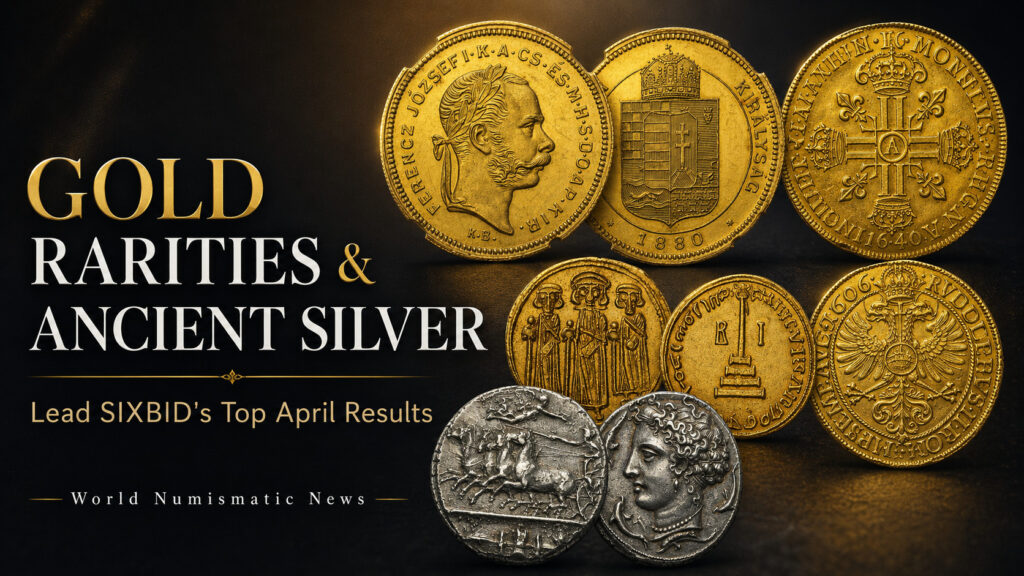
Read from the bottom up, SIXBID’s Top Coins board for April is less a price list than a climb through five centuries and four currencies, from a Georgian gold showpiece at €62 000 to a Habsburg rarity at €500 000. Each coin earned its place not by the weight of its metal but by the story pressed into it. Here they are, cheapest to dearest, with the franc, dollar and yen results converted to euros at April’s rates of roughly CHF 0.92, $1.17 and ¥185 to the euro the 2026 averages ran near 0.918 Swiss francs, 1.17 US dollars and 185 yen per eurofor the sake of the ranking.
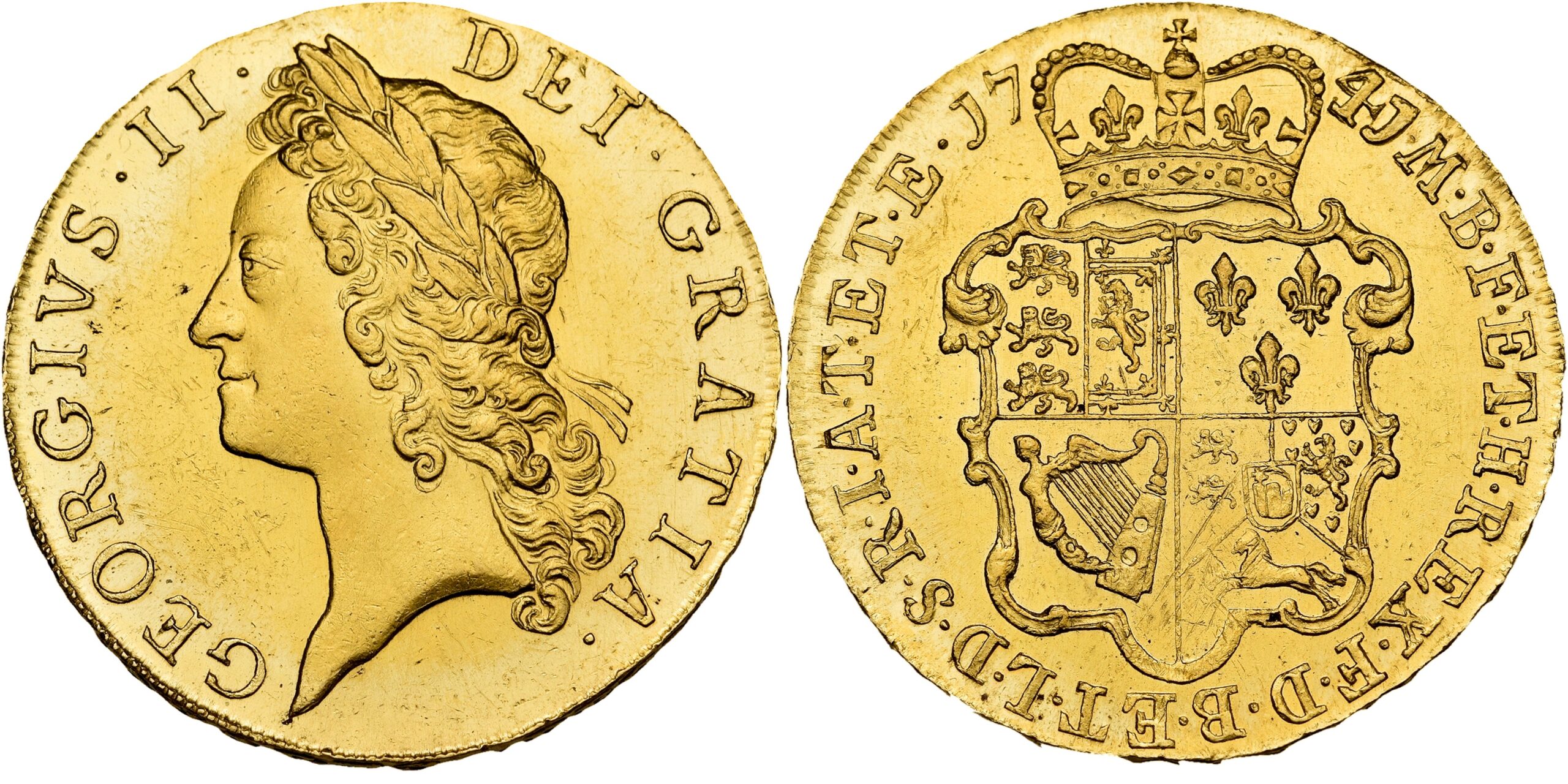
George II, 5 Guineas, 1741, €62 000
The fiveguinea piece was the heavyweight of English gold: the largest coin the Georgian mint struck, and never meant for the pockets of ordinary subjects. It was money for settling great debts and making greater impressions. This one carries the young laureate head of George II, the last British monarch who would personally lead an army into battle, at Dettingen, two years after this coin left the dies. What sets it apart is not rarity but survival. Nearly three centuries on, its fields remain prooflike and its frosted high points untouched, a nearmint witness to a denomination most collectors only ever meet worn smooth. Opened at €40 000, it found €62 000, the entry price, this April, to a board of giants.
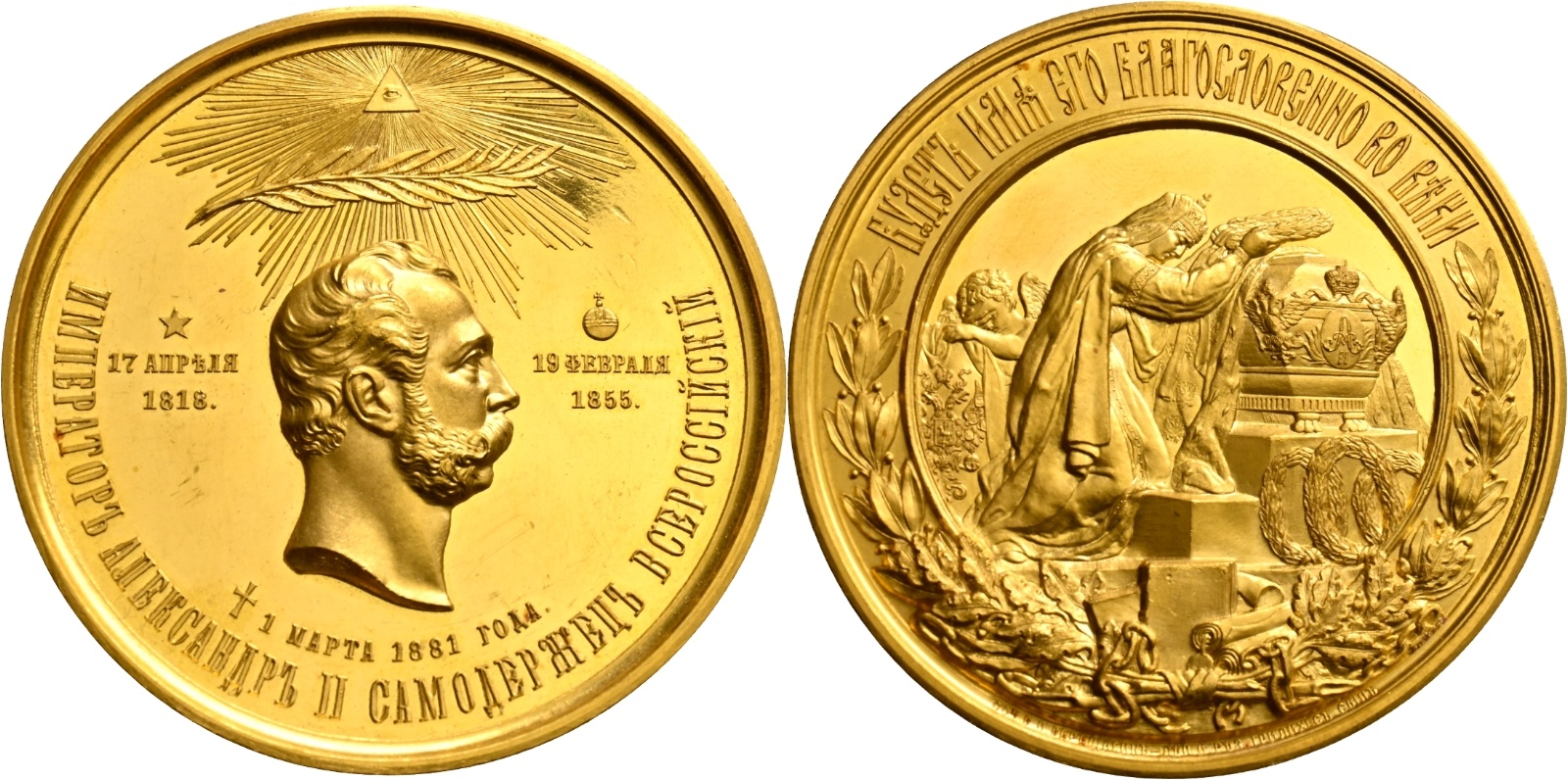
Alexander II, gold memorial medal, 1881, €75 000
On 1 March 1881, the tsar who had freed some twentythree million serfs was killed by the revolutionaries he had spent his reign trying to outrun. Alexander II, “the Liberator”, had survived attempt after attempt on his life before a bomb thrown by the People’s Will tore apart his carriage on a St. Petersburg canal. The irony is sharp: he is said to have been carrying, that very day, a reform draft that might have set Russia on a constitutional path. This near300gram gold medal, struck the same year by V. Alexeev and A. Griliches, is his memorial, his portrait framed by the dates of his birth and death on one face, and on the other a mourning figure of Russia laying a wreath upon his tomb. Some 77 millimetres across and in cabinet condition, it opened and closed at €75 000: a heavy disc of gold that turns an assassination into an act of remembrance.
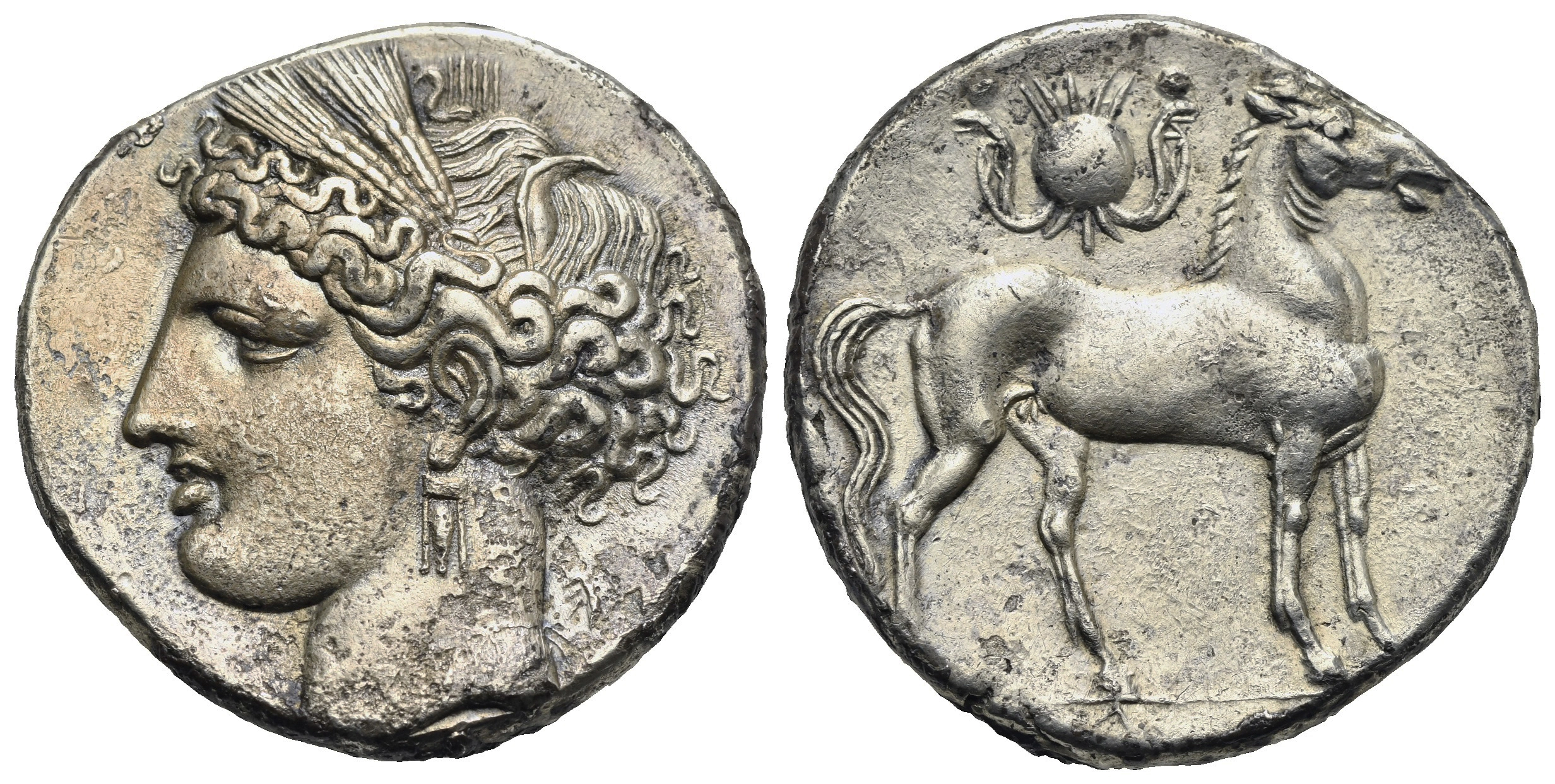
Carthage, hexadrachm (trishekel), First Punic War, CHF 90 000 (≈ €98 000)
When Carthage struck this coin, around 255 BC, it was losing. The First Punic War had ground against Rome for a decade, and the great maritime power was short of the silver it needed to keep its armies in the field, Greek mercenaries who would fight for coin but not for Carthage itself. So Carthage minted what it could: large silver pieces like this hexadrachm, carrying the head of the goddess Tanit and, on the reverse, a standing horse beneath a winged solar disc, the badge of the city. The example here appears to come from a previously unrecorded pair of dies, and fewer than ten of its kind are believed to survive. It opened at CHF 50 000 and reached CHF 90 000, about €98 000. A coin minted in difficulty, by a civilization Rome would within a few generations erase entirely, which is exactly why so little of it remains, and why what remains still draws a crowd.
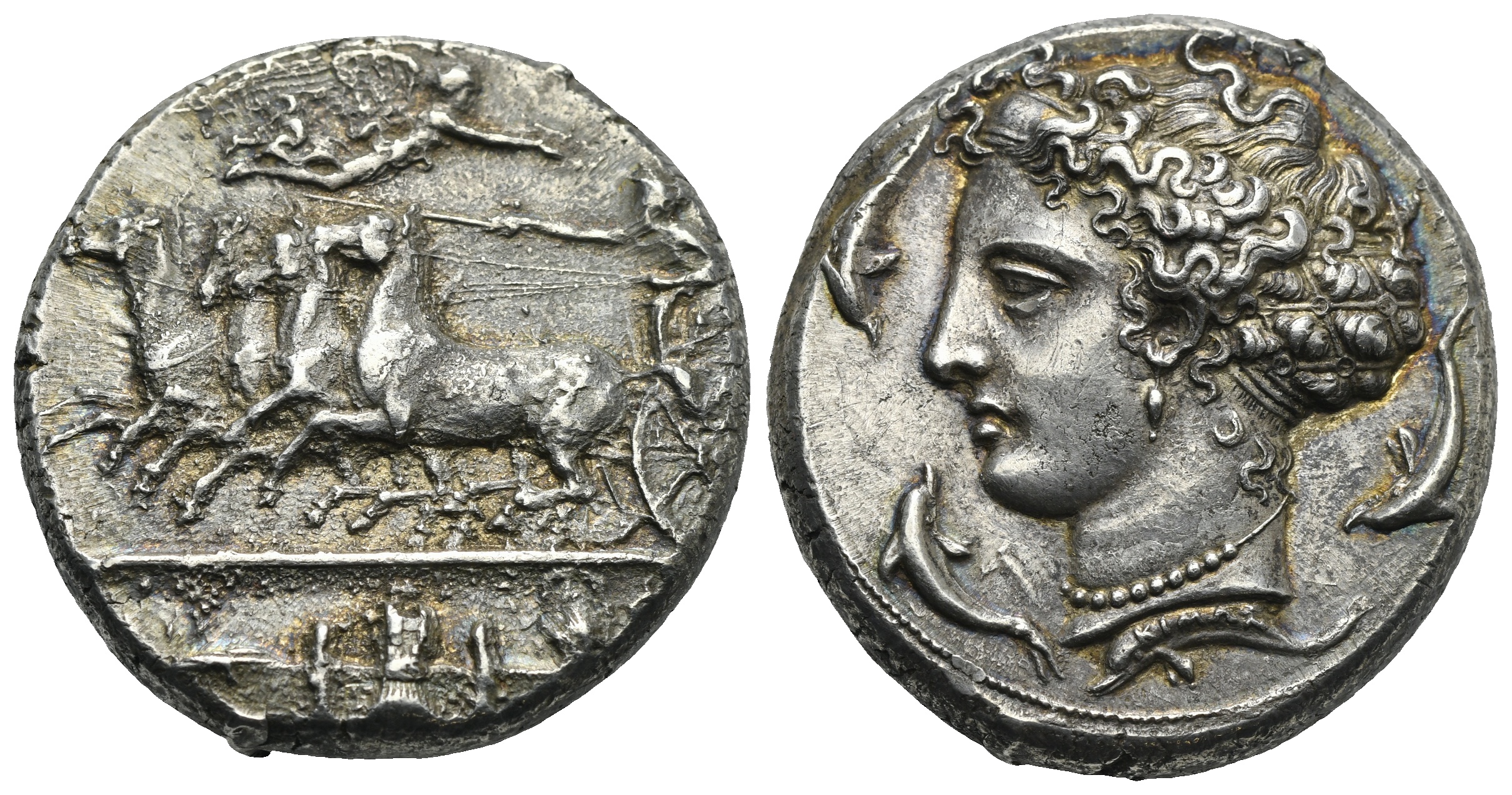
Syracuse, dekadrachm by Kimon, CHF 95 000 (≈ €103 000)
Some coins were money. This one was a monument. Around 405 BC, Dionysius I, the new tyrant of Syracuse, had just thrown back a Carthaginian invasion of Sicily, and he marked the moment the way a Greek city marked its triumphs, in silver, on the grandest scale available. He revived the dekadrachm, a denomination Syracuse had not struck in decades, and handed the dies to the finest engravers of the age: Kimon and Euainetos, artists who, unusually, signed their work. Kimon’s design survives here in full, a charioteer urging a galloping quadriga beneath a flying Nike, and on the reverse the head of the waternymph Arethusa, hair caught in a net, ringed by swimming dolphins. It is one of the highwater marks of ancient dieengraving, admired as art for twentyfour centuries. From a 2000 Tkalec sale, it opened at CHF 45 000 and more than doubled to CHF 95 000 (about €103 000). Carthage and Syracuse fought for generations; on this April board their finest coins stood a single bidding step apart.
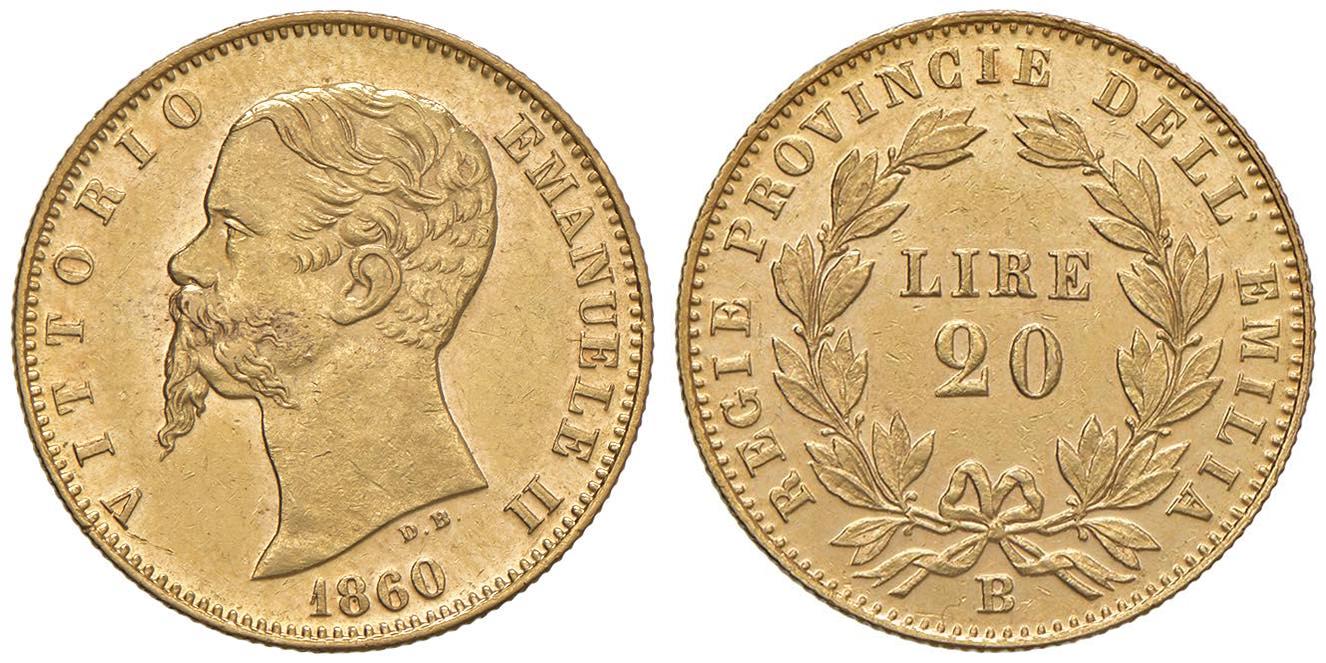
Vittorio Emanuele II, 20 Lire, 1860, €104 000
In 1860, Italy did not yet exist, but it was being assembled, province by province, plebiscite by plebiscite. After the central Italian states voted to join PiedmontSardinia, Vittorio Emanuele II ruled the Emilia provinces not yet as King of Italy but as their elected king, re eletto. This 20 Lire, struck at Bologna in that brief inbetween moment from dies cut by Donnino Bentelli, is a coin from a country midbirth: its legend names not a kingdom but the Regie Provincie dell’Emilia. Just 159 were struck. Within a year the title was obsolete, in 1861 Vittorio Emanuele became king of a united Italy, and this odd provisional inscription became a fossil of the transition. Opened at €100 000, it sold for €104 000, a small gold coin that caught a nation in the act of becoming one.
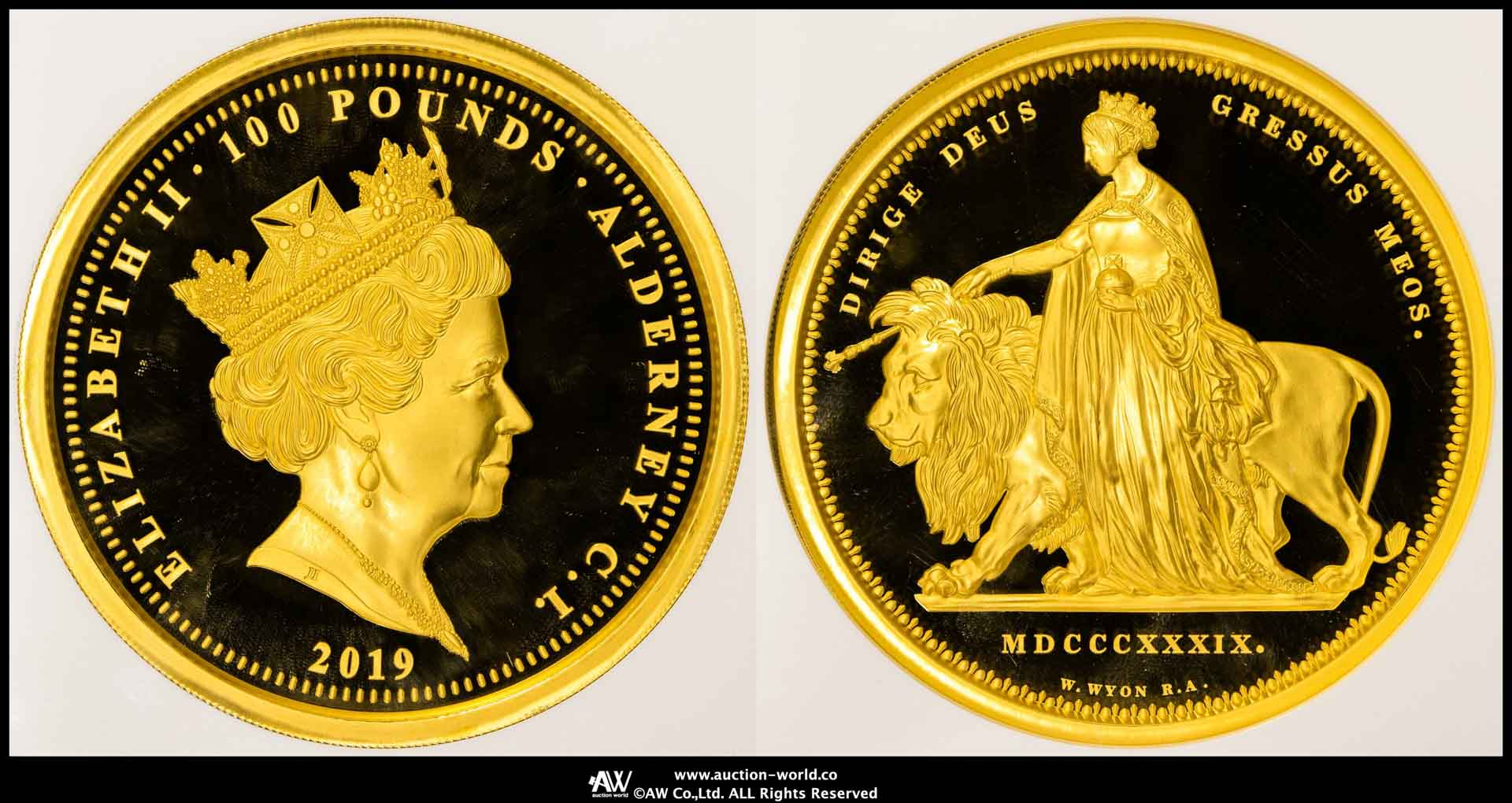
Una and the Lion, Alderney 100 Pounds, 2019, ¥24 100 000 (≈ €130 000)
Most coins have a description, a date, a denomination, a metal. A very few are so fixed in the collector’s imagination that they simply have a name. The Una and the Lion is one of them. In 1839, asked to mark the dawn of Victoria’s reign, the Royal Mint’s William Wyon made a daring choice: rather than show the young queen in conventional majesty, he cast her as Una, the embodiment of Truth from Spenser’s Faerie Queene, leading the British lion, strength tamed by virtue, beneath the motto DIRIGE DEUS GRESSUS MEOS, “may God direct my steps.” No British monarch had ever before been depicted on a coin as a fictional character, and the design casts Victoria as Una, the figure of truth who leads the lion that stands for Britain.The gamble produced what many still call the most beautiful coin in the world. The piece on this April’s board is not the original but its 200thanniversary tribute: an Alderney 100 Pounds of 2019, struck in a full kilogram of 24carat gold to a mintage of just five, graded NGC PF69 Ultra Cameo. It opened at ¥20 000 000 and closed at ¥24 100 000, roughly €130 000. A modern coin, but one trading entirely on a design that, after nearly two centuries, still answers only to its name.
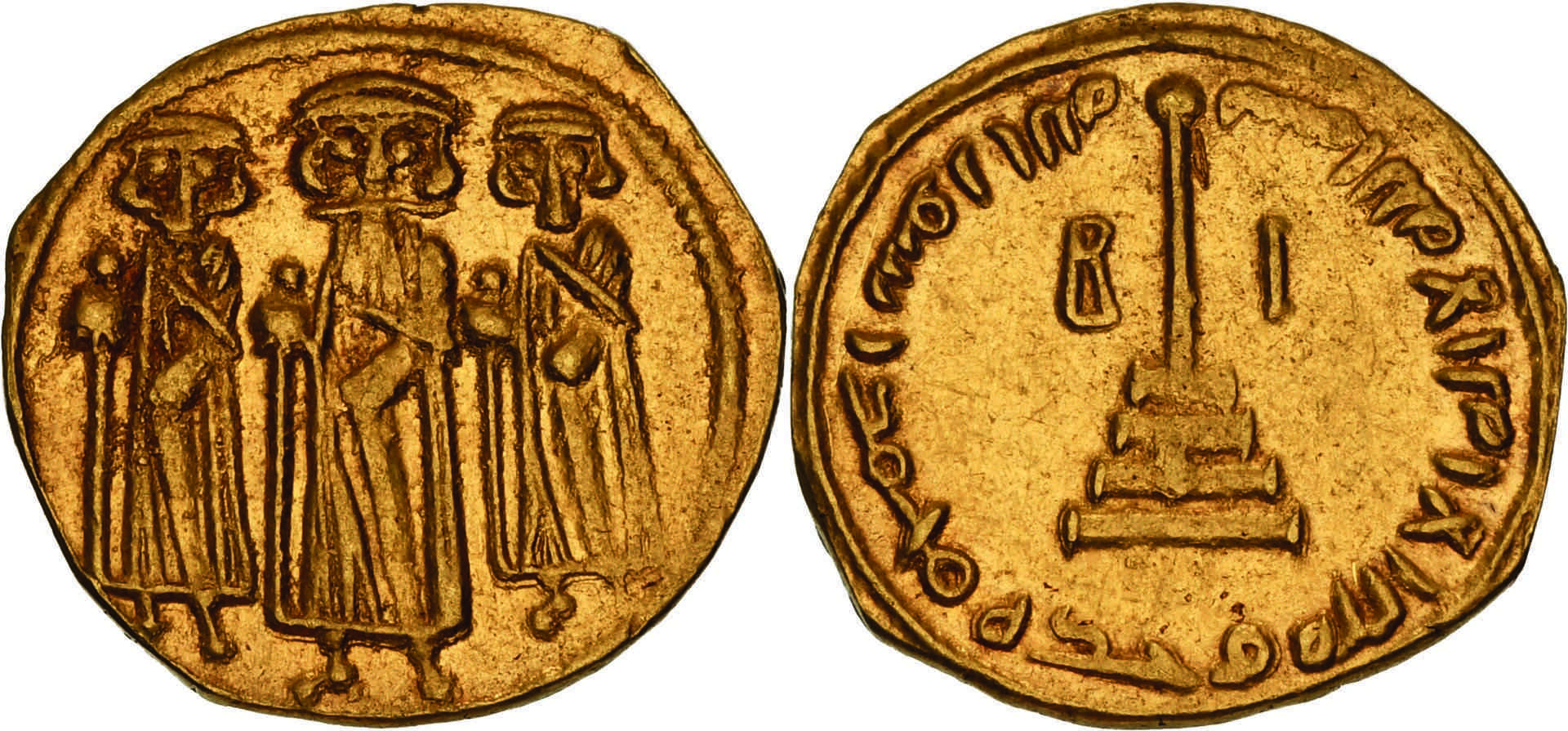
ArabByzantine, gold solidus, Damascus, $160 000 (≈ €137 000)
For roughly half a century after the Arab conquests swept through Syria and Egypt, the new rulers of the Near East struck almost no gold of their own. They had inherited mints, bureaucrats and infrastructure, and for decades they simply kept the old coinage flowing, Byzantine solidi bearing Christian emperors and crosses, imported or imitated to meet need. This solidus, struck at Damascus around AH 72–74 (the early 690s), is one of the first tentative breaks from that dependence. At a glance it is still a Byzantine coin: three standing imperial figures on the obverse, a globe on steps on the reverse. But around the edge runs something new, the Arabic profession of the Islamic faith, and the cross has begun to dissolve into a plain shaft. It is the opening move in the reforms of the caliph ‘Abd alMalik, who within a few years would sweep every human image off Islamic coinage in favour of pure script. Estimated at $150 000, it opened at $90 000 and reached $160 000 (about €137 000). The price was strong; what it bought was a hinge of monetary history, the moment one civilization’s coinage began, cautiously, to become another’s.
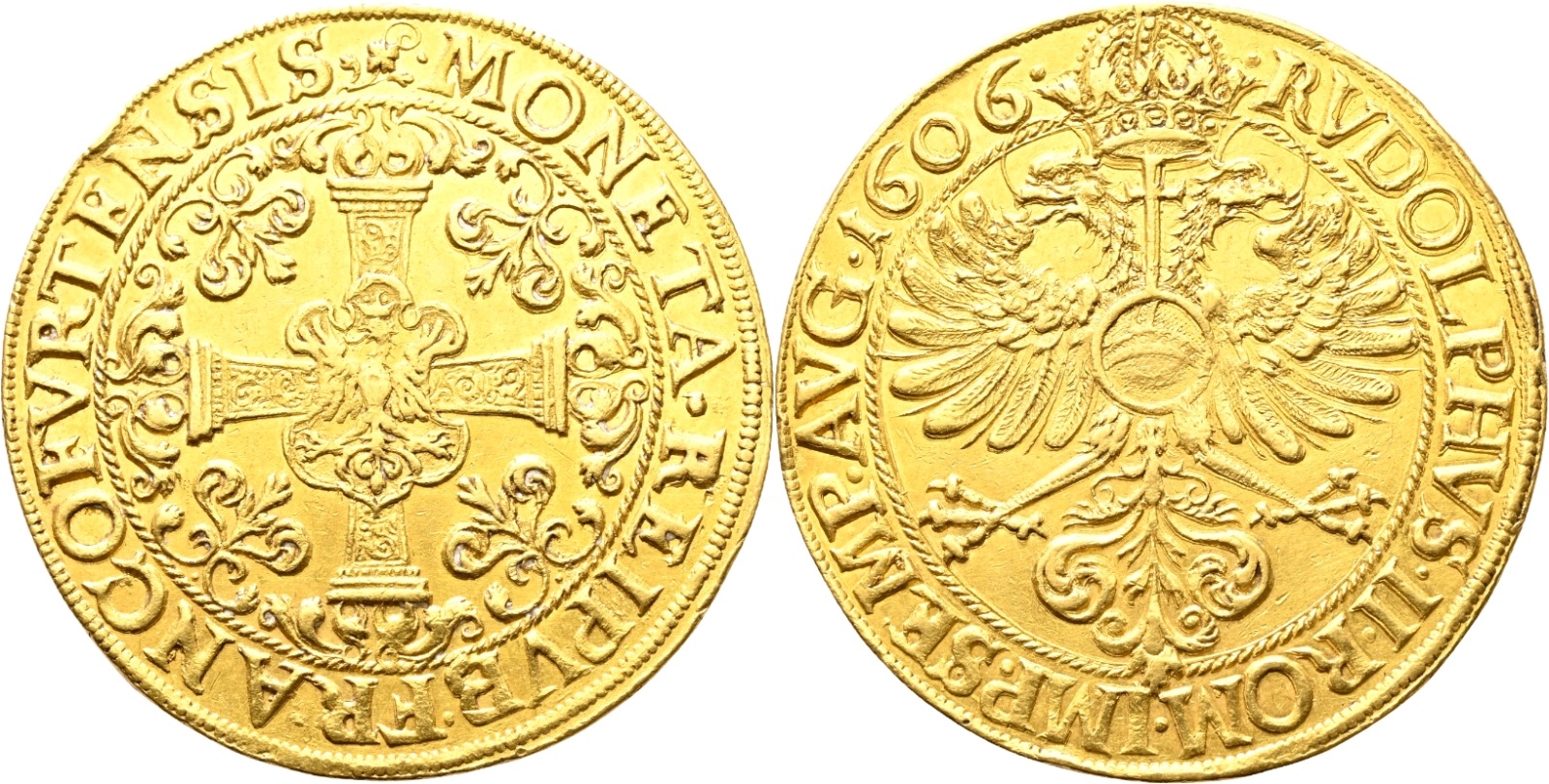
Frankfurt, 10 Ducats, 1606, €155 000
Rudolph II was the strangest of the Holy Roman emperors: a recluse who ruled from Prague surrounded by astronomers, alchemists and the largest cabinet of curiosities in Europe, while his empire drifted toward the catastrophe of the Thirty Years’ War. Frankfurt, the free imperial city where the emperors were crowned, struck this monumental gold piece in his name in 1606: ten ducats’ weight of gold, taken from the dies of the city’s silver taler, the imperial eagle on a cross on one face and the crowned double eagle bearing the orb on the other. It is the only known example, a presentation piece of a scale few cities ever attempted, surviving in a single specimen through four centuries and several distinguished collections. Opened at €75 000, it more than doubled to €155 000. When a coin is the only one of its kind, the arithmetic of desire is simple.
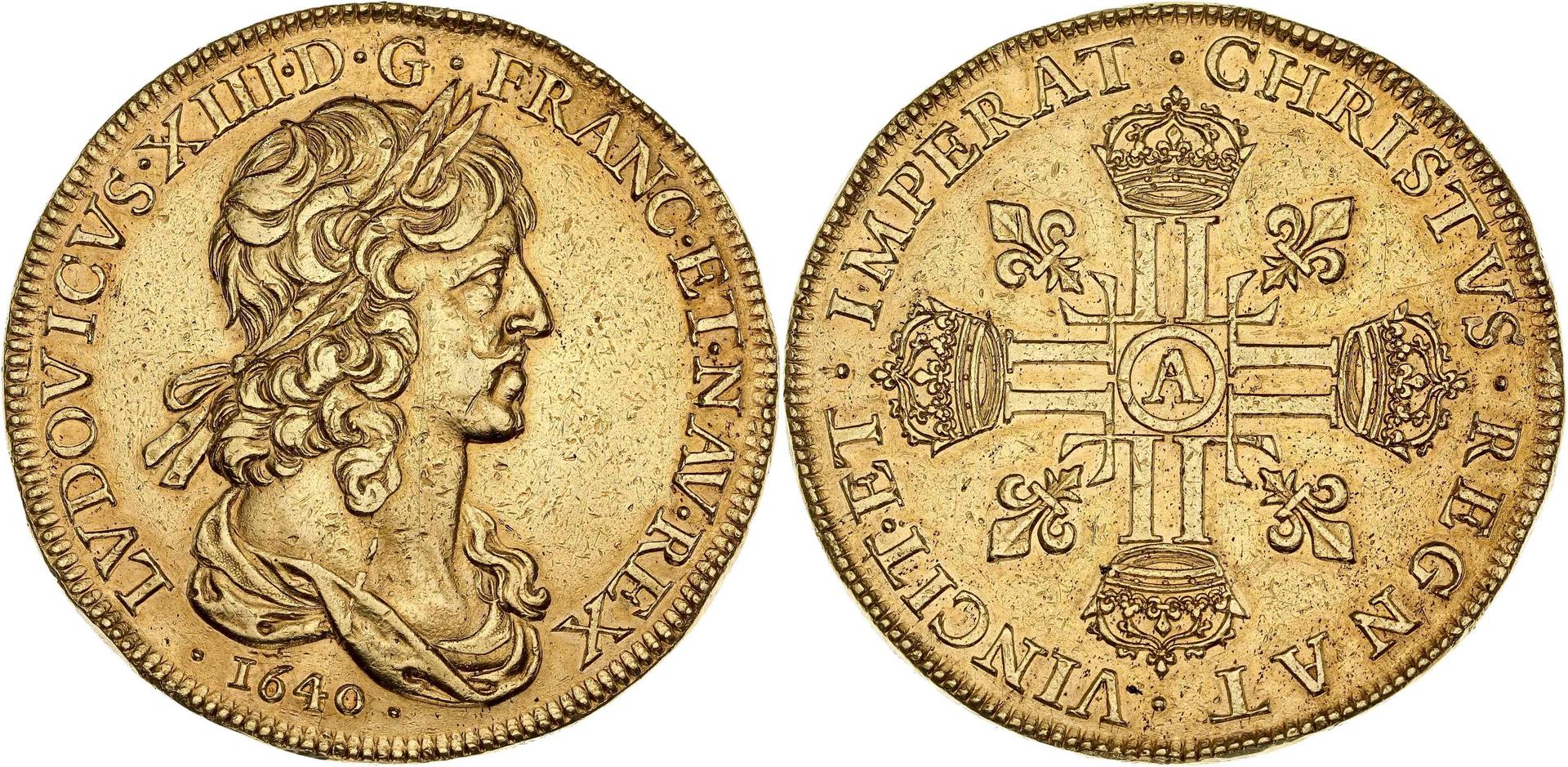
10 Louis d’or, 1640, €165 000
In March 1640, an edict signed at SaintGermain ended more than two thousand years of how France made money. The Edict of SaintGermain of 31 March 1640 created the louis d’or, and Jean Varin put the screw press back into operation to strike the new milled coinage on uniform round blanks.Out went the handhammered coinage of the medieval mints; in came milled coins struck on the balancier, the screw press championed by the engraver Jean Warin, round, uniform, machineprecise and far harder to clip or counterfeit. The new gold denomination took its name from the king whose laureate portrait it carried: the louis d’or. This piece is its grandest expression, a dix louis d’or, ten times the standard weight, 67 grams of gold engraved by Warin himself, with the draped bust of Louis XIII on the obverse and a cross of eight crowned Ls on the reverse. It is the showpiece of a coinage that would symbolize Bourbon France until the Revolution melted the monarchy down. Catalogued against a €150 000 estimate, with a pedigree back to the Paris trade of October 1945, it opened at €100 000 and sold for €165 000, the founding coin of a dynasty’s money, in its most extravagant form.
Nuremberg, 6 Ducat, 1631, ¥34 000 000 (≈ €184 000)
In 1631 the Thirty Years’ War was at its most savage. That spring Magdeburg had been sacked and burned with the loss of tens of thousands of lives; armies crossed and recrossed the German lands, and the free imperial city of Nuremberg sat anxiously in their path. And yet Nuremberg, one of the richest merchant cities of the Empire, struck this: a sixducat gold piece showing a sweeping view of the city’s spires and walls, a prayer for peace worked into the legend, beneath the doubleheaded eagle of Ferdinand II. It is a coin that documents both wealth and dread, a prosperous city advertising its splendour while praying, in gold, for the war to end. Graded NGC MS65 and called very likely the finest known, it opened at ¥15 000 000 and ran to ¥34 000 000, roughly €184 000. More than double its start, for a coin struck by a city holding its breath.

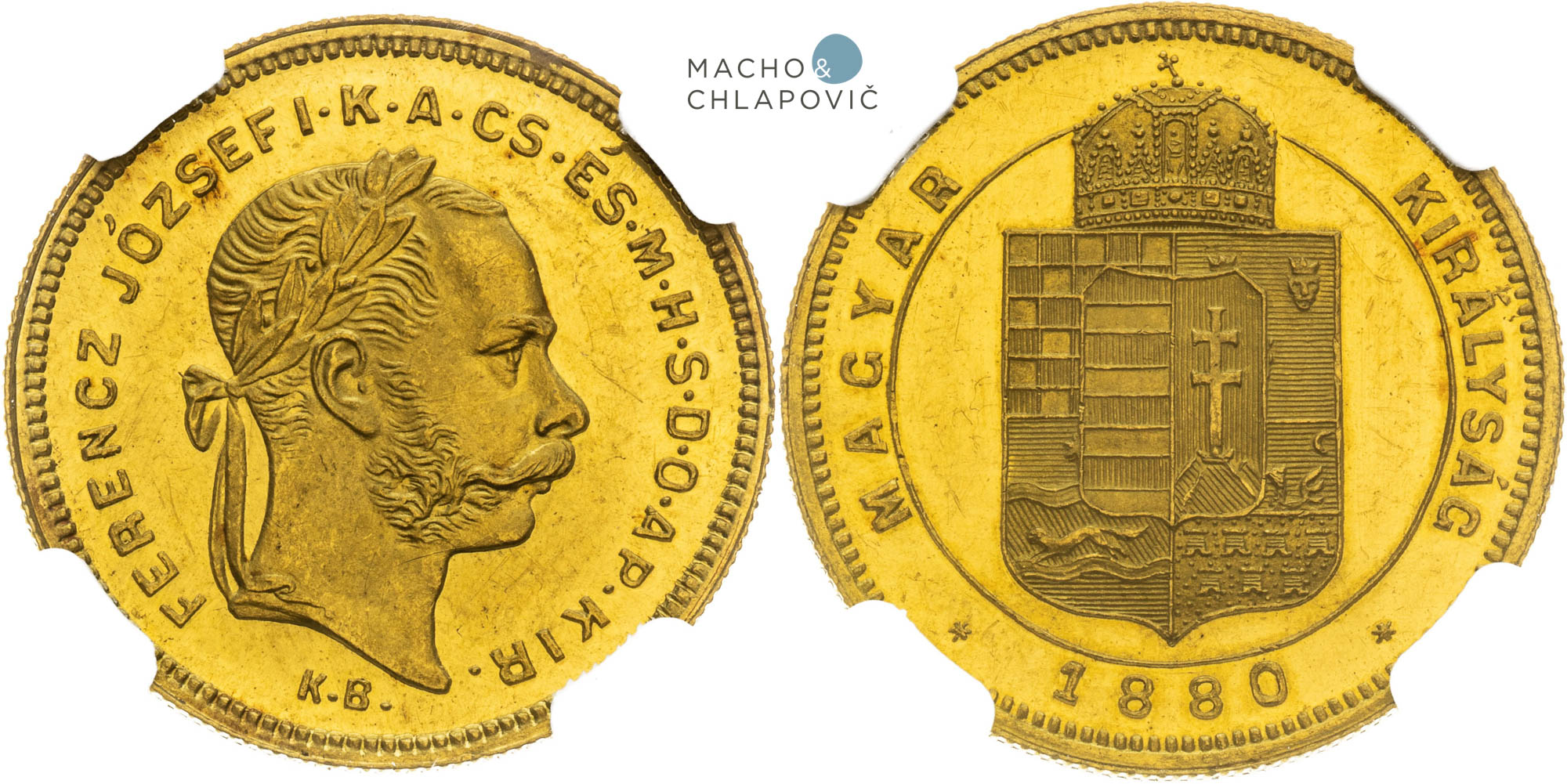
Franz Joseph I, Ducat, 1880, Kremnitz, €340 000
Franz Joseph I reigned for sixtyeight years, long enough to embody an entire empire, from the revolutions of 1848 to the eve of its collapse in the First World War. His effigy appeared on countless coins across the Habsburg lands. And yet this one, a single ducat struck at the great Hungarian mint of Kremnitz in 1880, bearing the arms and legend of the Kingdom of Hungary, is unique. No second example is known to exist. A coin of just three and a half grams, struck in deep prooflike fields, graded NGC MS62 Deep Prooflike and the top of its population, carrying a pedigree through the Nudelman and Kokolus collections. It opened at €200 000 and closed at €340 000, the month’s secondlargest result. Proof, if proof were needed, that in numismatics the smallest object in the room can be the rarest, and the rarest is what the market chases hardest.
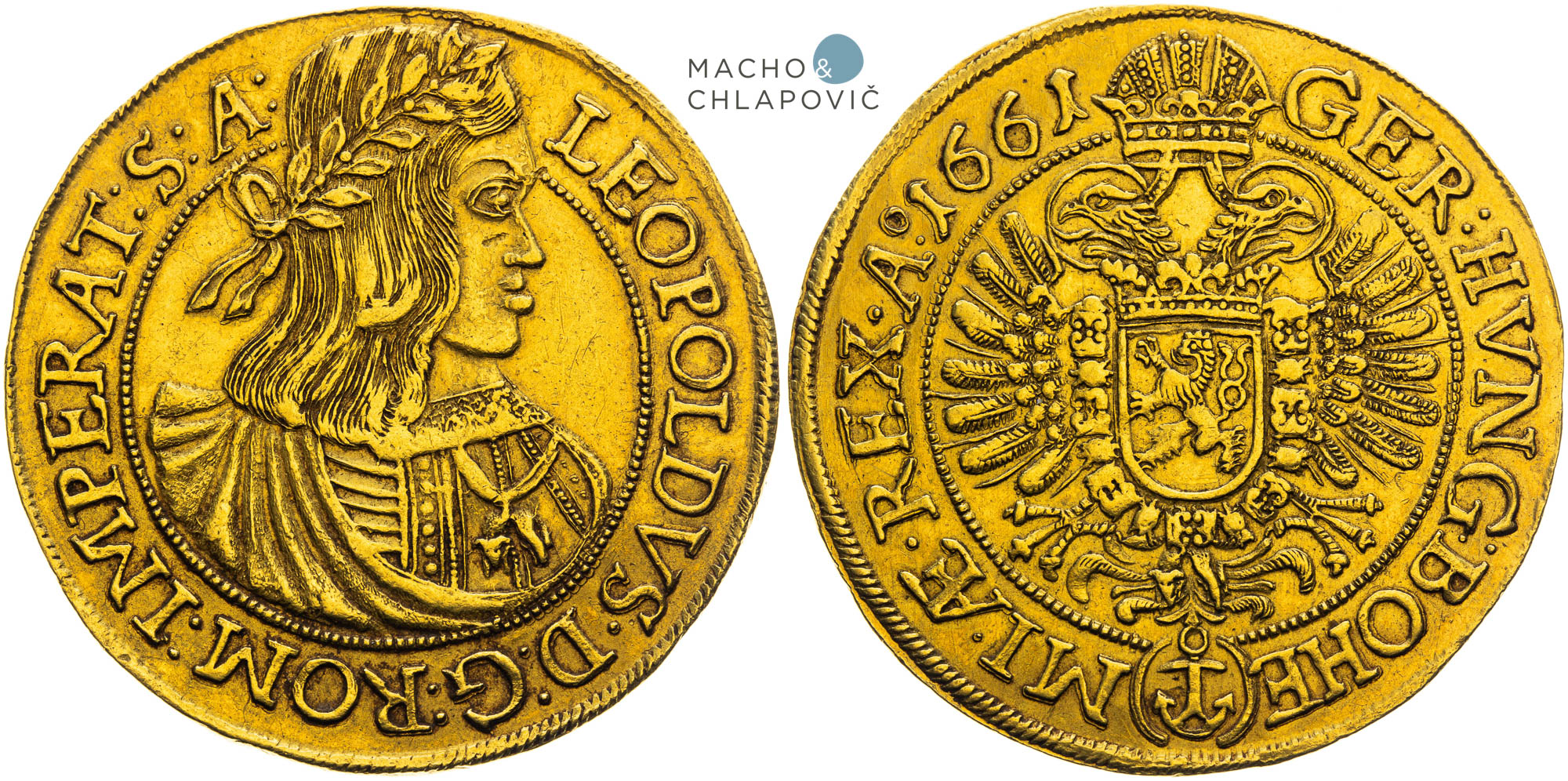
Leopold I, 10 Ducats, 1661, Prague, €500 000
At the head of the board sat ten ducats of imperial gold, struck at Prague in 1661 for Leopold I, the Habsburg emperor whose long reign would be defined by the Ottoman tide that broke against the walls of Vienna in 1683. This is gold as statement: a massive presentation piece, 35 grams and nearly 48 millimetres across, the young emperor’s laureate bust on one face and the crowned imperial eagle on the other, preserved extremely fine on both sides after three and a half centuries. It last appeared in public at Sotheby’s in London in December 2001, from the celebrated Rudolf Just Collection, the kind of pedigree that turns a rarity into a trophy. It opened at €300 000 and hammered at €500 000, the highest result on the April board. The sort of coin a specialist might wait an entire collecting life to bid on, and, having bid, remember for the rest of it.
What the month showed
Read from the foot of the table to its head, April’s board was less a price list than a procession: a Georgian showpiece, a murdered tsar’s memorial, two coins from a war between Carthage and Syracuse, a nation caught midbirth, a queen cast as Truth, the first stirrings of Islamic gold, and a crown of Habsburg, French and German rarities at the summit. What they share is not metal but scarcity, and the stories that scarcity made possible. The market, as ever, paid the most where the rarity was real and the history was documented. Those two things still set the pace, and, as every name on this board attests, they are not getting any easier to find.