
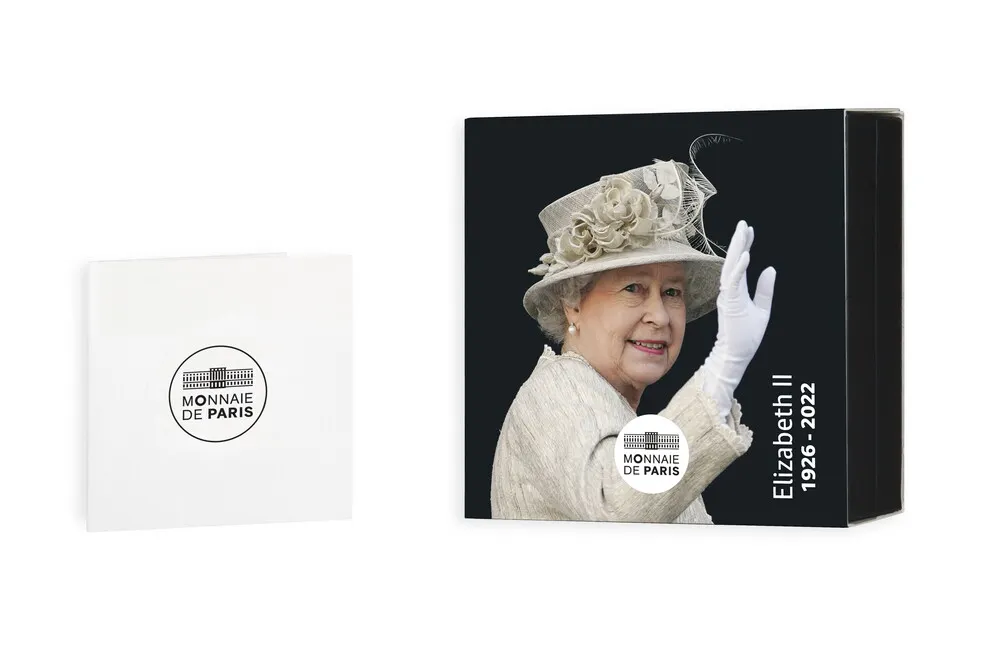
A century after she was born in London, Elizabeth II is being commemorated by the mint of the country across the Channel. To mark the centenary of her birth in 2026, the Monnaie de Paris has issued a five coin collection in gold and silver, two commemorative pieces and three collector coins, all carrying the 2026 year date and a design that reads, quite deliberately, as a biography in metal.
The premise is the unusual part. France’s mint, the oldest continuously operating in the world, devoting a full collection to a British sovereign is not the obvious tribute. But the obverse settles the question of why: the portrait is drawn from one of the Queen’s later visits to France, and the design treats her less as a foreign monarch than as a figure the two countries shared.
The collection
The set is built in two tiers. Two commemorative coins are struck in the Mint’s circulating quality, a 10 euro silver piece and a 100 euro silver piece, priced at 13 and 129 euros respectively. The 10 euro commemorative is the entry point to the whole collection: 31 mm of .333 silver, 13 grams, an Uncirculated finish, and a mintage of 10,000. It is also the one coin in the set that does not carry the tribute reverse, instead showing the standard French euro design, the face value framed by oak and laurel branches, the République Française legend, and the radiating lines that stand in for the Hexagon.
The three collector coins carry the Mint’s Historic quality, its proof tier, and the full commemorative design on both faces:
- a 10 euro silver coin, 37 mm of .999 silver at 22.2 grams, mintage 3,000, at 131 euros;
- a 50 euro gold coin, 22 mm of .999 gold at 7.78 grams, a quarter ounce, mintage 500, at 1,350 euros;
- and the flagship 200 euro gold coin, a full ounce of .999 gold at 31.1 grams and 37 mm, mintage 250, at 5,375 euros.
The 10 euro denomination therefore appears twice across the collection, once as the everyday circulating commemorative, once as the proof quality collector piece, a structure French collectors will recognise from the Mint’s standing programmes.

A portrait, and a French connection
The obverse carries a portrait of the Queen modelled on one of her last visits to France, set against a background of her royal monogram and flanked by her dates of birth and death, 1926 and 2022. It is a quiet choice. Rather than reach for a coronation image or a regnal portrait, the Mint anchored the coin to a moment of its own country’s encounter with her, which is what gives the obverse its particular character: a commemoration framed from the French side of the relationship.

Three headpieces, three lives
The reverse is where the collection earns its keep. Instead of a single emblem, it sets out three headpieces, each standing for a chapter of the Queen’s life. The coronation crown represents her role as sovereign. The tricorn hat recalls the Trooping the Colour, the annual review of the guard and the presentation of the regimental colour. And the mechanic’s helmet points back to the Second World War, when, at nineteen, she trained as a driver and mechanic in the Auxiliary Territorial Service, the first woman in the royal family to serve in that way.
That last detail is the one most worth pausing on. A reign of seventy years offers no shortage of imagery, and the obvious instinct would have been three crowns or three jewels. The decision to give a third of the reverse to a wartime mechanic’s helmet, the apprentice rather than the monarch, is what lifts the design above a routine anniversary issue.
Behind the headpieces sit the four floral emblems of the United Kingdom: the thistle for Scotland, the rose for England, the shamrock for Ireland, and the leek for Wales, the nations gathered into a single field, as they were under a single Crown.

The engraver
The collection is the work of Joaquin Jimenez, Chief Engraver of the Monnaie de Paris, whose mark appears on the coins alongside the Mint’s own and the 2026 date. Jimenez has held the title of Graveur général since 2020, a post that had sat dormant for nearly two decades, and his earlier work includes the obverse of France’s first circulating 1 and 2 euro coins. In 2019 he received the Coin of the Year programme’s Lifetime Achievement in Coin Design Award. In the note accompanying the release, he frames the Queen as something larger than a royal figure, a steady presence whose attention to detail and respect for tradition was the quality he set out to capture, in a design meant to read as plainly as the woman it honours.
For collectors
For collectors, the calculus is straightforward. The two silver pieces are accessible, 13 euros buys the circulating commemorative, 131 the proof quality 10 euro coin. The gold is where scarcity enters: 500 examples of the half ounce 50 euro piece and just 250 of the one ounce 200 euro flagship. Those are tight figures for a modern world coin tied to a name with this much pull, and they are the numbers most likely to move once the year date closes.
It remains a slightly unexpected tribute, a French mint compressing a British century into three headpieces and four flowers. But that is also what makes it worth a second look. Most centenary coins reach for the crown. This one remembered the helmet too.