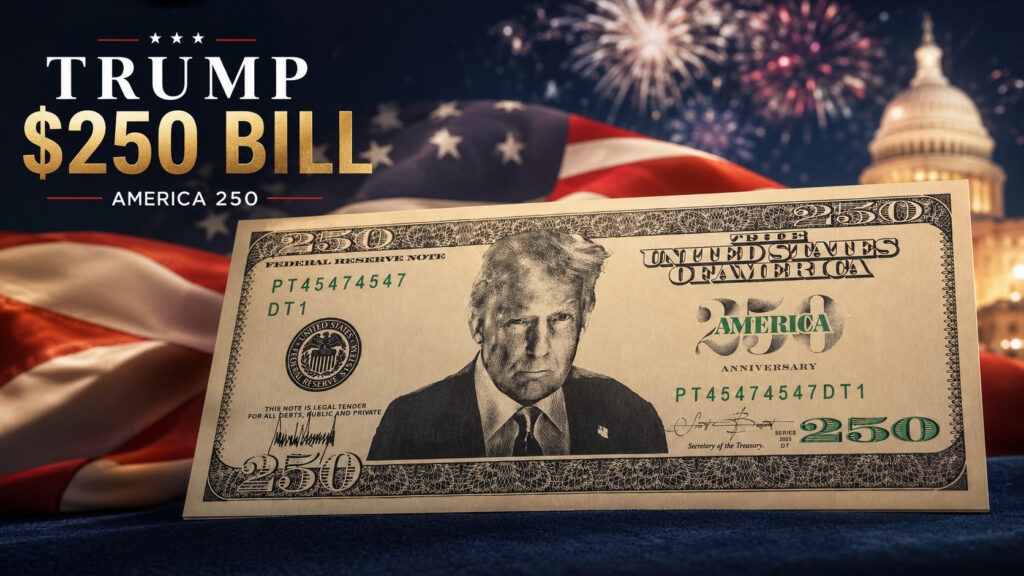
The U.S. Treasury has acknowledged for the first time that it is preparing for the possibility of a $250 Federal Reserve note bearing a portrait of Donald J. Trump, a denomination that does not exist, depicting a living person whom federal law currently bars from appearing on American currency at all. Treasury Secretary Scott Bessent confirmed the preparations at a White House press briefing on May 28, 2026, the day after The Washington Post reported them, holding up a copy of the article as he spoke.
For collectors, the interest here is less political than structural. A $250 note would be the first entirely new U.S. paper denomination in well over a century, the first depiction of a sitting president on circulating American currency, and a direct challenge to a statutory rule that has held since 1866. None of it can happen unless Congress acts first. So far, Congress has not.
The Legislation
The vehicle is H.R. 1761, the “Donald J. Trump $250 Bill Act,” introduced in the 119th Congress on February 27, 2025, by Representative Joe Wilson of South Carolina, with original cosponsors Diana Harshbarger of Tennessee, Ralph Norman of South Carolina, and Darrell Issa of California. The bill directs the Bureau of Engraving and Printing to design and print a $250 note bearing Trump’s portrait, amends Section 16 of the Federal Reserve Act to authorize the new denomination, and records the sense of Congress that such a note be issued to commemorate the semiquincentennial, the 250th anniversary of American independence in July 2026.
Wilson framed the proposal around the practical and the symbolic in equal measure: a higher denomination, he argued, would let families carry less cash, while the portrait would honor the president during the anniversary year. His office’s announcement called it “the most valuable bill for the most valuable President,” and illustrated the idea with an AI-generated concept image rather than an engraved design.
By September 2025 the bill had drawn thirteen Republican cosponsors and no Democratic ones. It was referred to the House Committee on Financial Services the day it was introduced, and it has sat there since, no hearing, no markup, no companion bill in the Senate. A year on, it remains exactly where it started.

The Rule Standing in the Way
The obstacle is not partisan arithmetic but statute. Federal law has prohibited the appearance of any living person on U.S. currency since 1866, and a separate requirement obliges the nation’s money to carry the motto “In God We Trust.” Bessent acknowledged both constraints directly, noting that no living person may currently appear on a note and that legislation would be needed to change the first requirement so that a living former or sitting president could be depicted. Wilson’s bill does exactly that, carving an exemption for anyone who is or has been President of the United States.
The scale of the departure is easier to see against the existing lineup. Every face on a circulating U.S. note today, Washington, Jefferson, Lincoln, Hamilton, Jackson, Grant, Franklin, belongs to someone long dead, and most to the eighteenth or nineteenth century. The denomination itself would also be a revival of a kind the country has not seen in generations: no U.S. note above $100 has been printed since 1945, and the old $500 through $10,000 bills were retired from issue in 1969 for lack of use. A $250 note would not merely add a face. It would reopen a tier of paper money the Treasury closed more than half a century ago.
The Mock-Up, and the Walk-Back
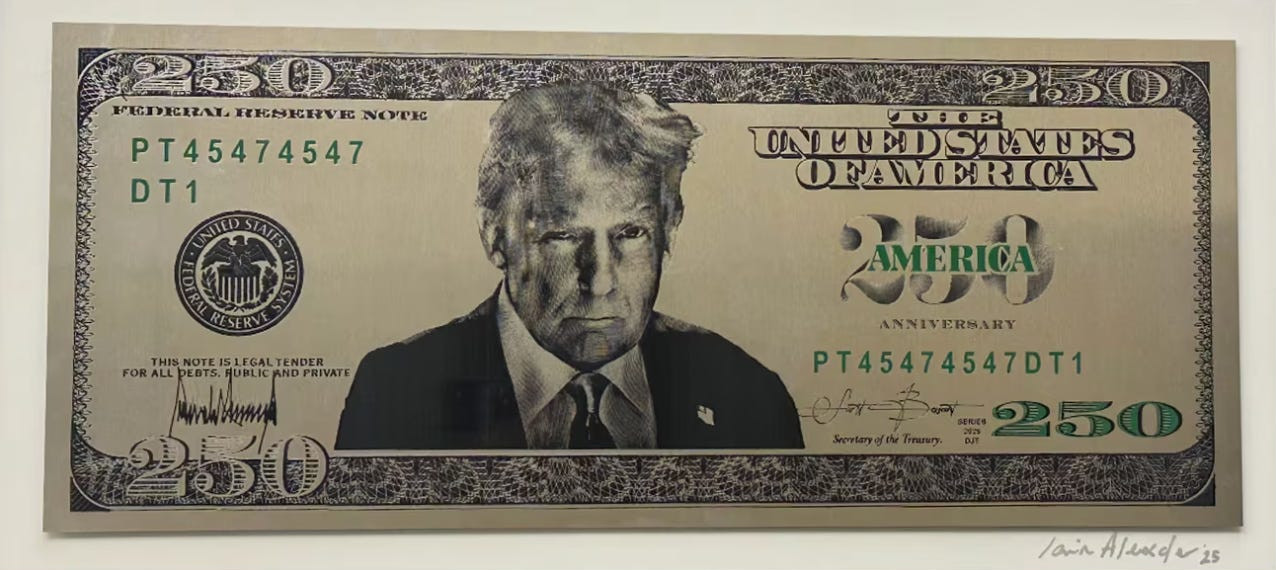
What turned a stalled bill into a news story was the revelation that work had quietly begun anyway. The Washington Post reported that administration officials had provided Bureau of Engraving and Printing staff with a mock-up of the proposed note, Trump’s portrait and signature, printed in the familiar green, with a 250th-anniversary logo, and that U.S. Treasurer Brandon Beach had pushed to expedite the process. The design was attributed to British artist Iain Alexander, who said he had spoken with Trump and that the president endorsed changes including the addition of the flag’s colors.
Bessent defended the groundwork as prudence rather than presumption, saying the Treasury had prepared in advance in case the legislation passes but would otherwise stick to the law, and adding that he saw nothing “untoward” about a sitting president appearing on an anniversary note. A Treasury official, pressed by CBS News, went further in the other direction, insisting that any designs circulating publicly “are not real” and that the bureau was conducting appropriate planning and due diligence in response to pending legislation. The public posture, in other words, is conditional. The internal activity suggests the project has been treated as live.
The $250 note also fits a broader pattern. The Treasury announced in early 2026 that future currency would carry Trump’s signature, a first for a sitting president, said in October it was developing a $1 coin bearing his image for the anniversary, and saw a commemorative gold coin with his likeness clear the Commission of Fine Arts.
What Happens Next
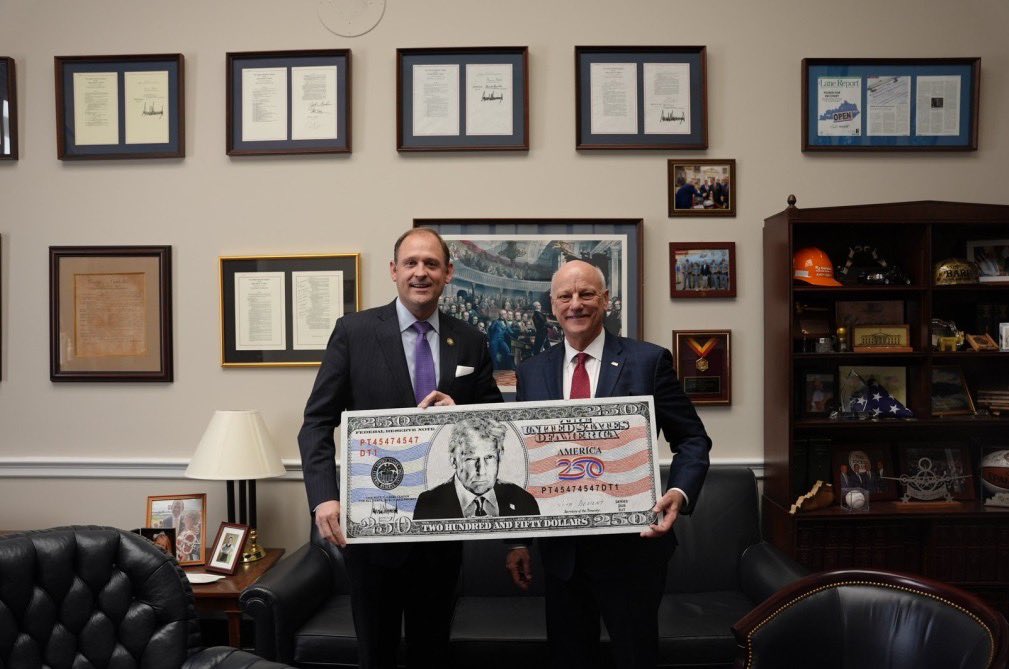
For now the $250 bill exists only as a concept image, a stalled bill, and an admission that the printing office has thought about how it might be made. Its fate rests entirely on legislation that has not moved out of committee in more than a year, against a statutory bar the Treasury cannot lift on its own. Whether the note is ever struck, the episode already marks the closest a living president has come to circulating American currency, and a quiet test of a rule that has outlasted every figure now printed on it.