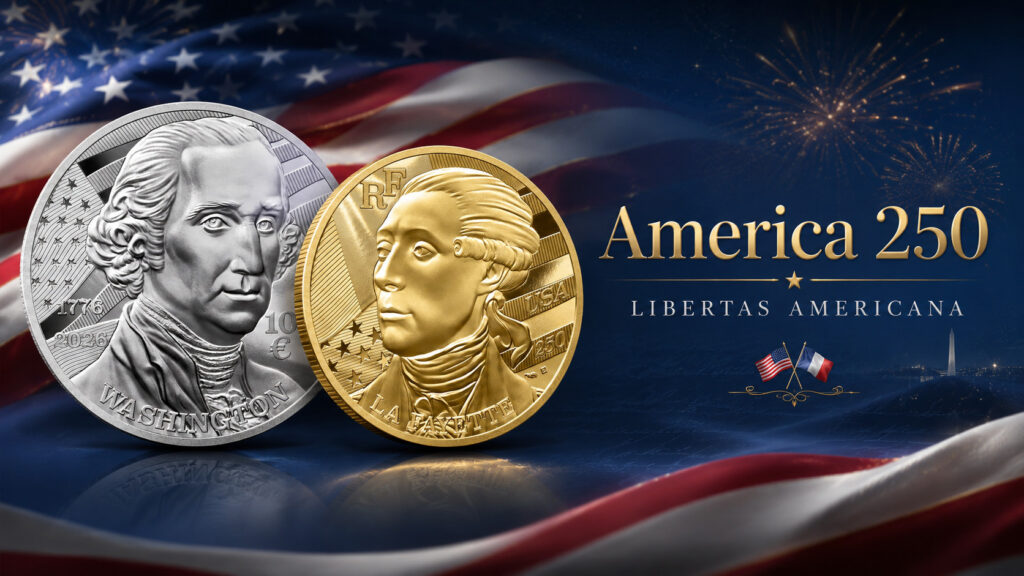
The Monnaie de Paris has opened its tribute to the 250th anniversary of American independence, and it has done so by going back to the one object that binds the two nations at the source: the Libertas Americana. The 2026 Independence of the United States – 250 years collection runs across gold and silver and splits into two design programs, a contemporary reinterpretation of the famous 1783 medal, and a paired portrait series honoring George Washington and the Marquis de La Fayette.
There is a neat logic to the choice. The mint reimagining the Libertas Americana for the republic’s 250th is the same mint that struck the original for Benjamin Franklin 243 years ago. For collectors, the draw here is partly the iconography and partly the provenance of the idea itself, and at the top of the range, the mintages are small enough to make that draw a practical concern.
The medal behind the collection
To understand why this release carries more weight than a typical anniversary issue, you have to start in Paris in 1783.
Benjamin Franklin, serving as America’s minister to France, conceived and largely financed a medal to mark the new nation’s victory in the Revolutionary War and to acknowledge the French alliance that made it possible. He turned to the engraver Augustin Dupré, working with the artist Esprit Antoine Gibelin, and the dies were cut and struck at the Paris Mint. The result was the LIBERTAS AMERICANA, a piece the Smithsonian’s National Museum of American History has called one of the most resonant objects in the founding story.
Its imagery did the talking. The obverse carried a young Liberty in profile, hair streaming behind her, a Phrygian cap on a pole at her shoulder, a figure that would go on to shape America’s earliest federal coinage. The reverse turned allegory into narrative: an infant Hercules strangling two serpents, standing in for the American victories at Saratoga and Yorktown, while the goddess Minerva, France, holds a British lion at bay.
Franklin distributed the medals to leaders on both sides of the Atlantic as the Treaty of Paris was bringing the war to a close. The only two struck in gold he reserved for Louis XVI and Marie Antoinette, a gesture of gratitude to the crown that had backed the revolution. Both gold pieces are thought to have vanished in the French Revolution a few years later. That is the lineage the 2026 collection steps into.
Liberty, reimagined
The first of the two programs is the Libertas Americana line, and it treats the old medal as a starting point rather than a template. The original iconography is reworked in a contemporary composition that brings Minerva and Lady Liberty together around the flame of liberty, the alliance rendered as a single image rather than two opposing halves. The coins carry the motto LIBERTAS POPULUSQUE UNIVERSALIS and the date 4 July 2026.
Fittingly, this program leans on an antique finish that nods to the matte, sculptural feel of an eighteenth century medal. It is also where the collection reaches its ceiling. The flagship is a five ounce gold piece in antique quality at €28,200.00, followed by a one ounce gold at €5,760.00 and a quarter ounce gold proof at €1,350.00. On the silver side sit a half kilo strike at €3,255.00 and a two ounce piece at €410.00, the most accessible way into the Libertas designs.
Washington and La Fayette, two brothers
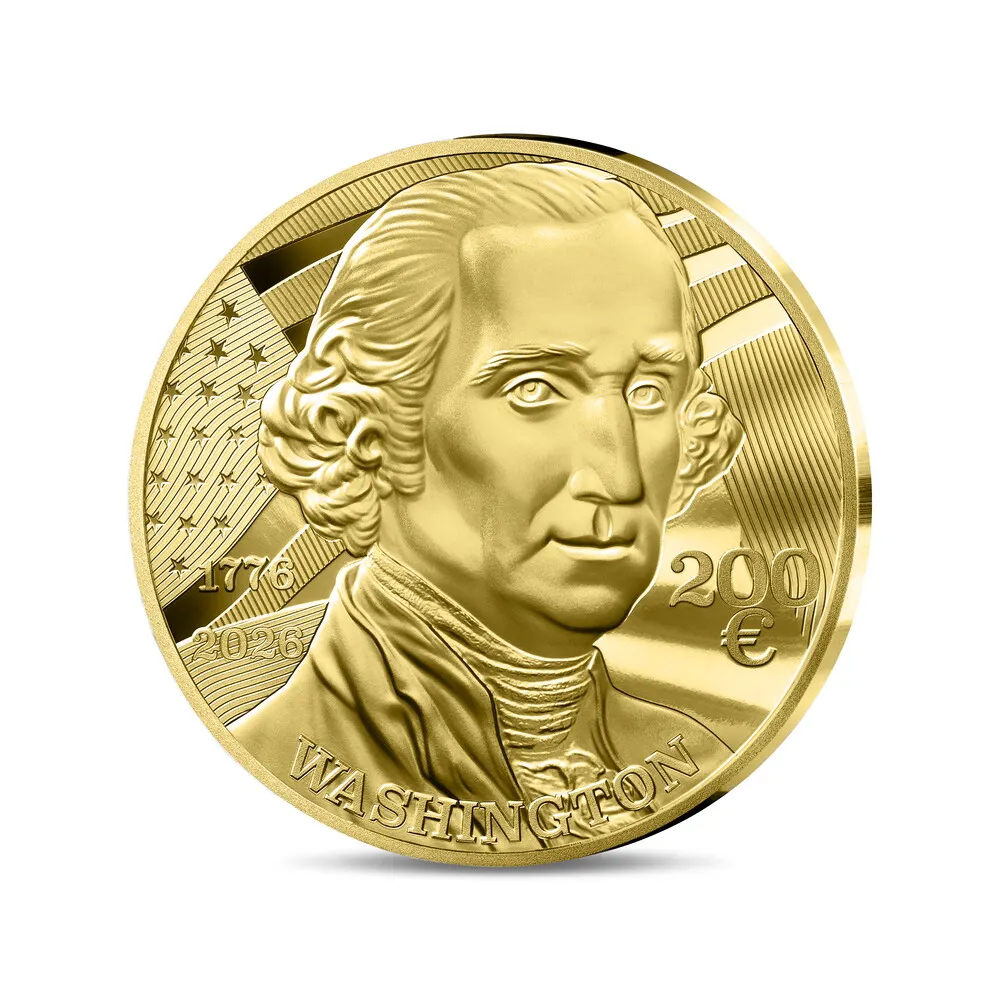
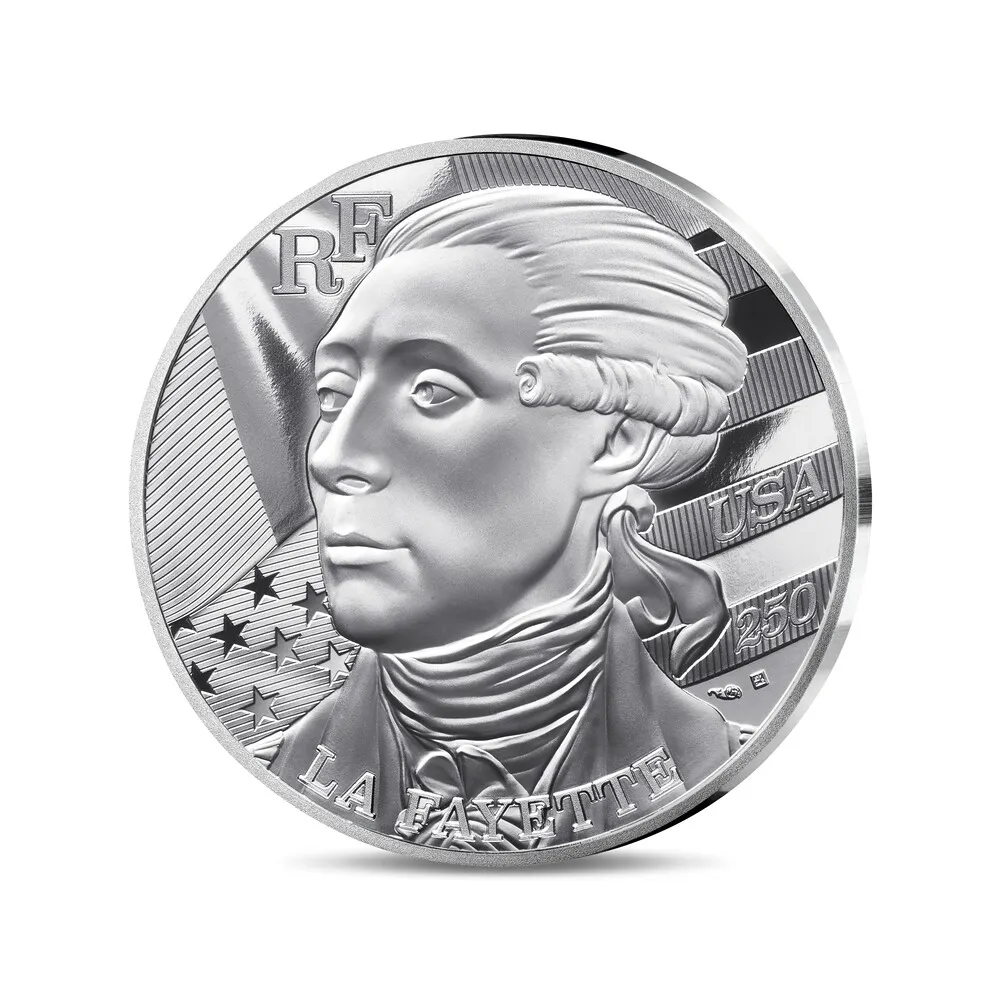
The second program trades allegory for portraiture. Here the obverse and reverse are given over to George Washington and the Marquis de La Fayette, set against the French and American flags, the two figures who, more than any others, personify the partnership the collection celebrates.
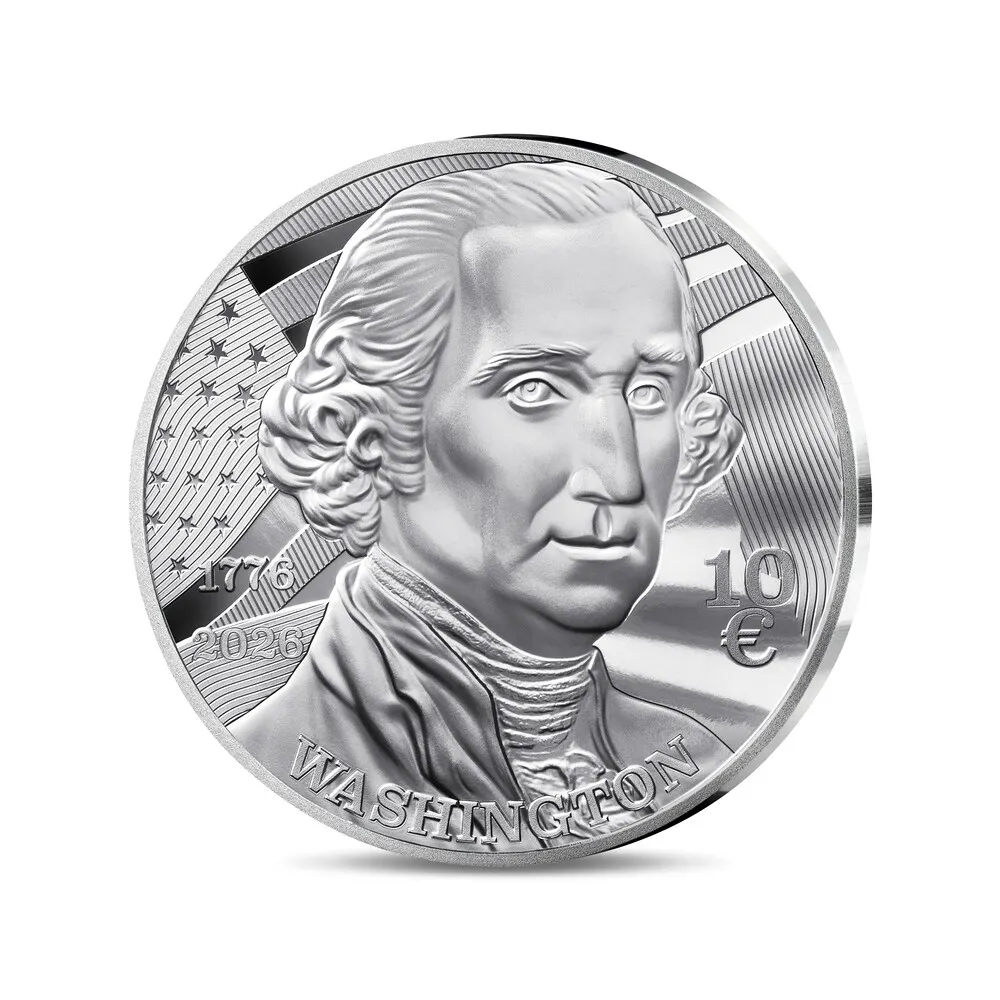
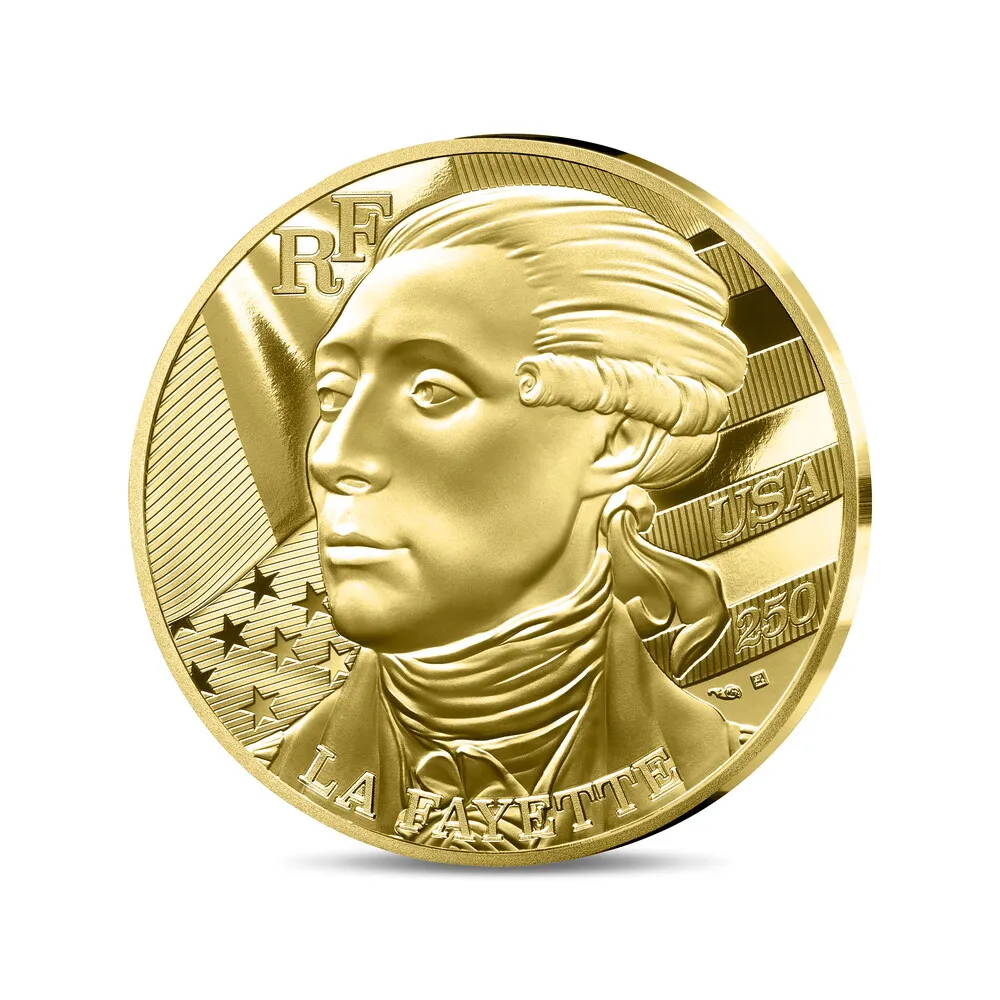
The engraver’s own framing is the most telling detail. The pairing was conceived in the style of a Franco American playing card, with one founding figure on each face, Washington on the one side, La Fayette on the other, two “brothers” of the same revolutionary moment. It is a small conceit, but it solves the central problem of a two nation tribute: how to honor both without subordinating either. On a playing card, neither side is the front.
This program is struck in proof and spans four denominations. The anchor is a 200€ gold coin, 37 mm, 999 fine, 31.1 grams, limited to just 250 pieces and priced at €5,375.00. Below it sit a 50€ gold (22 mm, 7.78 g, mintage 1,000) at €1,350.00 and a 10€ silver proof (37 mm, 22.2 g, mintage 5,000) at €131.00, the entry point for the whole collection. The standout, though, may be the 50€ silver high relief piece: 50 mm, a hefty 155.5 grams of 999 silver, capped at 1,000 examples and offered at €987.00. High relief is where the engraving workshop’s homage to its eighteenth century predecessors is meant to show, and a 50 mm canvas gives it room to.
Washington & La Fayette
Portrait series · proof finish · the two founders on obverse and reverse
| Issue | Metal | Ø | Weight | Mintage | Price |
|---|---|---|---|---|---|
| €200 gold | Gold 999‰ | 37 mm | 31.1 g | 250 | €5,375 |
| €50 gold | Gold 999‰ | 22 mm | 7.78 g | 1,000 | €1,350 |
| €50 silver high relief | Silver 999‰ | 50 mm | 155.5 g | 1,000 | €987 |
| €10 silver | Silver 999‰ | 37 mm | 22.2 g | 5,000 | €131 |
What collectors are weighing
Across both programs, the collection prices from €131.00 to €28,200.00, a spread wide enough to suit a casual buyer and a serious one from the same catalogue. The decisions worth making are at the edges. The 250 piece gold portrait coin and the 1,000 piece high relief silver are the issues most likely to settle quickly, and the antique finish Libertas golds are the ones whose appeal rests as much on concept as on metal. The proof portrait silver at €131.00, by contrast, is built to be the piece most people actually take home.
A friendship struck twice
There is something quietly fitting about Paris being the place that tells this particular story again. In 1783 the Monnaie de Paris gave the young United States its first great self portrait and handed the only gold examples to a king and queen who would not survive the decade. In 2026 the same institution reissues that vision of Liberty for a republic turning 250, and pairs her with the two men who carried the alliance between the wars. The medal that once announced America to the world now marks how long the world has known it.