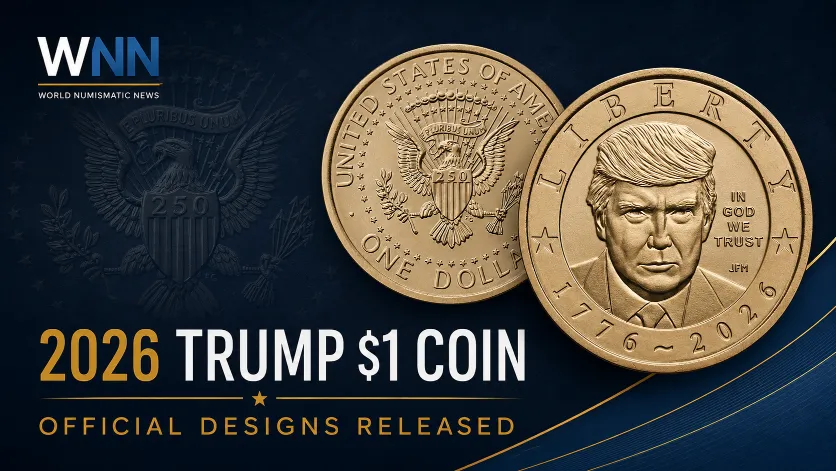
The United States Mint published the official designs and the full technical specifications for the 2026 Semiquincentennial President Donald J. Trump $1 Coin on August 4, three weeks after Treasury Secretary Scott Bessent first showed the finished artwork to the public. The Mint’s announcement moves the coin from a Treasury reveal to a documented product: struck at Philadelphia, carrying a plain edge and no mint mark, with $1 Coin Rolls and Bags expected to go on sale within the next few months.
For collectors, the specification table is the story. It settles the questions that have circulated since July, what the coin is actually made of, whether there is any gold in it, where it will be struck and how it will be sold, and it confirms a set of design decisions that quietly separate this dollar from every other golden dollar currently in production.
What the U.S. Mint Announced on August 4
The release came as a standard Mint press announcement rather than a political event, which is itself part of the news. Mint Director Paul Hollis framed the designs as a depiction of America’s past, present and future, and said he was “honored to be a part of this historic milestone” in the nation’s coinage. That is the first time the Mint’s own director has spoken publicly about a coin that Treasury has been announcing on its behalf since October 2025.
The product listing on the Mint’s website carries a short note of its own: numismatic product availability is expected in late fall 2026. The coin itself is to be released into circulation this fall, with rolls and bags sold exclusively through the Mint.
The Obverse: Joseph Menna’s Portrait, Sourced From a White House Photograph
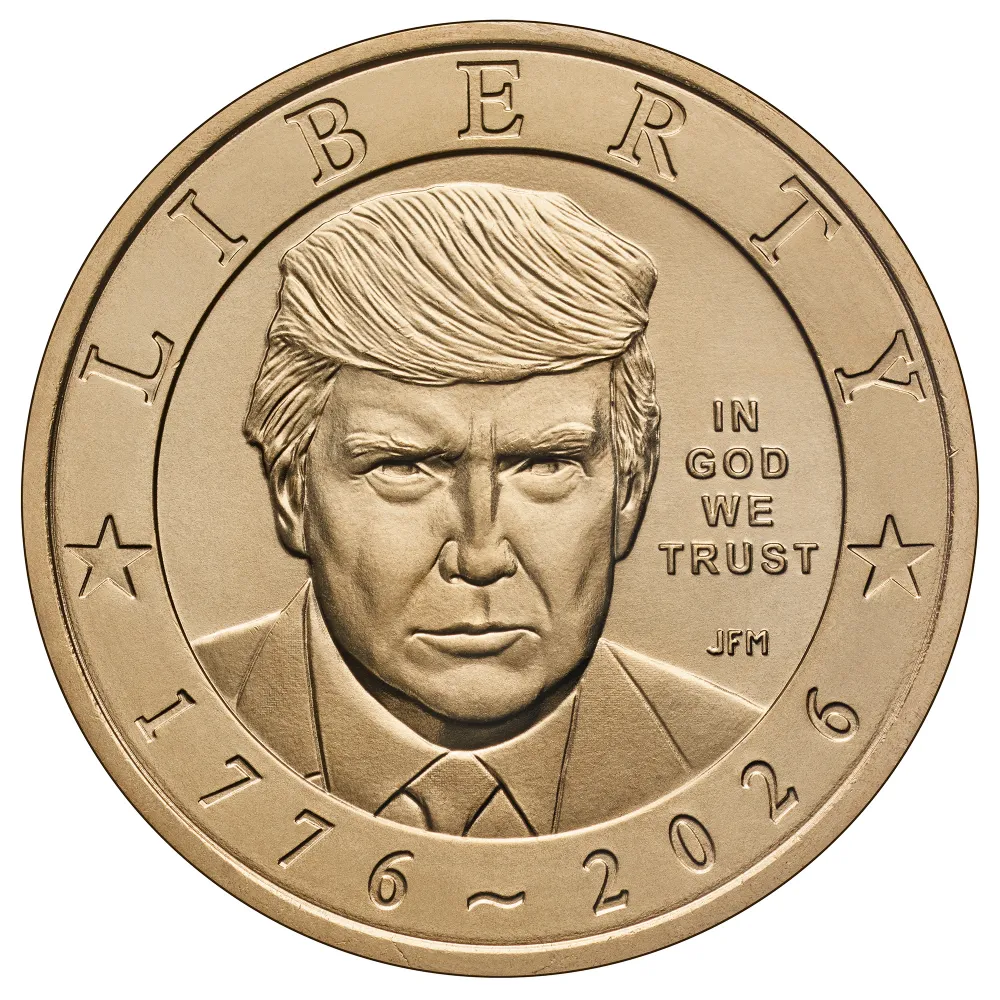
United States Chief Engraver Joseph Menna designed the obverse, working from an official White House photograph taken by Daniel Torok. The portrait faces very nearly forward, and carries the inscriptions LIBERTY, IN GOD WE TRUST and the dual date 1776~2026.
That portrait was not the one the Commission of Fine Arts preferred. The CFA had recommended a profile obverse and a heraldic eagle reverse adapted from the Great Seal, and neither recommendation was adopted. The Citizens Coinage Advisory Committee, which normally reviews Mint design portfolios, did not review this one at all, a point that produced a pointed exchange at a subsequent CCAC meeting. Design recommendations from both bodies are advisory; the final selection belongs to the Secretary of the Treasury.
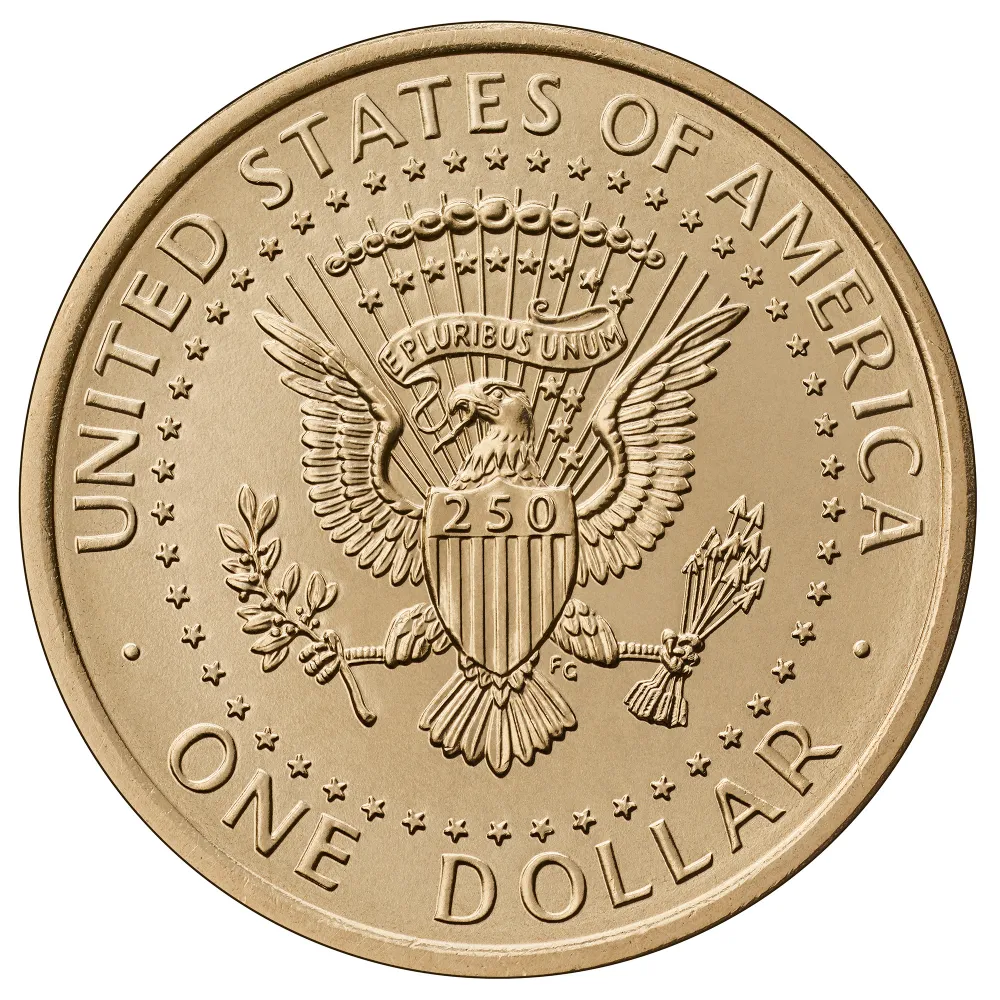
The Reverse: Frank Gasparro’s Presidential Seal, 25 Years On
The reverse is credited to former Mint Chief Engraver Frank Gasparro, who died in September 2001. Collectors will recognize it immediately, because it has been in American pockets since 1964. Gasparro adapted the Presidential Seal for the John F. Kennedy Presidential Series Medal and then carried it onto the reverse of the Kennedy half dollar, where the eagle holds an olive branch and a bundle of arrows, a shield sits on its breast and a banner reading E PLURIBUS UNUM runs through its beak.
The only alteration of consequence is the numeral 250, placed inside the shield to mark the Semiquincentennial. The surrounding inscriptions are UNITED STATES OF AMERICA and ONE DOLLAR. It is an unusually conservative choice for a coin that has attracted the attention this one has, and it produces a genuine curiosity of attribution: a 2026 circulating coin whose reverse carries the design credit of an engraver who retired in 1981.
2026 Trump $1 Coin Specifications: Plain Edge, No Mint Mark, No Gold
The composition is the standard manganese brass alloy used for the golden dollar since 2000: 88.5% copper, 6% zinc, 3.5% manganese and 2% nickel. There is no gold in it. The gold color is the alloy, not a coating and not bullion, and the coin is legal tender at face value.
The weight, diameter and thickness are identical to those of the Sacagawea, Presidential, Native American and American Innovation dollars, which means the Mint is striking this coin on its existing dollar planchet with existing tooling.
The interesting departure is at the edge. Every circulating dollar since 2007 has carried incused edge lettering, with the date, mint mark and E PLURIBUS UNUM rolled into the third side of the coin. This one does not. The edge is plain, there is no mint mark and no privy mark, so the date has moved to the obverse and the motto to the reverse banner. The practical consequence for collectors is that the edge lettering varieties that have kept attributors busy across the Presidential and Native American series simply cannot occur here.
| Specification | Detail |
|---|---|
| Denomination | $1 |
| Composition | 88.5% Cu, 6% Zn, 3.5% Mn, 2% Ni |
| Weight | 8.10 g (0.286 oz) |
| Diameter | 26.49 mm (1.043 in) |
| Thickness | 2.00 mm (0.079 in) |
| Finish | Circulating |
| Edge | Plain |
| Mint | Philadelphia |
| Mint mark | None |
| Privy mark | None |
Rolls, Bags and Release Date: What Collectors Can Expect
The Mint has confirmed the product format and nothing beyond it. Rolls and bags are coming, exclusively from the Mint, in the next few months, with numismatic availability expected in late fall. Price, mintage, household limits and an order date have not been announced.
Two things are worth holding onto while waiting for those numbers. The first is that 2026 now carries three separate dollar programs running in parallel: the Native American dollar honoring Polly Cooper and the Oneida Indian Nation, the American Innovation dollar for Iowa featuring Norman Borlaug, and this one. The second is that Philadelphia is the only announced production facility, which puts every roll and every bag on the same footing.
The Legal Question, Answered by Citation
The press release cites its authority directly: 31 U.S.C. §5112(y)(1)(C) and the Circulating Collectible Coin Redesign Act of 2020, Public Law 116-330, under which the Secretary may issue a new $1 coin for a single year beginning January 1, 2026.
That citation is the Mint’s answer to the objection that has followed the coin since the first draft designs appeared. Critics, including members of Congress who wrote to Secretary Bessent in December, point to 31 U.S.C. §5114(b), the codified descendant of an 1866 statute, which provides that only the portrait of a deceased individual may appear on United States currency and securities. The 2020 Act does not address the point either way. The administration’s position is that a specific, time limited authorization for a Semiquincentennial dollar governs over the general prohibition.
A suit filed in Oregon sought to block production on the §5114 argument. The court declined to reach the merits, finding the plaintiff lacked standing, which leaves the statutory question live but unlitigated. The Mint has also noted precedent in prior filings, principally the 1926 Sesquicentennial half dollar bearing Calvin Coolidge and a 1995 Special Olympics silver dollar depicting Eunice Kennedy Shriver.
What Happens Next
The coin now has designs, specifications, a mint and a product format, and lacks only the numbers that will determine how collectors experience it. Price and mintage will decide whether this becomes the season’s sellout or simply another dollar sitting in the Mint’s catalogue, and the household limit, if there is one, will decide how quickly the secondary market forms. There is a larger question underneath all of that. Since Treasury halted circulating production of dollar coins in 2011, the denomination has effectively been a collector product wearing circulating clothes. This is the first dollar in 15 years that the Mint says will actually be released into circulation, and whether it gets there, or goes straight from the roll into a flip, may end up being the most revealing thing about it.