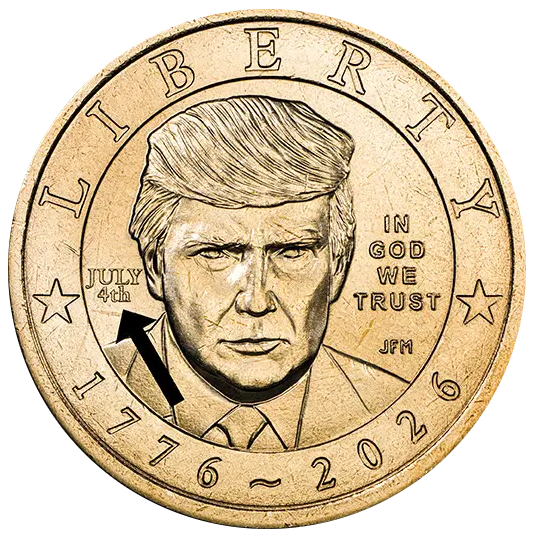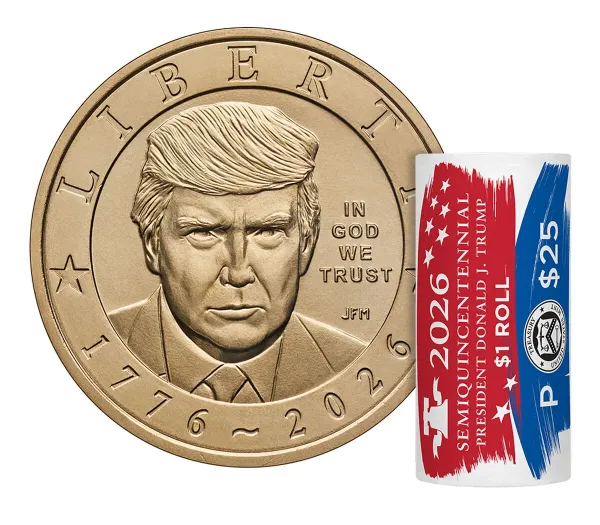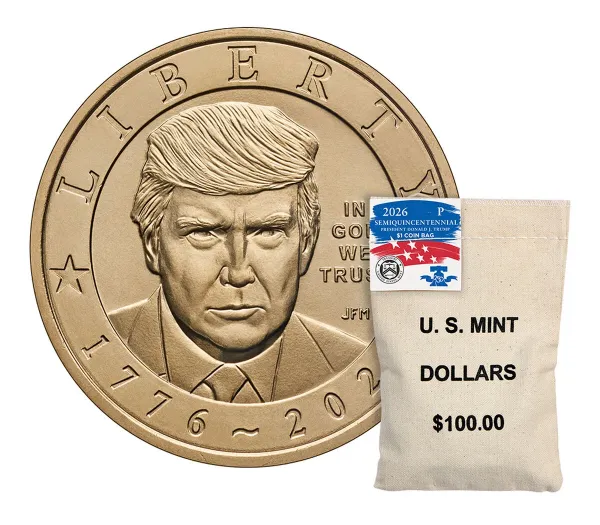
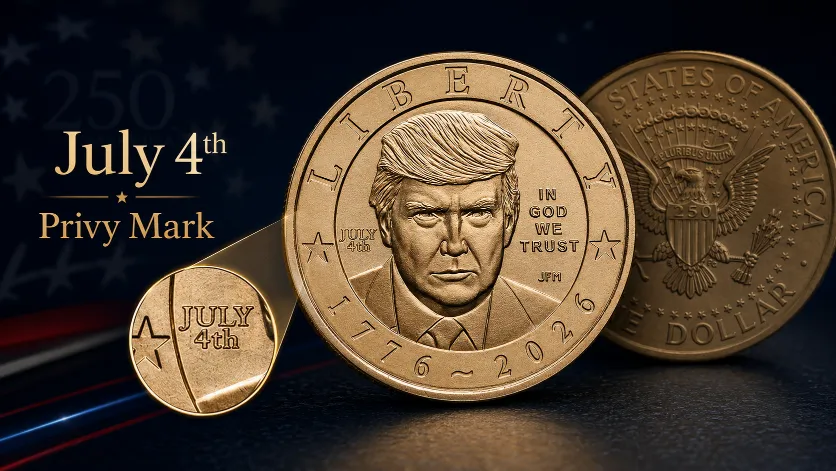
Two lines of text, small enough to miss at arm’s length, are doing most of the work in the United States Mint’s September 2 release. The inscription reads JULY 4th. It sits in the open left field of the obverse. And 250,000 of the 2026 Semiquincentennial President Donald J. Trump $1 Coins carry it.
That inscription is a privy mark, and this is the second time in 2026 the Mint has used this particular one. The first was on a quarter that cost 25 cents to find. The second is sealed inside a numismatic product with a $61 entry price. Knowing what the mark is, where exactly it sits, and how the Mint has been deploying privy marks all year is the difference between knowing what you are looking for on September 2 and hoping you will recognise it.
What a Privy Mark Actually Is
A privy mark is a small symbol or inscription added to a coin to communicate something about its production. It is not a mint mark, and the distinction matters. A mint mark tells you where a coin was struck. A privy mark tells you something else: which moneyer struck it, when a specification changed, or, in modern practice, what the coin is commemorating.
The device is old. Privy marks appear on English coinage under Edward III in the 14th century, used by clerks to distinguish coins struck at different times and to keep the minting process accountable. The name descends from the Old French prive, in turn from the Latin privatus, meaning set apart or private. That was the original logic: anyone inside the system could read the mark, while the person spending the coin would never notice it was there.
Modern mints have inverted that logic completely. A privy mark is now something you are meant to notice, and increasingly something you are meant to hunt for.
Where the July 4th Privy Mark Sits on the Trump Dollar
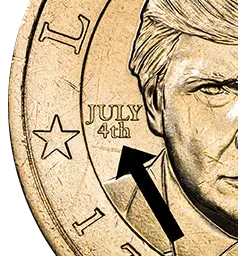
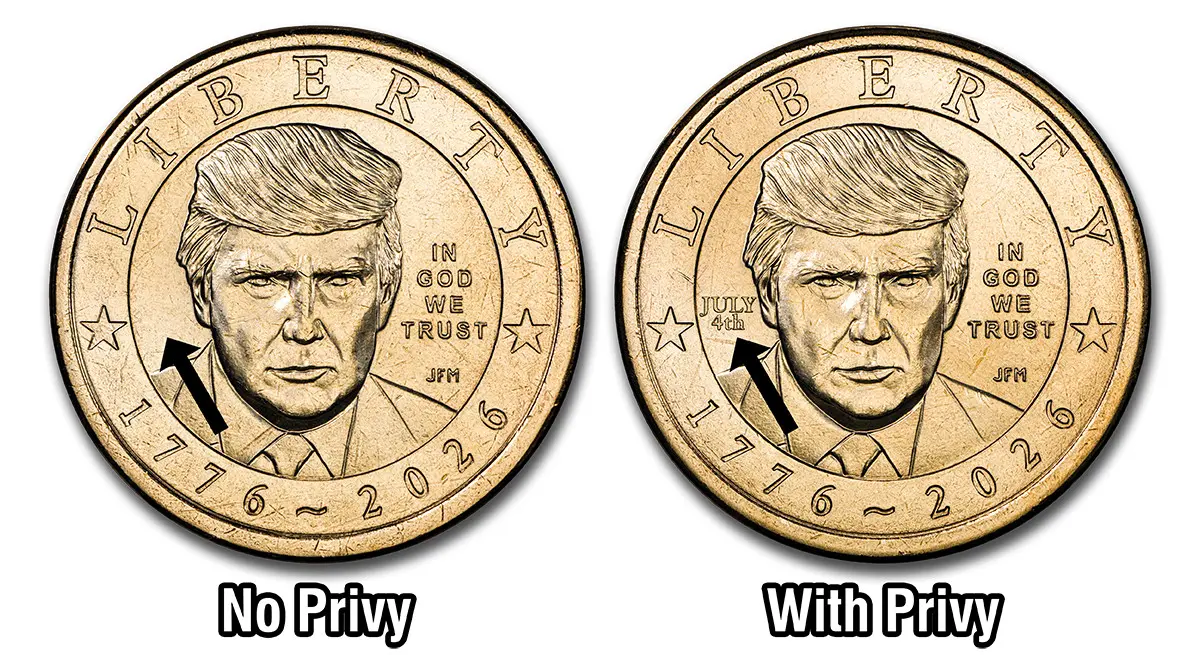
On the obverse, in the open field to the left of the portrait.
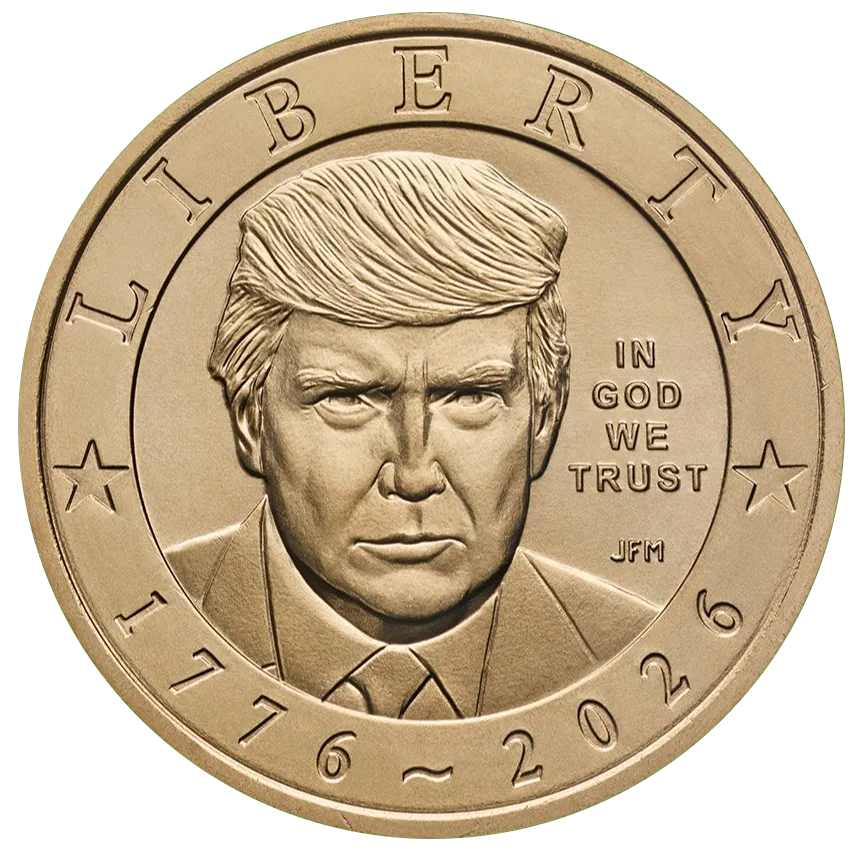
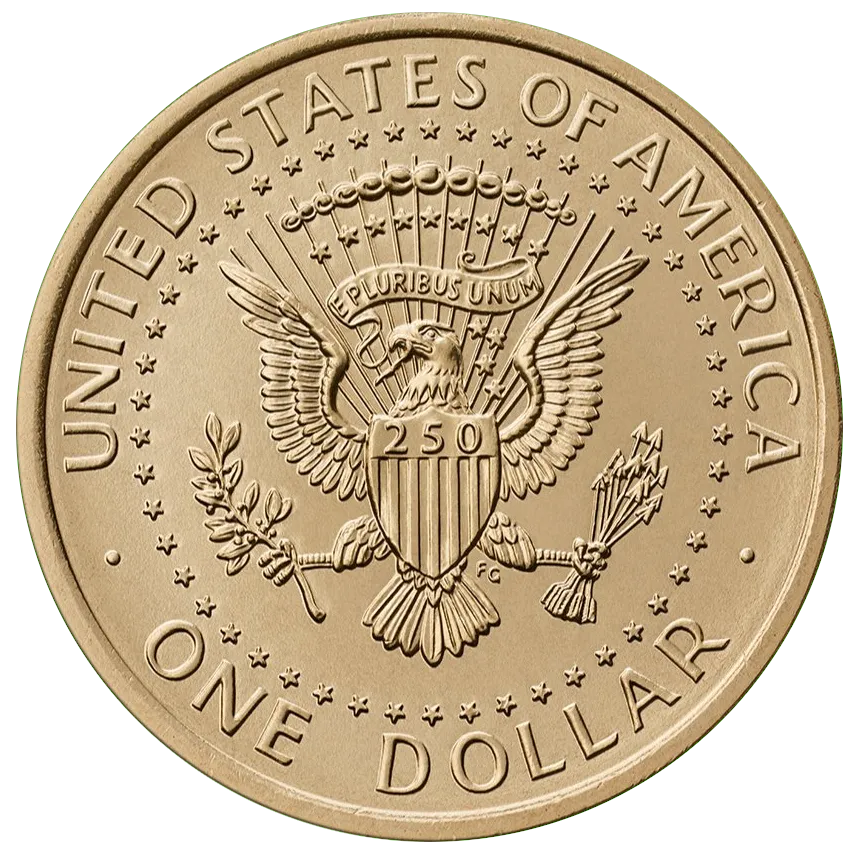
Images released by CAC Grading show a small two line inscription, JULY above 4th, positioned directly above the five pointed star in the lower left field. It is recessed into an area that is entirely blank on the standard coin, which is what makes side by side comparison the fastest way to confirm one. The rest of the obverse is unchanged: LIBERTY arcing above the portrait, IN GOD WE TRUST at right, and the dual date 1776 ~ 2026 across the lower field. CAC’s photographs show no corresponding change to the Presidential Seal reverse.
Everything else about the marked coin matches the standard issue. Both were struck at Philadelphia, both carry no mint mark, both have a circulating finish, and both share the same manganese brass composition of 6% zinc, 3.5% manganese, 2% nickel and the balance copper, at 8.100 grams and 26.49 mm on a plain edge. The privy is the only difference between them, which is precisely why it carries a premium.
One practical obstacle is worth knowing before September 2. The Mint wraps its rolls by automated machine and gives no guarantee which side of a coin will face outward at either end. There is no way to check a sealed roll for the mark. The wrapper has to come off.
The Same Mark on a Quarter, and a Completely Different Hunt
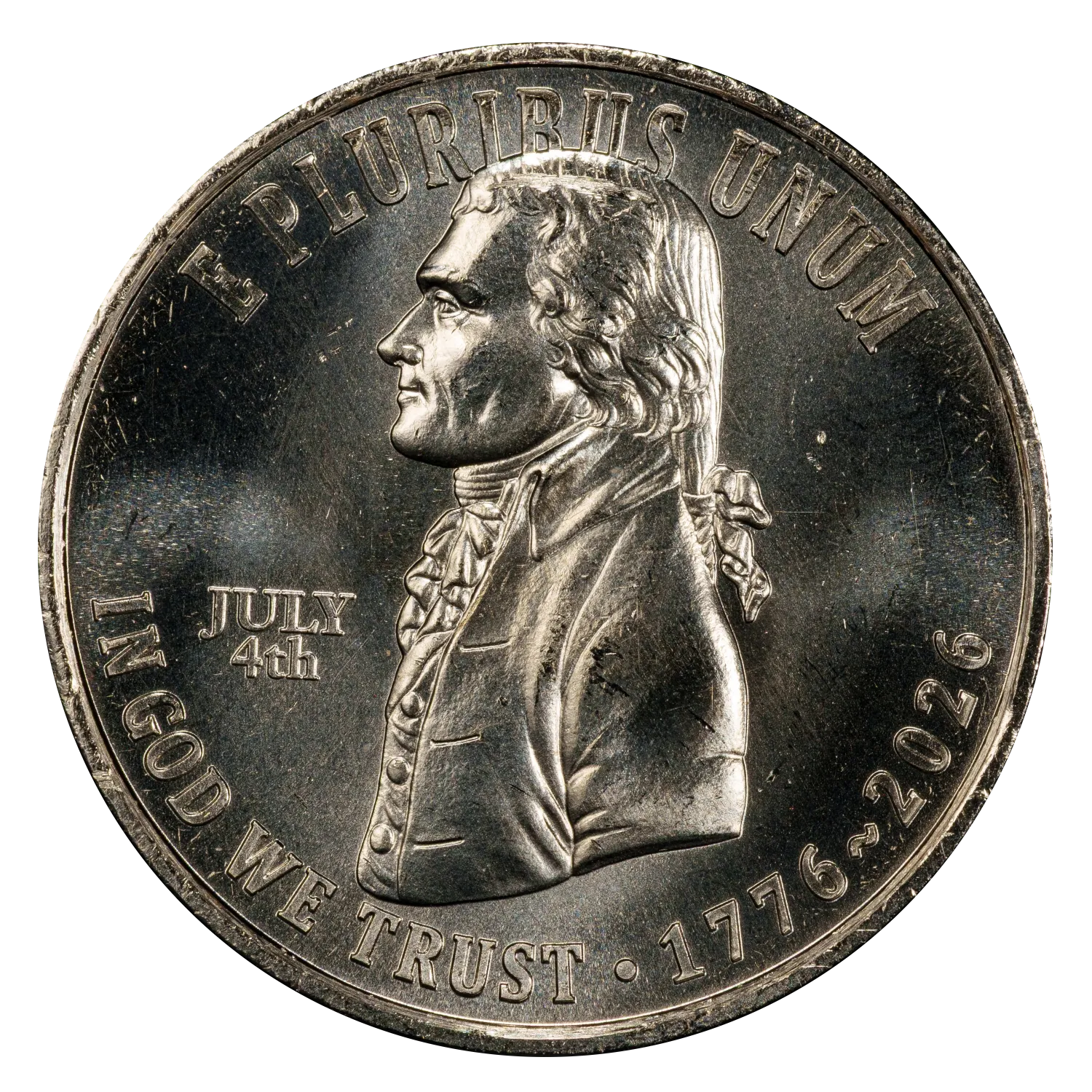
The July 4th privy is not new to 2026 coinage. It debuted on the Declaration of Independence quarter earlier this year, in the same quantity and in a strikingly similar position: on the obverse, in the field to the left of Thomas Jefferson’s portrait, on coins struck without a mint mark.
What differed was the delivery. The Mint did not sell those 250,000 quarters. It mixed them randomly into bulk shipments bound for Federal Reserve Banks and let them find their own way into the nation’s cash drawers. The grading services turned that into a national event: NGC posted a $2,500 bounty for the first submission, claimed by Mike Trout of Bennettsville, South Carolina, whose coin cleared the grading room on July 6 and graded NGC MS 66. PCGS answered with a $5,000 Quarter Quest bounty awarded on earliest postmark rather than order of arrival, carrying a First Discovery pedigree, with an Early Find pedigree available for 90 days afterwards.
The dollar reverses every one of those conditions. Nobody will find one in change, because the Mint has placed the marked coins inside products that cost $61 for a 25 coin roll and $154.50 for a 100 coin bag. The quarter was free to look for and impossible to buy. The dollar is impossible to find and must be bought first. The mark is identical. The economics around it are not.
2026 Is the Year the Privy Mark Became Standard at the U.S. Mint
The July 4th mark is one of several the Mint has put into circulation and into numismatic products this year, to the point where the privy mark has stopped being an occasional flourish and started functioning as the Semiquincentennial’s house device.
| 2026 issue | Privy mark | Quantity | Mint | How to get one |
|---|---|---|---|---|
| Declaration of Independence quarter | JULY 4th, obverse left field | 250,000 | Philadelphia, no mint mark | Random into circulation via Federal Reserve |
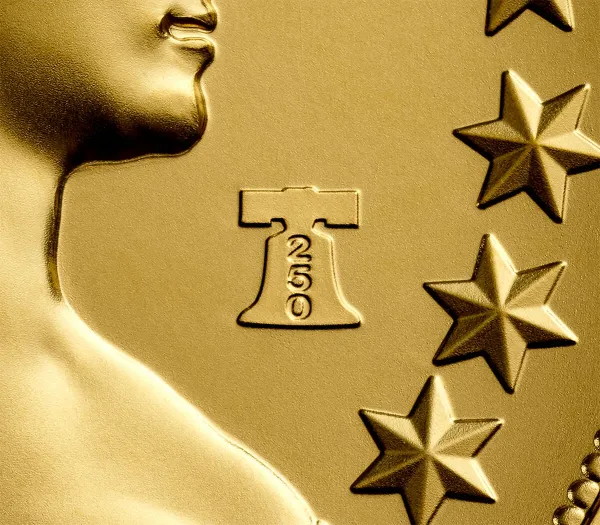
| Morgan and Peace silver dollars, enhanced uncirculated | Liberty Bell with “250” | 250,000 limit each | West Point, no mint mark | Mint sale, August 25, $169 each |
| Enduring Liberty half dollar | “9-11-01” encircled by ALWAYS REMEMBER | 2,983 | West Point, W mint mark | Not offered for public sale |
| Best of the Mint gold coins | Liberty Bell | Set mintages vary | West Point | Mint sale, by set |
| President Donald J. Trump $1 Coin | JULY 4th, obverse left field | 250,000 | Philadelphia, no mint mark | Interspersed in rolls and bags, September 2 |
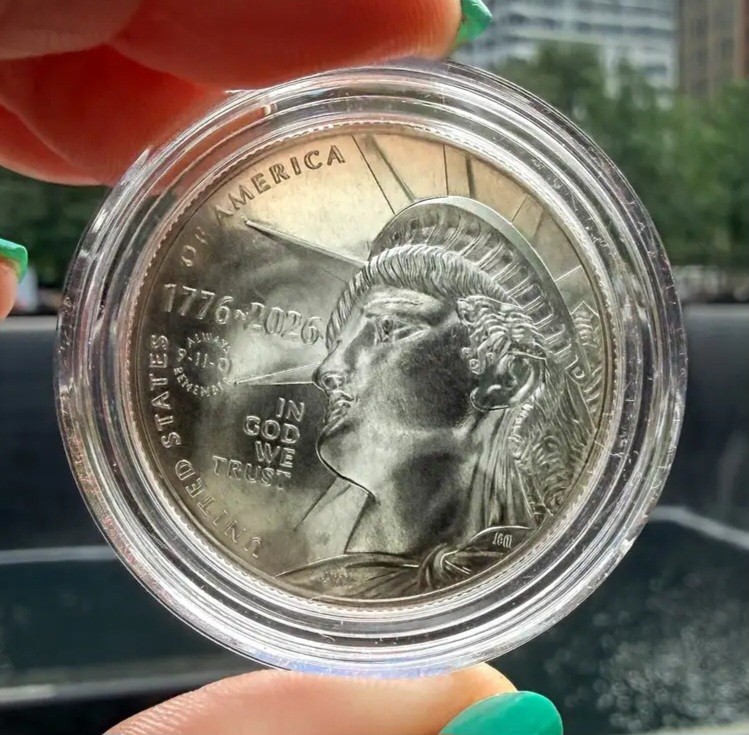
The Enduring Liberty half dollar is the outlier and the most affecting of them. The Mint struck 2,983 of those coins at West Point, one for each name inscribed at the National 9/11 Memorial, and presented them to the Memorial and Museum on August 21 ahead of the twenty fifth anniversary observances. They were never offered for sale. A privy mark used that way is closer to its medieval function than to its modern one: a mark that means something specific to the people who can read it.
The Mint has described the privy Trump dollars as first of their kind. The claim needs a qualifier to survive that table. What appears to be genuinely new is a circulating quality dollar carrying a privy mark, not the privy mark itself, and not the year’s use of one.
The Mint Has Done This Before
American coinage has carried privy marks, or their functional equivalent, for far longer than 2026 suggests.
From 1853 to 1855 the Mint placed arrows beside the date on silver coins to signal a reduction in weight. Its own records do not call them privy marks, but they did the job of one. The 1921 Alabama half dollar carries a 2X2 in the field and the Missouri half dollar a 2X4, both added to help sales, and the 1922 Grant commemorative half dollar and gold dollar were struck with a star for the same reason. Between 2009 and 2014, the Preamble to the Constitution platinum proof series carried a small eagle that shifted position from coin to coin.
The modern run began in 2019, when the American Innovation dollar series adopted a gear shaped privy, and accelerated sharply the following year. In 2020 the Mint struck America the Beautiful quarters at West Point bearing a V75 privy inside a cartouche shaped like the Rainbow Pool at the World War II Memorial, then mixed them into bulk bags of Philadelphia and Denver quarters shipped to Federal Reserve Banks. That is the same distribution mechanic the July 4 quarter used six years later. The 2021 American Silver Eagle added a star privy, which the Mint records as the first privy mark used on a bullion coin.
Read against that history, 2026 is not an invention. It is an escalation.
What a July 4th Privy Mark Is Worth
The quarter is the only usable evidence, and its curve is a caution rather than a promise. Early examples carried four figure asking prices in the first days of the hunt. Raw examples now change hands in the region of $100 to $200, a fall of roughly an order of magnitude inside two months, driven by the simple fact that 250,000 coins are a great deal more than the first week of a hunt makes them feel.
Three structural differences will shape the dollar’s own curve. Supply arrives faster, because 250,000 coins distributed through two products on one afternoon reach the market in days rather than trickling out of bank drawers over a season. The cost floor is higher, because each coin in a roll costs $2.44 and each coin in a bag costs $1.545 before anyone has found anything. And the supply will be more concentrated, because a household limit of two per product still favours buyers able to move at noon on a Wednesday.
Two things are worth resisting. Ratios circulating on social media and at shows are not Mint figures, and the Mint has published product limits rather than a mintage limit, which are not the same thing. A product limit caps how many units the Mint sells under a given code. It does not tell you how the 250,000 marked coins are spread across them, or whether all of them will pass through these two products at all.
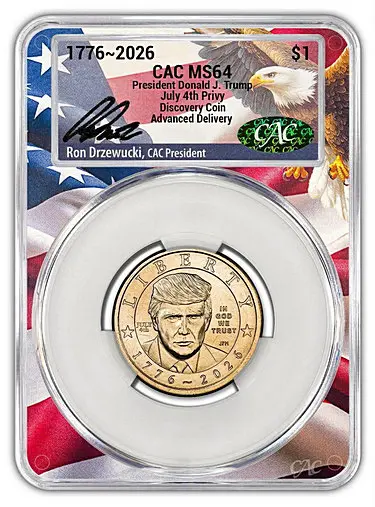
The one piece of the story that cannot be repeated is already settled. Heritage Auctions numismatist Rene Alvarenga found the first documented example in an Advanced Delivery roll before the Mint had explained the programme, CAC Grading certified it MS64 and labelled the holder “July 4th Privy,” “Discovery Coin” and “Advanced Delivery,” and Heritage intends to donate it to the American Numismatic Association. Every other privy dollar shares the design. Only that one carries the pedigree.
What to Watch from September 2
The interesting question is no longer what the mark is. It is what a marked coin looks like once 250,000 of them are in collector hands and the certified populations start to fill in. Modern varieties usually take months to resolve, because nobody can agree at the outset how many exist. This one arrives with a stated figure, a documented discovery, and a fixed on sale date, which is a rare set of conditions in modern American coinage and an unusually clean test of what a privy mark is actually worth once the hunt stops being new.
Frequently Asked Questions
What is the July 4th privy mark? It is a small two line inscription reading JULY above 4th, added to selected 2026 Semiquincentennial coins to mark Independence Day during America’s 250th anniversary year. It is a privy mark, not a mint mark, and it identifies a special striking rather than a striking location.
Where is the privy mark on the 2026 Trump dollar? On the obverse, in the open field to the left of the portrait, directly above the five pointed star in the lower left. That area is completely blank on the standard coin.
How many Trump dollars have the July 4th privy mark? The Mint has stated 250,000, struck at the Philadelphia Mint on the Fourth of July.
How do I get a July 4th privy Trump dollar? Only by buying the rolls and bags. The Mint is interspersing the marked coins randomly through the 25 coin rolls at $61 and the 100 coin bags at $154.50, on sale from September 2 at noon EDT. They are not sold separately, and they will not turn up in circulation.
Is the July 4th privy mark the same as the one on the 2026 quarter? It is the same inscription in a comparable position, on the obverse to the left of the portrait. The difference is distribution: the quarters went into circulation through Federal Reserve shipments, while the dollars are only available inside Mint products.
Do privy mark coins have a different mint mark? No. The privy marked Trump dollars carry no mint mark at all, exactly like the standard version, and both were struck at Philadelphia.
What is a July 4th privy mark coin worth? There is no settled market yet for the dollar. The July 4 privy quarter opened at four figure asking prices and now trades around $100 to $200 raw, which is the closest available guide and a reminder that early prices on a new hunt rarely hold.
Can you see the privy mark without opening the roll? No. Mint rolls are machine wrapped with no guarantee of which side faces outward, so a sealed roll cannot be checked.