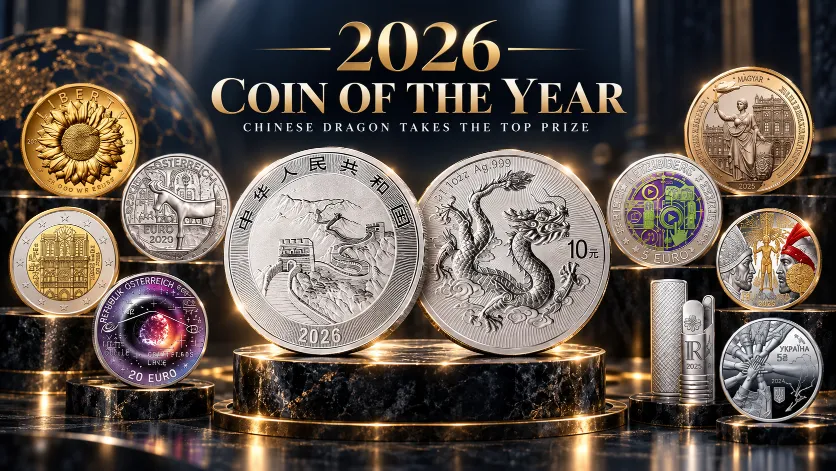
China has never won the Coin of the Year. On August 27, at the David L. Lawrence Convention Center in Pittsburgh, that changed. The 2026 Coin of the Year went to a silver 10 yuan piece struck by the Shenzhen Guobao Mint for the People’s Bank of China, catalogued as Chinese Dragon, which had already taken the Best Crown Coin category before the overall ballot was read.
It is a notable result for a competition that usually crowns an elaborate collector issue. The Chinese Dragon is a bullion coin, only the second the Shenzhen Guobao Mint has produced, and the first in what the mint intends as a continuing dragon series. It beat a field of roughly 600 coins dated 2025, judged by an international panel of more than 100 people drawn from across the numismatic field.
The Chinese Dragon
The coin works because it refuses to choose between two of the most heavily used motifs in Chinese numismatics and instead sets them against each other. The obverse carries a serpentine stretch of the Great Wall winding through a mountainous landscape, the work of engravers He Chun and Jiang Qian Qian. The reverse belongs to the dragon, coiled against a field of cloud, designed by engraver Wang Hu Ming and drawn from two specific sources: the Gilded Dragon of the Tang dynasty and the Nine Dragon Wall in Beijing’s Forbidden City.
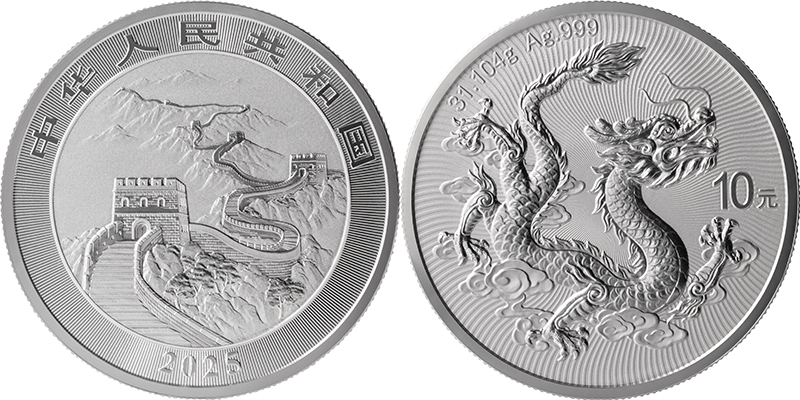
Writing for CoinsWeekly, Ursula Kampmann put the coin’s advantage in the background rather than the motifs. Both sides are worked to a fine granular texture that gives the wall its haze and the dragon its depth, on a coin that will spend most of its life being traded by weight.
China has collected COTY category nominations and category wins for years without ever taking the top trophy. It has one now.
How the Field Was Cut to Ten
The competition is presented by World Coin News and co-sponsored by the World’s Fair of Money and The Journal of East Asian Numismatics, with Numismatic Guaranty Company also listed among the 2026 sponsors. This was the fourth year the ceremony has been held alongside the American Numismatic Association’s summer show.
The worldwide call for nominations opened in early January 2026 and closed on a pool of roughly 600 coins dated 2025. In May, the COTY Nominating Committee cut that pool to ten finalists in each of ten categories, the group known as the COTY 100. The judging panel then voted, and according to organisers several categories stayed close to the final hours of counting.
Ten trophies were awarded. One coin took two of them.
Austria Takes Three
Münze Österreich left Pittsburgh with three categories, and two of them went to the same pair of designers.
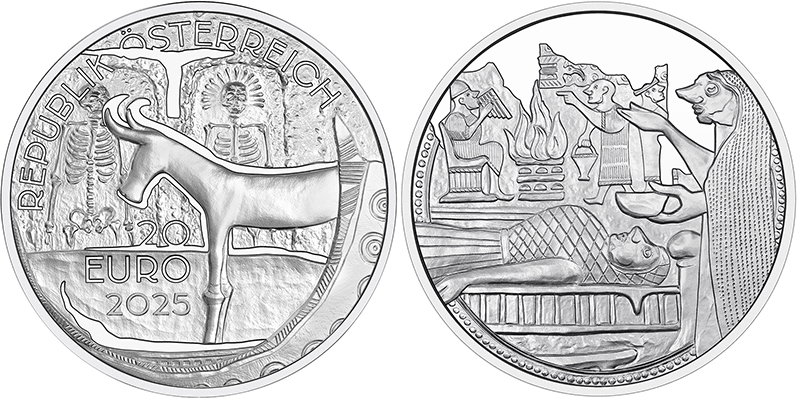
Most Historically Significant went to the 20 euro silver Beliefs and Rituals, the third and final coin in The White Gold of Hallstatt series, designed by Kathrin Kuntner and Rebecca Wilding. The series was launched in 2024 to mark Bad Ischl’s year as European Capital of Culture, and this closing issue turns to the burial ground that mine operator Johann Georg Ramsauer uncovered near the Hallstatt salt works in 1846. One face gathers the grave finds, a ceremonial cow and calf vessel, two skeletons, ornamented belt plates. The other shows a cremation, watched over by a waterbird, the creature the Hallstatt culture took as a sign of the divine because it moved freely on land, in water and in air. A coin from the same series won this same category at last year’s awards.
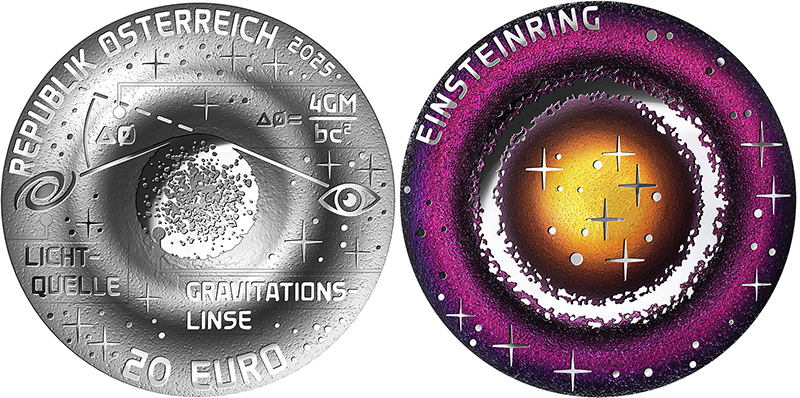
Best Silver Coin went to the 20 euro Einstein Ring, the second issue in the mint’s The Beauty of the Universe series. An Einstein ring is what an observer sees when a galaxy cluster bends the light of a more distant object around itself, producing one source that looks like several. Einstein predicted the effect and did not expect anyone would ever see it. The coin sets out the geometry on one side, complete with the deflection formula, and puts the colour printed ring on the other. Kampmann’s assessment is that this Austrian cosmology run, which has already produced two overall COTY champions, was built for exactly this outcome. The Einstein Ring is a continuation, not a surprise.
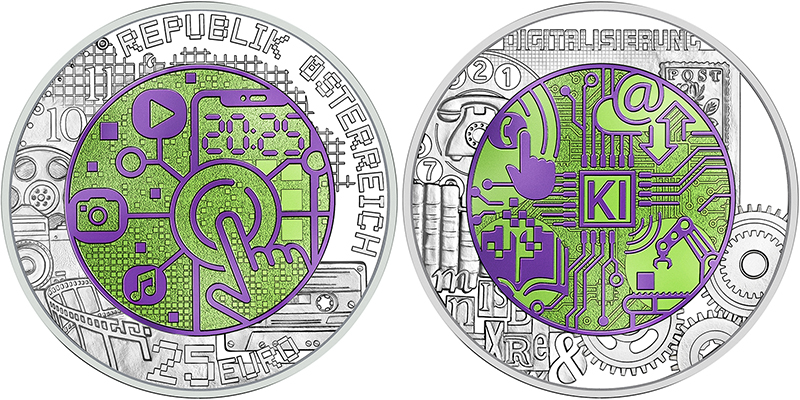
Best Bi-Metallic Coin went to the 25 euro Digitalisation, again by Kuntner and Wilding, and again to the niobium programme the Austrian Mint has been running since 2003. The green and violet of the core are not paint or ink but anodised oxidation, a colour effect produced in the metal itself. The design puts analogue objects around the silver ring, letters, rotary telephones, books, gears, printing type, and their digital descendants in the niobium centre. It is a category Austria has won so often that Kampmann suggested the more interesting question is which years it has lost.
France Takes Three
The Monnaie de Paris matched Austria’s count with three very different coins.
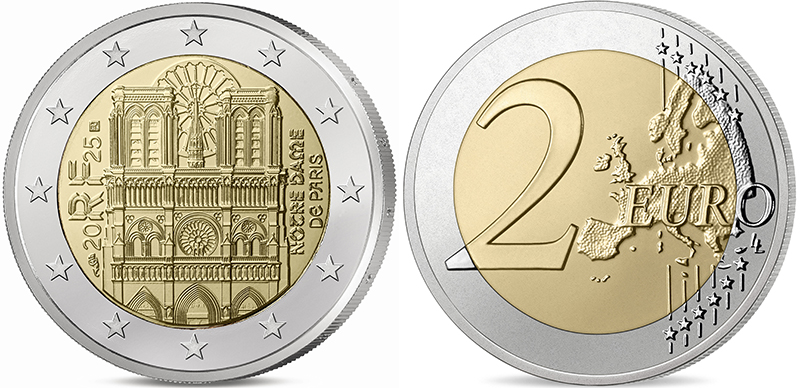
Best Contemporary Event Coin went to the 2 euro Notre-Dame, and it is the only winner this year that anyone can find in their change. Twenty million began entering circulation from late October 2025, released gradually as the mint withdrew worn pieces, carrying the cathedral’s west front, its towers and rose window, a year after the December 2024 reopening. Mint chief executive Marc Schwartz framed the issue as a tribute to the craftspeople who rebuilt the building after the 2019 fire. The design is credited to chief engraver Joaquin Jimenez. Notre-Dame won this same category for France last year, on a different coin.
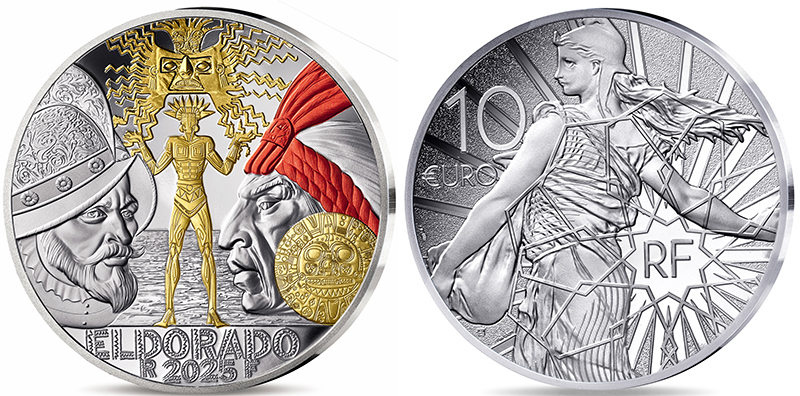
Most Artistic Coin went to the 10 euro El Dorado, part of the Semeuse series and its Myths of Gold theme. One side carries a modernised version of Oscar Roty’s Sower with a heraldic tricolour worked into her drapery. The other sets a Spanish conquistador and Atahualpa, the last Inca emperor, face to face across a gilded idol above the lake where a gold covered lord was said to have made his offerings. Two portraits, one myth, and the conquest that came of chasing it.
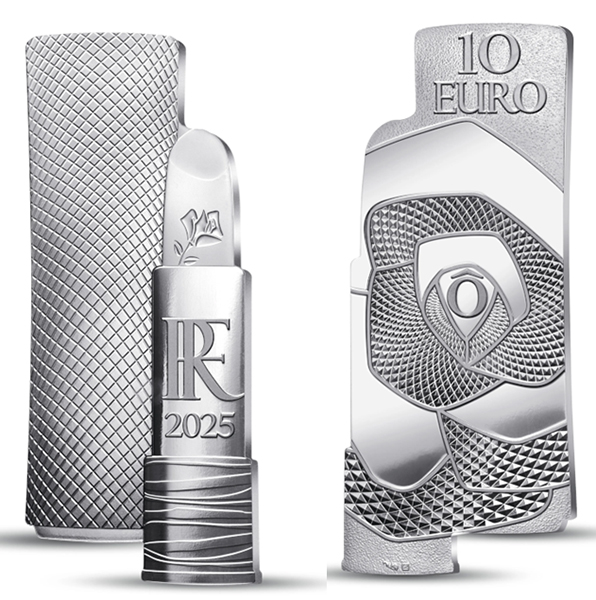
Most Innovative Coin went to the 10 euro 90 Years of Lancôme, and it is the winner that most tests the format of the competition. It is a monnaie de forme, struck in the exact silhouette of Lancôme’s L’Absolu Rouge lipstick, 55.50 by 23.46 millimetres, with a diamond pattern on the cap and Joaquin Jimenez’s rose opening across the reverse in alternating polished and guilloché finishes. Kampmann used the category to raise a fair objection: innovation is the hardest thing to judge from two flat photographs, which is all a panel usually gets. By her count, France has now taken the innovation category in each of the last three years.
Gold from the United States, Change from Hungary
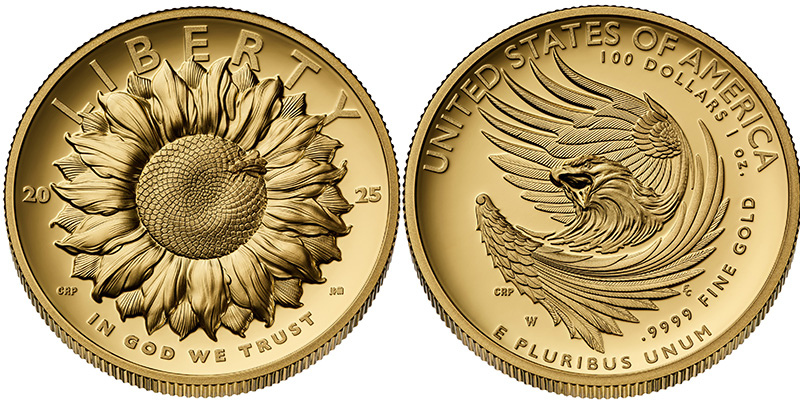
Best Gold Coin went to the United States Mint for the 2025 American Liberty $100, one ounce of .9999 gold struck in high relief at West Point to a mintage of 12,000. Christopher R. Polentz of the Artistic Infusion Program designed both sides: a sunflower and a bee on the obverse, standing for the tending that liberty requires, and a swirling, energetic eagle on the reverse. Medallic artists John P. McGraw and Eric David Custer sculpted the two designs. The eagle is the reason the category went to Washington, a national symbol handled as a living animal rather than a heraldic device.
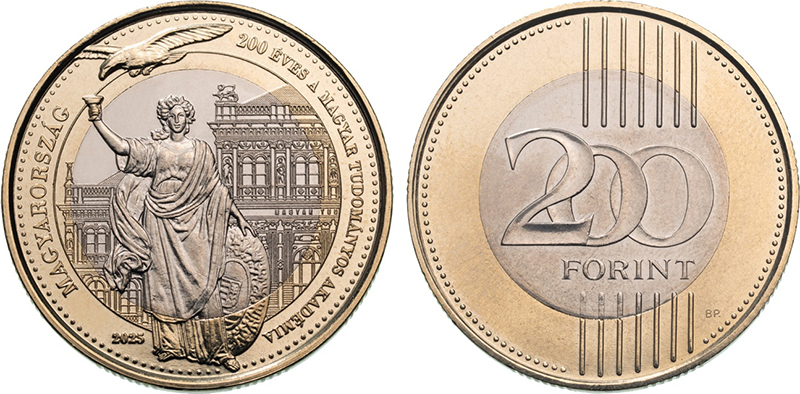
Best Circulating Coin went to Hungary for the bimetallic 200 forint marking the bicentenary of the Hungarian Academy of Sciences, designed by goldsmith János Balázs Bitó and issued in November 2025 to a mintage of one million. The institution it honours began in 1825 when Count István Széchenyi pledged a year of his estate income to found a Hungarian learned society. Hungary is not a COTY regular. Kampmann observed that its recent strength was built on the competition’s short lived People’s Choice Award, and this year it converted that standing into a category win.
Ukraine Holds the Line
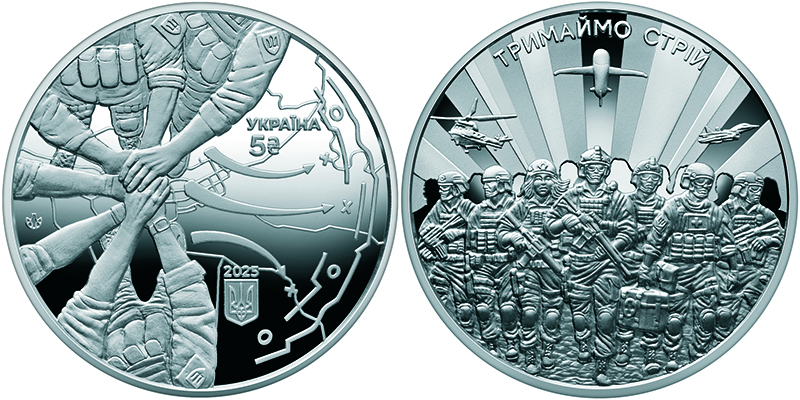
Most Inspirational Coin went, as it has in recent years, to the National Bank of Ukraine, for the 5 hryvnia nickel silver Let’s Hold the Line!, issued on 24 February 2025, the third anniversary of the full scale invasion, in a mintage of 50,000.
Andrii Sahach designed it, with engraving by Volodymyr Atamanchuk and Anatolii Demianenko. One face shows Ukrainian defenders joined hand to hand in a closed circle, set over a schematic map whose lines of defence resolve into the shape of a trident. The other shows soldiers advancing beneath aircraft and drones, with the silhouettes of civilians in various trades behind them, the home front rendered as part of the formation rather than as background.
The 2026 COTY Winners at a Glance
| Category | Country | Coin | Denomination and metal | Issuer |
|---|---|---|---|---|
| Coin of the Year | China | Chinese Dragon | 10 yuan, silver | Shenzhen Guobao Mint |
| Most Historically Significant | Austria | Beliefs and Rituals, The White Gold of Hallstatt | 20 euro, silver | Münze Österreich |
| Best Contemporary Event Coin | France | Notre-Dame | 2 euro, base metal | Monnaie de Paris |
| Best Gold Coin | United States | American Liberty | $100, gold | United States Mint |
| Best Silver Coin | Austria | Einstein Ring | 20 euro, silver | Münze Österreich |
| Best Crown Coin | China | Chinese Dragon | 10 yuan, silver | Shenzhen Guobao Mint |
| Best Circulating Coin | Hungary | Hungarian Academy of Sciences | 200 forint, base metal bimetallic | Hungarian Mint |
| Best Bi-Metallic Coin | Austria | Digitalisation | 25 euro, silver and niobium | Münze Österreich |
| Most Artistic Coin | France | El Dorado, The Sower | 10 euro, silver | Monnaie de Paris |
| Most Innovative Coin | France | 90 Years of Lancôme | 10 euro, silver | Monnaie de Paris |
| Most Inspirational Coin | Ukraine | Let’s Hold the Line! | 5 hryvnia, nickel silver | National Bank of Ukraine |
What the Results Say
Six of the ten categories went to Austria and France, and the specialist categories in particular now look close to locked. The result that matters is the one at the top. A bullion coin from a Chinese mint, sold by weight and made for a market rather than a collector cabinet, beat every collector issue put in front of the panel. Design quality on bullion has been improving quietly for years while the trophies went elsewhere. In Pittsburgh, the ballot finally caught up.
Frequently Asked Questions
What won the 2026 Coin of the Year? China’s silver 10 yuan Chinese Dragon, struck by the Shenzhen Guobao Mint for the People’s Bank of China. It also won the Best Crown Coin category.
When and where were the 2026 COTY winners announced? At the Coin of the Year ceremony on August 27, 2026, at the David L. Lawrence Convention Center in Pittsburgh, held alongside the American Numismatic Association’s World’s Fair of Money.
Why do 2025-dated coins win the 2026 award? The COTY always runs a year behind the coins it judges. The 2026 awards considered coins dated 2025, giving mints worldwide time to issue, submit, and be nominated.
Who designed the Chinese Dragon 10 yuan? Wang Hu Ming engraved the dragon reverse, taking his source material from the Gilded Dragon of the Tang dynasty and the Nine Dragon Wall in the Forbidden City. He Chun and Jiang Qian Qian engraved the Great Wall obverse.
How are the COTY winners chosen? A worldwide call for nominations produced a pool of about 600 coins. The COTY Nominating Committee cut that to ten finalists in each of ten categories, the COTY 100, and a panel of more than 100 international judges voted on the category winners and the overall champion.
Which countries won the most 2026 COTY categories? Austria and France took three each. China took two, including the overall title. The United States, Hungary, and Ukraine took one each.
Is this China’s first Coin of the Year win? It is China’s first overall Coin of the Year. Chinese issues have been nominated for and have won individual categories in previous years.
Who presents and sponsors the Coin of the Year awards? The competition is presented by World Coin News. The 2026 edition was co-sponsored by the World’s Fair of Money and The Journal of East Asian Numismatics, with Numismatic Guaranty Company also listed among the sponsors.