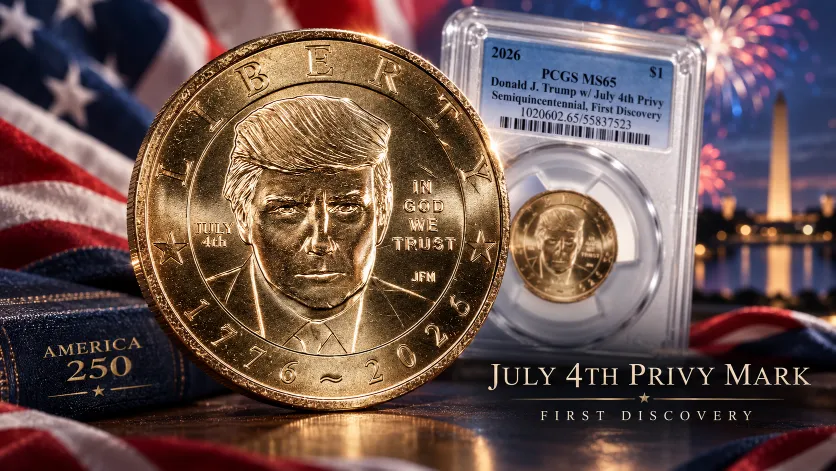
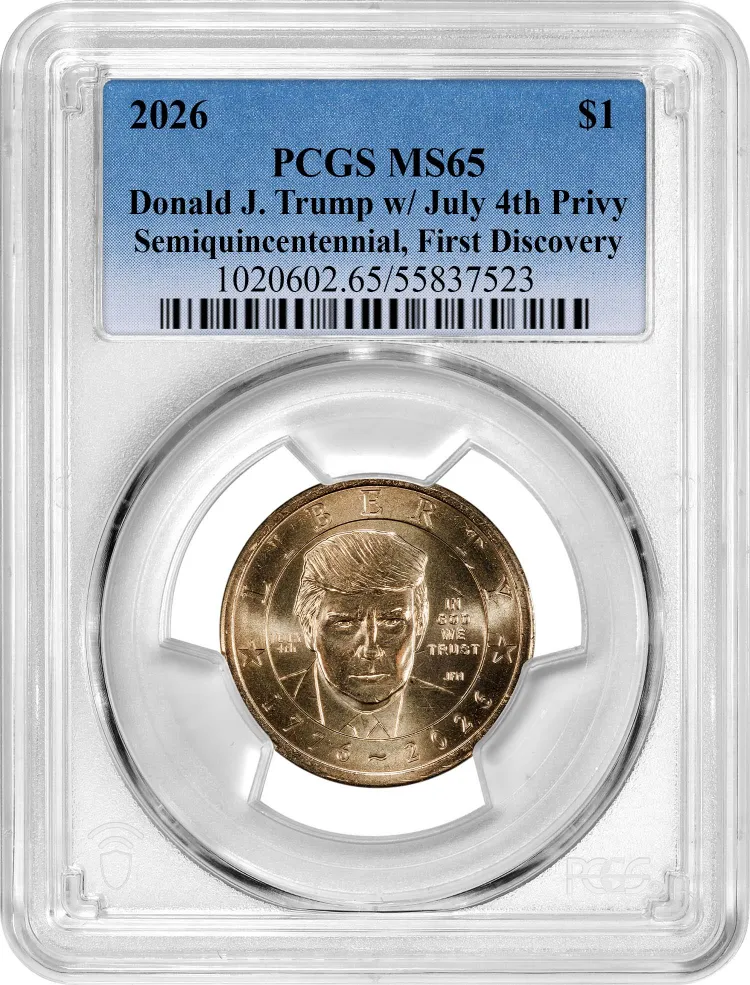
A coin arrived at a California grading room more than a week before the public was told it existed. Professional Coin Grading Service has certified what it identifies as the First Discovery 2026 Semiquincentennial President Donald J. Trump $1 Coin with the July 4th privy mark, graded MS65 and encapsulated with a First Discovery special label.
The grading itself is the smaller half of the story. When the coin landed, PCGS did not simply slab it and move on. Its experts went to the United States Mint for answers, and the answers they came back with are now the working baseline for one of the largest modern coin hunts in years.
A coin that arrived before the announcement
PCGS says it received the coin on August 24, 2026, through an advance release submission, according to <cite>PCGS</cite>. Public sales of the 2026 Trump dollar rolls and bags did not open until noon Eastern on September 2. The Mint’s own press release describing the privy marked pieces did not go out until August 27.
For three days in late August, in other words, there were confirmed July 4th privy mark dollars sitting in third party grading rooms while the Mint’s live product pages still said nothing about them at all.
What the Mint confirmed
PCGS President Stephanie Sabin said the Mint confirmed a production total of 250,000 Semiquincentennial President Donald J. Trump 2026 $1 Coins carrying the July 4th privy mark. All of them, she said, were “struck on July 4, 2026,” and were then randomly dispersed through bags and rolls of the new dollar.
That confirmation matters more than it might appear. Until it came, collectors had a documented physical coin and no published mintage, no distribution method, and no way to size the hunt. The Mint has since published the same 250,000 figure on its own product pages.
Two discovery coins, two labels
The PCGS certification is not the only claim on the story, and the two should not be confused.
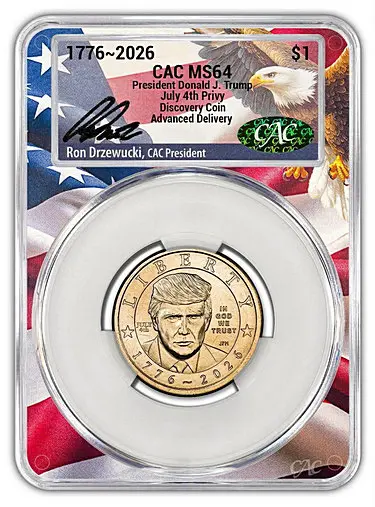
On August 26, CAC Grading announced that Heritage Auctions numismatist Rene Alvarenga had found an unannounced July 4th privy mark Trump dollar inside an advanced delivery roll. CAC certified that piece MS64 and labelled it as a discovery coin, according to <cite>CoinWeek</cite>. Heritage said it would donate the coin to the American Numismatic Association, a gesture made in the middle of the ANA World’s Fair of Money in Pittsburgh, which ran August 25 to 29.
So the hobby now has a CAC documented discovery coin announced on August 26 and a PCGS First Discovery coin received on August 24. Both designations attach to specific certified pieces and to nothing else. A July 4th privy mark dollar pulled from a roll in October is the same variety, not the same coin, and no label language transfers with the design.
Where the privy mark sits
The privy mark is easy to miss and impossible to unsee.
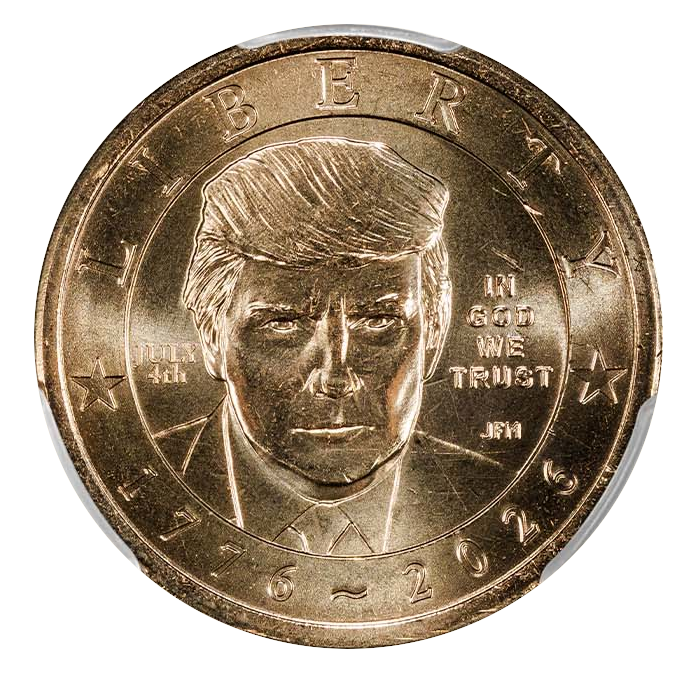
It appears on the obverse, to the left of the portrait, as a small two line inscription reading JULY over 4th, set directly above the five pointed star in the lower left field. On the standard coin that area of the field is blank.
Everything else follows the regular issue. LIBERTY arcs above the portrait, IN GOD WE TRUST sits at the right, and the dual date 1776 ~ 2026 runs across the lower obverse. Chief Engraver Joseph Menna designed the obverse from an official White House photograph by Daniel Torok. The reverse carries Frank Gasparro’s Presidential Seal, the heraldic eagle with olive branch and arrows familiar from the Kennedy half dollar, with 250 worked into the shield and E PLURIBUS UNUM on the banner.
The coin is not gold, despite the colour. It is the standard manganese brass clad dollar alloy, 8.1 grams, 26.49 mm, plain edge, struck at Philadelphia with no mintmark and a circulating finish.
The two products, and the odds inside them
The Mint did not sell the privy marked coins separately. It mixed them into the same rolls and bags everyone else was buying.
| Product | Contents | Price | Product limit | Coins at full limit |
|---|---|---|---|---|
| 25-coin roll (P) | 25 circulating quality $1 coins | $61.00 | 150,000 | 3,750,000 |
| 100-coin bag (P) | 100 circulating quality $1 coins | $154.50 | 50,000 | 5,000,000 |
A household limit of two per product applied for the first 24 hours after the noon launch.
Run the arithmetic and the shape of the hunt becomes clear. If both product limits are filled and the 250,000 marked coins are spread evenly, roughly 1 dollar in every 35 packaged carries the July 4th privy mark. That puts a 25-coin roll a little better than even money, and a 100-coin bag at something close to 19 chances in 20. Those are WNN’s own figures from the published product limits, not a Mint estimate, and they move in the collector’s favour if the Mint packages fewer units than the limits allow.
The quarter that set the pattern
This is the second July 4 hunt of the Semiquincentennial year. Earlier in 2026 the Mint struck 250,000 Declaration of Independence quarters with a July 4 privy mark and fed them into bulk shipments bound for the Federal Reserve, turning the search loose on the whole country’s pocket change.
The dollar inverts that. Same 250,000 figure, same Independence Day striking, but the coins were routed into the Mint’s own numismatic products rather than into circulation. The quarter could turn up in a cash register. The dollar, on current information, turns up in a roll someone paid $61 for.
The legal frame
The design exists because of the Circulating Collectible Coin Redesign Act of 2020. The administration’s position is that the Act authorises the Treasury Secretary to oversee special coinage for the Semiquincentennial, and that its restriction on depicting a person applies to the reverse rather than the obverse, where the portrait sits. A Treasury spokesperson has said departmental and Mint reviews found the design consistent with federal law. The reading has been publicly questioned by others, and WNN will report any formal challenge as it develops.
On the numismatic point there is less argument. This is the first time a sitting president’s portrait has appeared on a circulating United States coin. The nearest precedent, Calvin Coolidge on the 1926 Sesquicentennial half dollar, was a commemorative issue rather than a circulating one.
What happens next
The interesting number is no longer 250,000. It is how many of those coins get found, graded, and reported before the market decides what a July 4th privy mark dollar is actually worth. PCGS, NGC, and CAC Grading are already processing them under competing early release designations, and early asking prices on a newly publicised modern issue reflect excitement rather than an established market. Populations will tell that story properly in a few months. For now, the hunt is the point, and for the first time in a long while the Mint has given collectors a known quantity of something they have to go and find themselves.
Frequently asked questions
What is the Trump dollar July 4th privy mark? It is a small two line inscription, reading JULY over 4th, added to the obverse of 250,000 2026 Semiquincentennial President Donald J. Trump $1 Coins. The Philadelphia Mint struck all 250,000 on July 4, 2026. The mark identifies coins produced on that single day and appears nowhere on the standard version of the coin.
How many July 4th privy mark Trump dollars were struck? 250,000. The U.S. Mint confirmed the figure to PCGS and has since published it on its own product pages. That is the total struck, not the total known to survive or to have been found, and no population figure for certified examples has been established yet.
How do I get one? There is no way to order one directly. The Mint mixed the privy marked coins randomly into its 25-coin rolls and 100-coin bags of 2026 Trump dollars, priced at $61.00 and $154.50. You buy the standard product and search it. The alternative is the secondary market, where certified examples are already being offered.
What are the odds of finding one in a roll or a bag? If the Mint fills both product limits and the coins are spread evenly, roughly 1 coin in 35 carries the mark. On that basis a 25-coin roll is a little better than an even chance and a 100-coin bag is close to 19 chances in 20. This is WNN arithmetic from the published product limits of 150,000 rolls and 50,000 bags, not a Mint estimate.
Where exactly is the privy mark on the coin? On the obverse, to the left of the portrait, directly above the five pointed star in the lower left field. It reads JULY on the first line and 4th on the second. On a standard coin that part of the field is empty, which makes side by side comparison the fastest way to check a roll.
Is the Trump dollar made of gold? No. The golden colour comes from the manganese brass clad composition used for modern U.S. dollar coins, roughly 6% zinc, 3.5% manganese, 2% nickel, and the balance copper. Each coin weighs 8.1 grams, measures 26.49 mm, and is legal tender at one dollar.
What does “First Discovery” on the PCGS label mean? It identifies that specific coin as the first example of the variety PCGS examined and certified, received on August 24, 2026 through an advance release submission. It is a designation attached to one piece. Other July 4th privy mark dollars share the variety, not the designation, and CAC Grading has separately labelled a different coin as its own discovery example.