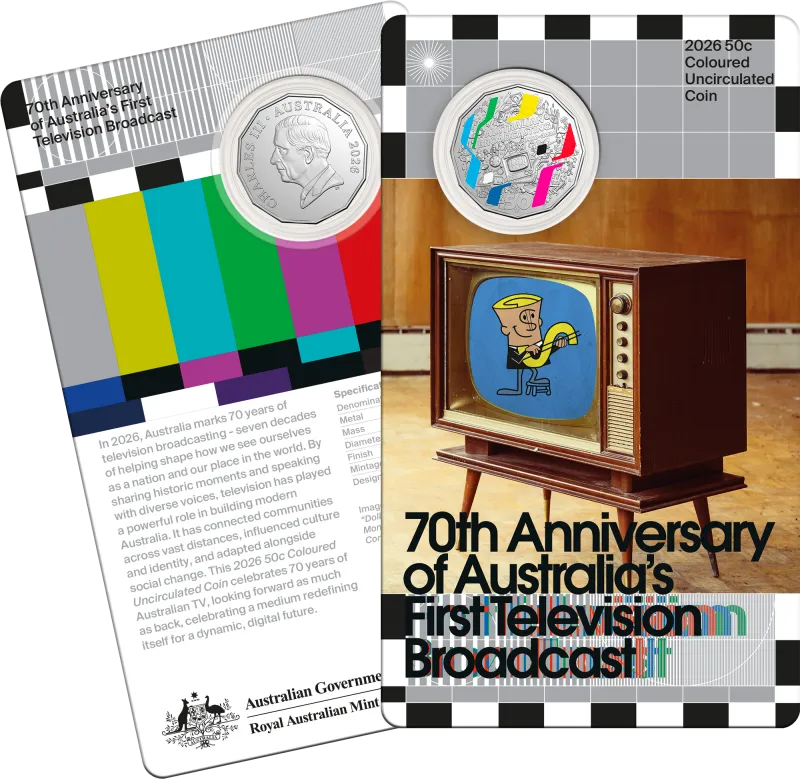
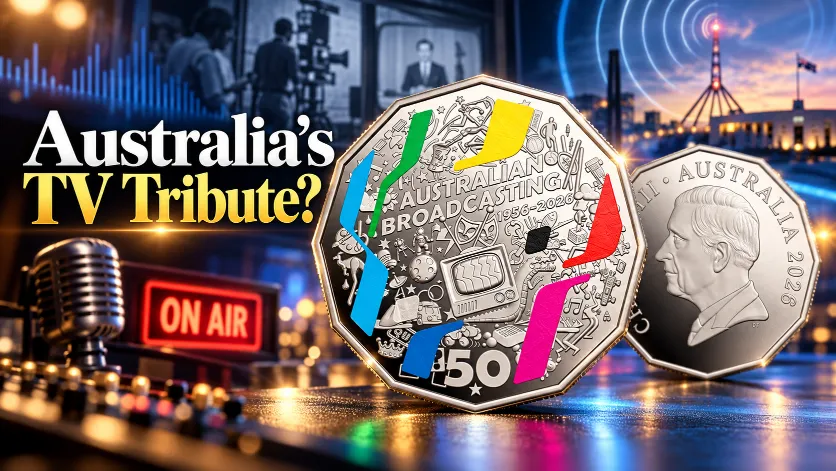
The Royal Australian Mint has turned the television test card into coinage. Its 2026 Australian television 50c coin marks 70 years since the country’s first TV broadcast, pairing a reverse crowded with small icons from the nation’s viewing history with a bold print of the colour bars every Australian of a certain age will recognise from late nights and early mornings. The issue comes in two finishes, a coloured uncirculated 50c and a coloured silver proof, and went on sale through the Mint in mid September after a short ballot for its EQL program.
It is an anniversary coin in the truest sense. The design does not celebrate a single programme or personality. It celebrates the habit itself, the living room gathering around the set that Australians have been doing since 1956.
Seventy years of the telly
Australian television went to air on 16 September 1956, timed to arrive before the Melbourne Olympic Games, with presenter Bruce Gyngell welcoming the first viewers to the new medium. The early years were black and white, heavy wooden cabinets and families huddled around newsreels, variety hours and children’s programming. Colour arrived in 1975, and with it came the era of shows like Countdown and a new vividness for sport and drama.
The Mint’s own account of the decades that followed names Neighbours, Play School and Four Corners as programmes that shaped national conversation, and credits satellite links and regional broadcasting with carrying television into remote communities. Today the medium spans free to air, streaming and on demand viewing, still telling local stories against a global flood of content. The coin’s timing is neat as well: the 70th anniversary of the first broadcast falls in the same year as the 70th anniversary of the Melbourne Games it was built to serve.
The design: a test pattern in your pocket
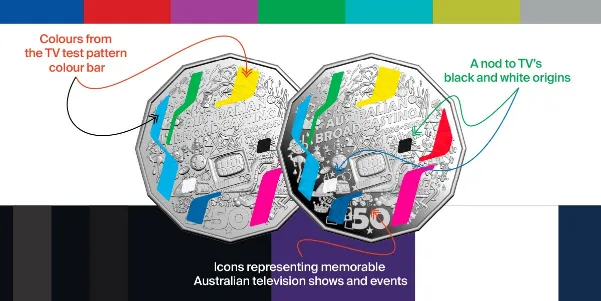
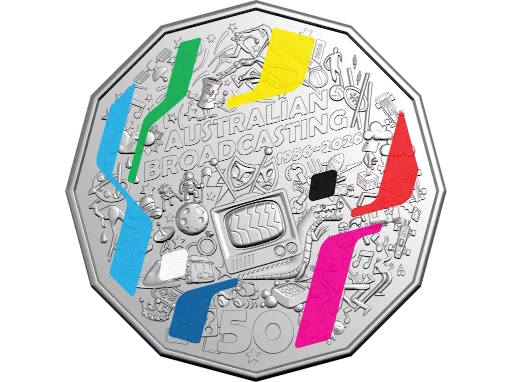
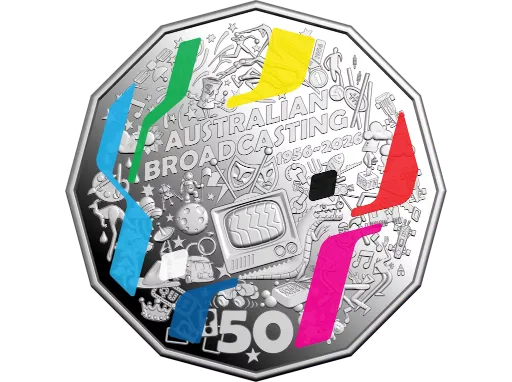
The reverse is covered in small illustrations, each standing for a memorable Australian broadcast, arranged around the inscription AUSTRALIAN BROADCASTING 1956 – 2026. The Mint invites collectors to see how many they can identify, and the icons repay a close look: a vintage set, sporting moments, fireworks and the other shared moments that made television a national campfire.
The colour is where the coin earns its personality. The printed portion is an abstract take on the colour bars from the SMPTE test pattern, the calibration signal devised by the Society of Motion Picture and Television Engineers. Streaks of green, yellow, cyan, blue, red and magenta cut diagonally across the dodecagonal field. Sections of the print are left in black and white deliberately, a nod to the monochrome years that came before 1975.
The result is a design that reads from arm’s length as pure graphic colour and up close as a detailed social history. For a coloured 50c, that dual reading is rarer than it should be.
Two finishes, one very different limit
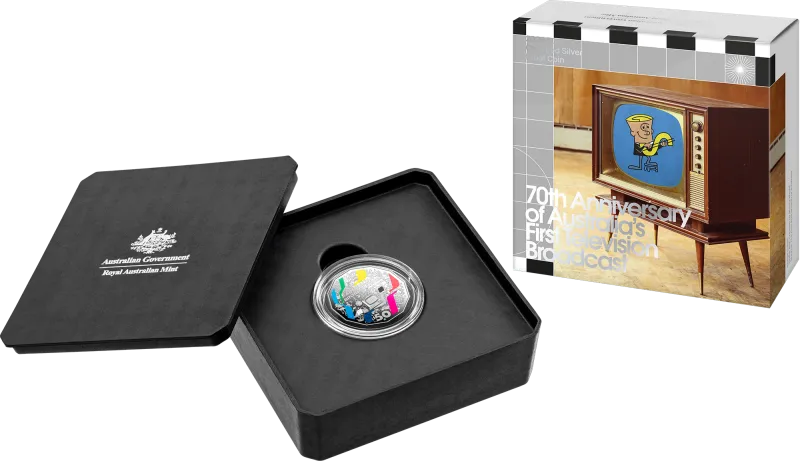
The uncirculated version carries a mintage of 50,000 at $30.00, with a limit of three per person, while the silver proof is capped at 7,000 pieces at $165.00 and limited to one per person. Both are packaged in television themed presentation: the uncirculated coin on a card styled after the test pattern and a vintage timber cabinet set, the proof in a black display case with an illustrated outer sleeve.
| Edition | Finish | Mintage | Issue price (AUD) | Limit per person |
|---|---|---|---|---|
| 2026 50c Coloured Uncirculated | Uncirculated, coloured | 50,000 | $30.00 | 3 |
| 2026 50c Coloured Silver Proof | Proof, coloured, silver | 7,000 | $165.00 | 1 |
The one per person limit on the proof is the tell. The Mint clearly expected demand to outrun 7,000 pieces, and it routed the first opportunity through an EQL ballot that opened on 11 September and closed on 14 September 2026, before general release on 15 September through the Mint Contact Centre, the Mint Shop and participating authorised distributors.
A coin for the lounge room
The 2026 Australian television 50c coin is not a historically weighty issue, and it does not pretend to be. What it offers is a well judged idea executed with genuine wit: the most familiar image in broadcasting, turned into something you can hold. For collectors of Australian coloured 50c issues it is an obvious addition, and for anyone who grew up waiting for the test pattern to give way to the morning cartoons, it may be the rare modern commemorative that feels personal.
Frequently asked questions
What is the 2026 Australian television 50c coin? It is a coloured 50 cent coin from the Royal Australian Mint marking 70 years since Australia’s first television broadcast on 16 September 1956. The reverse shows small icons from Australian TV history around the inscription AUSTRALIAN BROADCASTING 1956 – 2026, with a coloured print based on the TV test pattern colour bars.
What versions are available? There are two: a coloured uncirculated 50c with a mintage of 50,000 and a coloured silver proof 50c with a mintage of 7,000. Both share the same reverse design.
How much do the coins cost? The uncirculated coin was issued at $30.00 and the silver proof at $165.00, both in Australian dollars. Secondary market prices may differ once the Mint’s allocation is gone.
Is there a limit on how many I can buy? Yes. The Mint set a limit of three per person on the uncirculated coin and one per person on the silver proof.
Where can I buy one? The coins went on general release from 8:30am AEST on 15 September 2026 through the Mint Contact Centre, the Mint Shop and participating authorised distributors. Before that, an EQL ballot ran from 11 to 14 September 2026.
What do the coloured stripes on the coin represent? They are an abstract version of the colour bars from the SMPTE test pattern, the calibration signal created by the Society of Motion Picture and Television Engineers. The black and white sections of the print acknowledge the years before colour television arrived in Australia in 1975.
What are the icons on the coin? Each small illustration represents a memorable Australian television broadcast or moment. The Mint has not published a key to them and encourages collectors to identify as many as they can.
Why is the date 1956? Australian television first went to air on 16 September 1956, launched in time for the Melbourne Olympic Games that year. The 2026 coin therefore marks the 70th anniversary of both the first broadcast and the Games it was timed for.