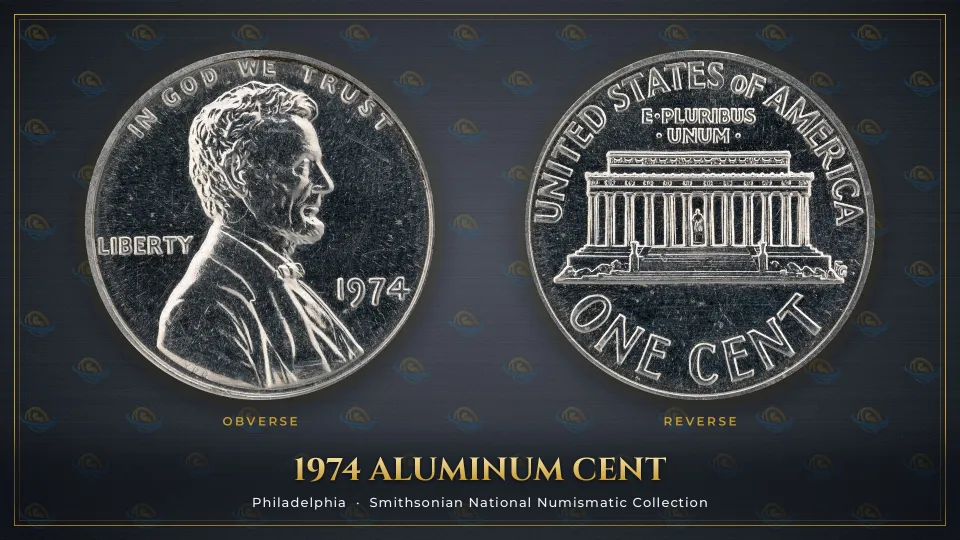
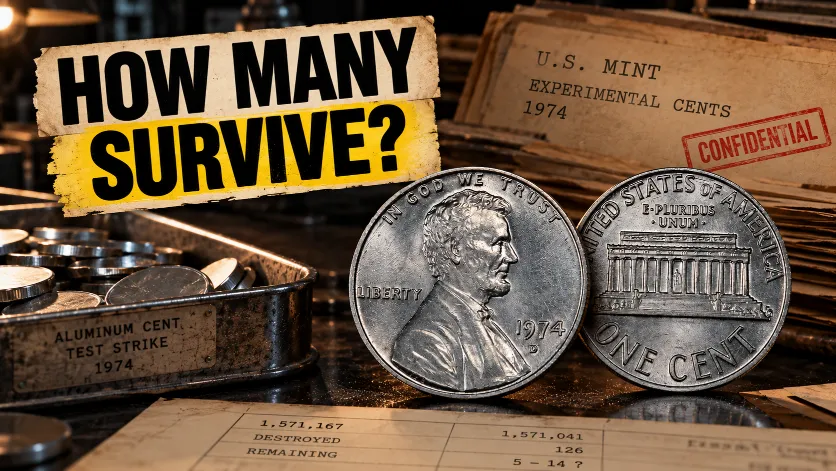
The 1974 aluminum cent is usually filed under “2 known,” and on the narrowest reading that is correct. Only two Philadelphia examples can be placed in a specific collection today, one at the Smithsonian and one in private hands. But the U.S. Mint’s own audit records never closed the ledger on these coins, and at various points they implied that somewhere between 5 and 14 pieces remained extant or unaccounted for after the recall.
That gap changes how the coin should be counted. A WNN census of every traceable 1974 experimental cent, covering the Philadelphia and Denver aluminum strikes and the far less famous bronze clad steel pieces, finds six physical coins whose existence is directly documented, several more supported by strong firsthand testimony, and a legal status that explains why almost none of them have ever crossed an auction block.
One and a half million cents, and a gap in the ledger
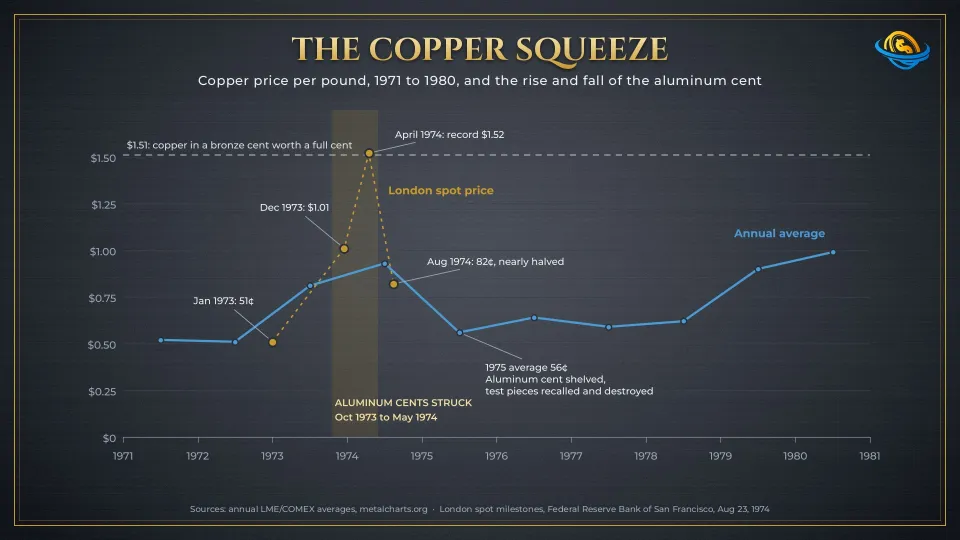
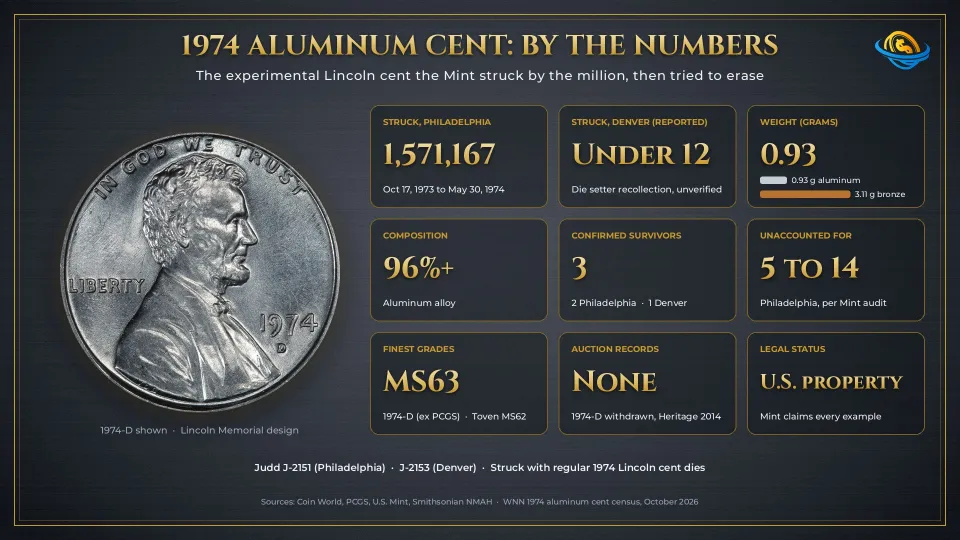
The aluminum cent was the Mint’s answer to a copper problem. By 1973 the cost of the metal in a bronze cent was climbing toward the coin’s face value, and an alloy of at least 96% aluminum promised enormous savings. The test pieces weighed about 0.93 gram, against roughly 3.11 grams for a normal bronze cent.
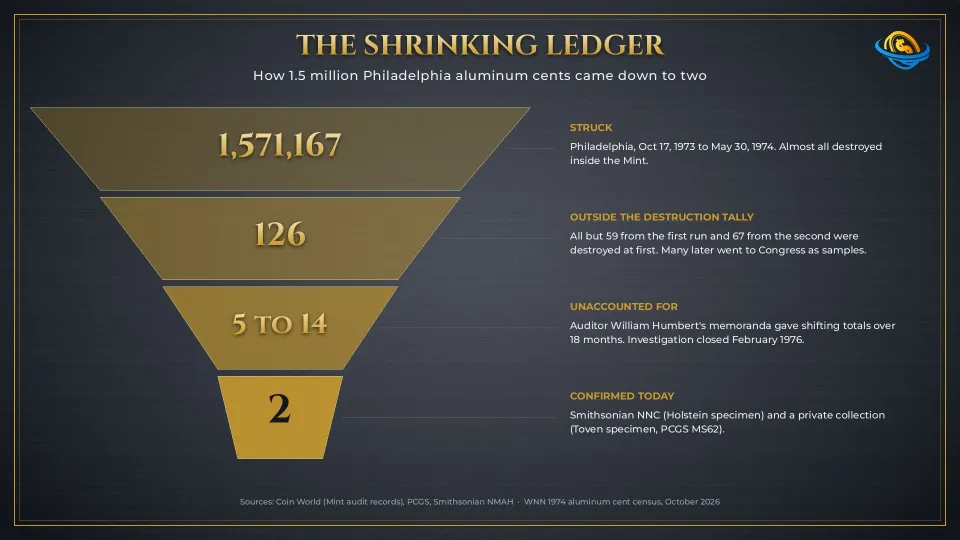
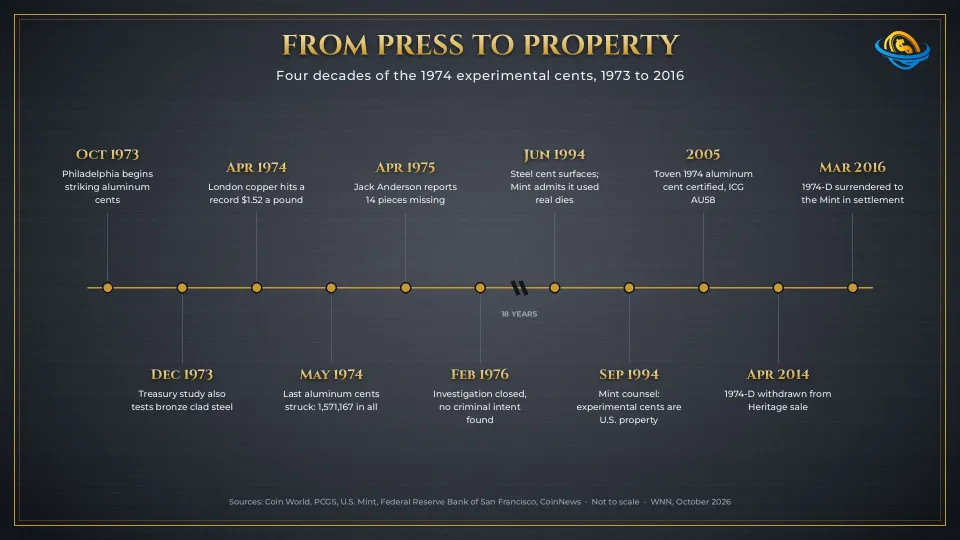
Philadelphia struck them in quantity. The reliable figure from Mint audit records is 1,571,167 pieces, not the 1,579,324 that still circulates in older secondary sources. The first run of 1,441,039 coins came off the presses between October 17, 1973 and March 29, 1974, and a second run of 130,128 followed between April 12 and May 30 (CoinWorld).
Almost all of them were destroyed inside the Mint. The few that were not became the problem. A small number went out as demonstration samples to members of Congress, congressional staff and other officials while the proposal was under debate. When Congress rejected aluminum, Mint Director Mary Brooks asked for them back, and many were returned and melted.
The accounting is where it unravels. Mint auditor William Humbert’s records showed that all but 59 coins from the first run and all but 67 from the second had initially been destroyed, leaving 126 pieces outside the destruction tally. Most were later distributed, returned or destroyed, but over the following 18 months Humbert’s memoranda produced shifting totals of between 5 and 14 coins still extant or unaccounted for. Syndicated columnist Jack Anderson reported in April 1975 that 14 were missing from congressional recipients, and other newspaper accounts put the figure at 13 (PCGS). The government closed its investigation in February 1976, finding no evidence of criminal intent (CoinWorld).
None of that proves 14 coins survive. It proves the government could not account for them, which is a different and more interesting thing.
The good luck piece in a staffer’s wallet
The first confirmed survivor has the cleanest pedigree of any coin in this story.
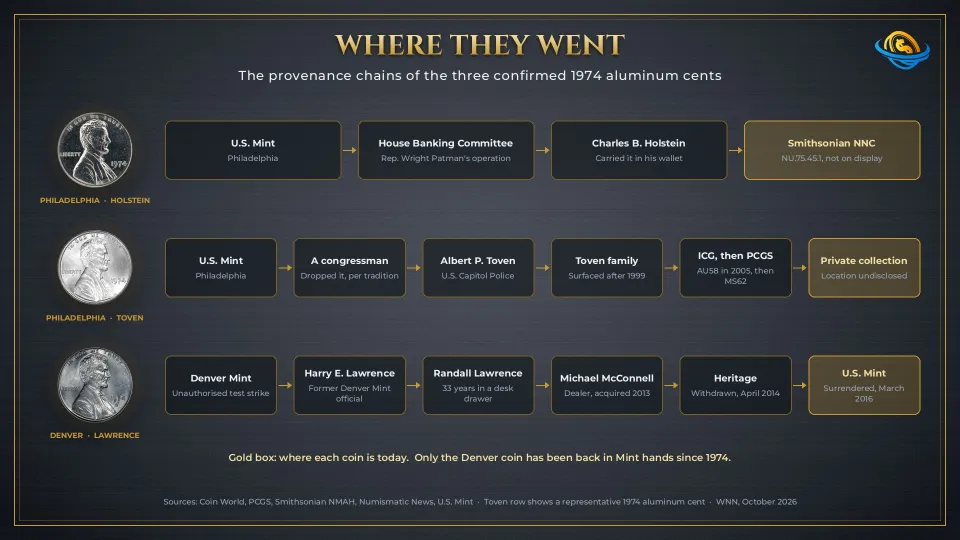
Charles B. Holstein was staff director of the Consumer Affairs subcommittee of the House Banking Committee, the operation chaired by Rep. Wright Patman. Mint records indicate that at least 7 samples reached Patman’s committee, with Holstein and minority staff director Orman Fink among the recipients. Holstein reportedly carried his coin in his wallet as a good luck piece for more than six months, and when federal officials began trying to recover the samples, he handed it to the Smithsonian instead (Numismatic News).
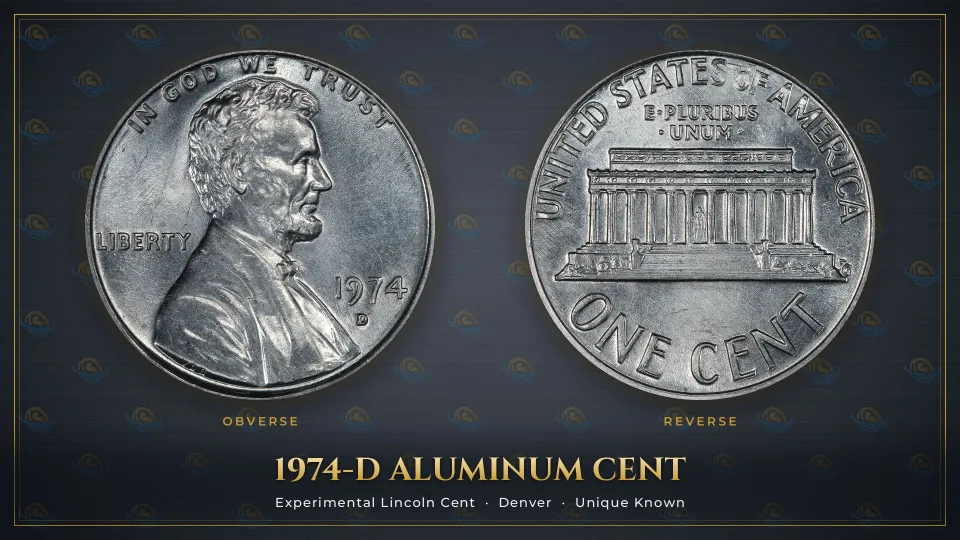
It remains there, catalogued in the National Numismatic Collection as NU.75.45.1 with Holstein in the credit line, though it is not currently on public display. One correction is worth making firmly: some secondary accounts describe this coin as a Mint specimen. It is not. It belongs to the Smithsonian, and the Mint does not hold either of the two known Philadelphia aluminum cents.
The dime that wasn’t
The second Philadelphia coin is the only one in private hands, and it arrives with the story collectors like best.
According to the traditional account, U.S. Capitol Police officer Albert P. Toven saw a congressman drop what Toven took for a dime, in or around the Rayburn House Office Building. When he tried to hand it back, the congressman told him to keep it. Only later did Toven realise what he had picked up (CoinWorld).
The coin stayed out of sight until after Toven’s death in 1999. ICG authenticated it in 2005 as AU58 at 0.93 gram, and it soon crossed to PCGS, where it now grades MS62. It has never sold at public auction.
PCGS has gently questioned whether the dropped coin story is literally accurate, observing that a soft aluminum piece striking a floor might be expected to show more damage than this one does (PCGS). That doubt touches the anecdote, not the coin. The authenticity of the Toven specimen is not in question. Its legal standing is less settled: in 2016 the Mint said it regarded the Philadelphia pieces as government property and could seek to recover this one if circumstances allowed (CoinWorld). No recovery has ever been documented.
A sandwich bag in Denver
If the Philadelphia story is a paper trail with holes, the 1974-D aluminum cent is a single object with an almost absurd biography.
It belonged to Harry Edmond Lawrence, a former senior official at the Denver Mint. After his death in 1980 his son Randall inherited his coins, and by Randall’s account the aluminum cent sat in a plastic sandwich bag in a desk for 33 years, including roughly a month in the trunk of his car during a move (PCGS). Dealer Michael McConnell acquired the group in 2013 and eventually recognised that the oddly light 1974-D might be something extraordinary.
PCGS agreed, grading it MS63 under certification number 28544237. Lawrence and McConnell consigned it to Heritage for the April 2014 Central States sale, where the auction house reportedly valued it at around $250,000 while far wilder estimates approaching $2 million circulated in the press. Then the Mint asserted ownership, and the coin was withdrawn before it could sell. There is no realised auction price for the 1974-D aluminum cent, and there never has been.
The dispute went to federal court in the Southern District of California. In March 2016 the parties settled: Lawrence and McConnell relinquished every claim to the coin and Mint Police took custody of it (CoinNews). The Mint then displayed it at the 2016 ANA convention in Anaheim and again at the 2017 World’s Fair of Money in Denver.
Precision matters in describing what happened. The coin was not seized under a confiscation order. It was surrendered under a settlement of ownership litigation, and it remains the one modern case in which the government recovered a specific privately held 1974 experimental cent.
Nor was it necessarily the only one struck. Denver die setter Benito Martinez told Coin World that he personally remembered striking fewer than a dozen aluminum cents, using blanks cut from experimental sheet that had been sent to Denver for blanking tests. Denver was never authorised to strike coins from them (CoinWorld). The Lawrence coin is therefore best described as unique known, not unique struck. In more than half a century, no second example has surfaced.
The bag that split at the steel mill
The least known of the 1974 experimental cents may be the best story of all.
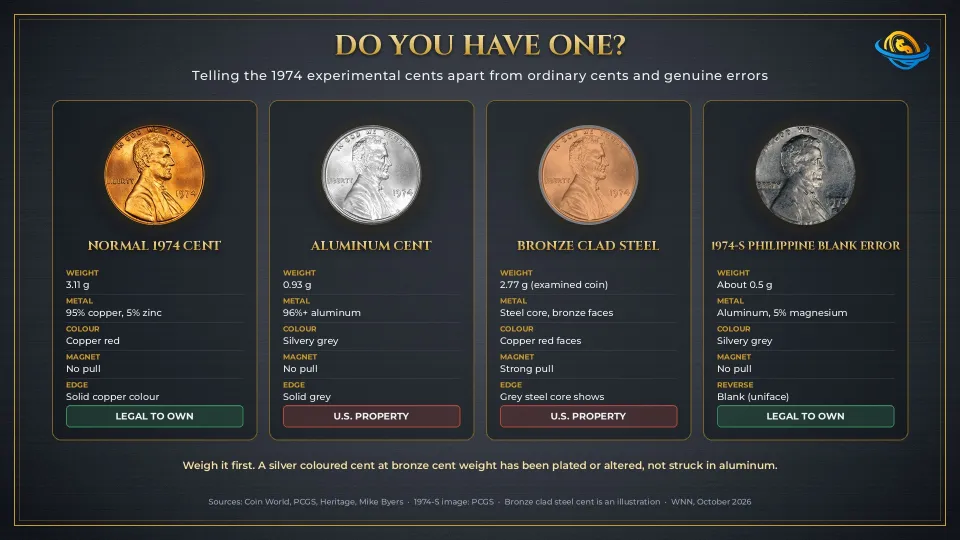
Aluminum was not the only alternative the Treasury tested. Its December 1973 study also examined a mild steel core clad on both sides with a 90% copper, 10% zinc alloy. From the faces it looked like an ordinary cent. From the edge, a grey steel core showed through, and the piece was magnetic. The material was rejected because it demanded excessive striking force, caused fabrication and annealing problems and offered nothing close to aluminum’s savings. The official report added that the non aluminum compositions had been struck with “nonsense dies,” precisely so the Mint would not create collectible Lincoln cent oddities.
That turned out not to be entirely true.
In June 1994, Coin World’s William T. Gibbs took a call from a retired Pennsylvania steel worker. In 1974, the caller said, Mint officials and Mint Police had brought bags of the experimental steel cents to the Alan Wood Steel Co. for destruction, somewhere in the order of 200,000 to more than 250,000 pieces. During the operation a bag split, scattering coins across the floor. Workers were ordered back while Mint personnel gathered them up, but not every cent made it back into the bags (CoinWorld).
The caller said he had 5. He sent the best one to Coin World. It weighed 2.77 grams, had a specific gravity of 7.9142, carried normal 1974 Lincoln cent designs on bronze coloured faces, showed a grey core at the edge and was strongly magnetic.
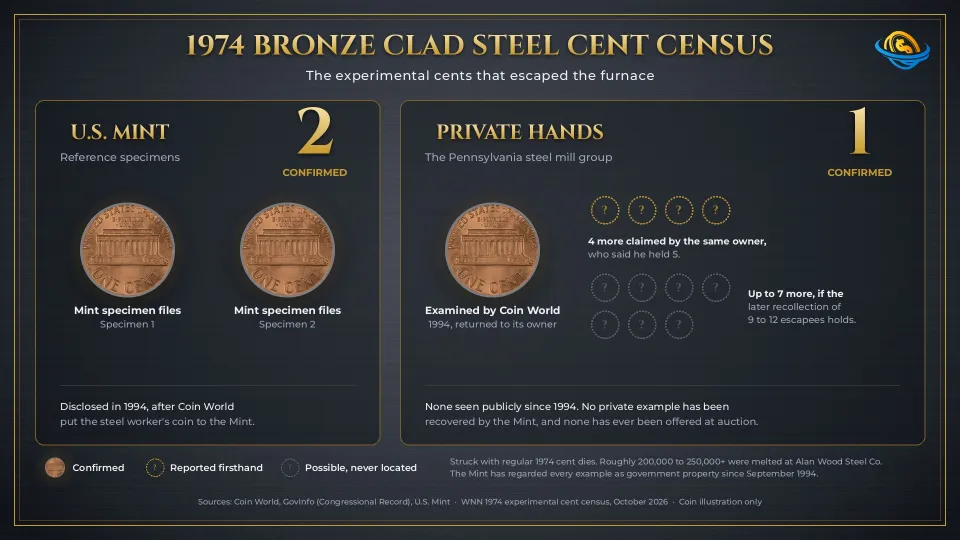
When Coin World put the evidence to the Mint, the Mint searched its records and conceded the point: it had struck 1974 Lincoln cents on bronze clad steel planchets using regular cent dies. It also disclosed that 2 such specimens remained in its own reference files (GovInfo). The original Coin World report was later entered into the Congressional Record.
Gibbs returned the examined coin to its owner quickly, concerned that the Secret Service might arrive at the Coin World offices to seize it. He later lost contact with the man and, revisiting the story years afterwards, remarked that the owner might since have died. The owner had at one point asked Gibbs to help market the coins, even floating a trade for a top line pickup truck. Gibbs declined.
The reason no bronze clad steel cent has ever appeared in a Heritage or Stack’s Bowers catalogue is legal, not numismatic. In September 1994, Mint chief counsel Kenneth B. Gubin stated that these cents had the same status as the aluminum test pieces: experimental, never issued, and therefore government property subject to recovery (CoinWorld). No private example has been recovered. None has been offered either.
How many survive is genuinely uncertain. The conservative count is 3: the 2 Mint specimens and the coin Coin World examined. Accept the owner’s own statement that he held 5, and the figure rises to at least 7. Gibbs later recalled the steel worker saying that at least 9 and perhaps as many as 12 coins escaped the furnace, some heat damaged, while earlier accounts put the number among the workers at 5 to 8. The oral history is not internally precise, which is exactly why WNN will not publish “12 known.”
Errors that are not experiments
One further complication belongs in any honest census, if only to be kept apart from the rest. There are genuine 1974-S cents struck on aluminum, and they have nothing to do with the copper crisis.
One is a uniface 1974-S struck on a Philippine 1-sentimo aluminum planchet of roughly 95% aluminum and 5% magnesium, weighing about 0.5 gram and graded PCGS MS61. It appears to have been resting on another cent when struck, taking an obverse impression with a blank reverse. Heritage sold it in January 2023 for $19,200, describing it as a legal to own error rather than one of the recalled experimental pieces (CoinWeek). A second 1974-S error, on a Nepal 2-paisa aluminum planchet and certified PCGS PR68, is reported by dealer Mike Byers.
These are foreign planchet errors struck in the ordinary course of production at San Francisco. They are collectible, they are rare, and they are not 1974 aluminum cents in the sense this census uses the term.
Counting the 1974 aluminum cents that survive
The table below separates what can be shown from what can only be inferred. For these issues, a single “known examples” figure is not enough.
| Issue | Confirmed | Where they are | Reported or implied | WNN status |
|---|---|---|---|---|
| 1974 aluminum (Philadelphia) | 2 | Smithsonian NNC (Holstein); private (Toven, PCGS MS62) | 5 to 14 extant or unaccounted for, per Mint audit memoranda | 2 confirmed; further survivors documentarily implied |
| 1974-D aluminum | 1 | U.S. Mint custody since 2016 (Lawrence, formerly PCGS MS63) | Fewer than 12 struck, per die setter recollection | Unique known |
| 1974 bronze clad steel | 3 | U.S. Mint specimen files (2); anonymous private owner (1) | At least 7 on firsthand testimony; perhaps 11 to 14 in all | 3 confirmed; at least 7 strongly reported |
| 1974-S on Philippine 1-sentimo planchet | 1 | Private | None | Foreign planchet error, not experimental |
| 1974-S on Nepal 2-paisa planchet (proof) | 1 | Private | None | Foreign planchet error, not experimental |
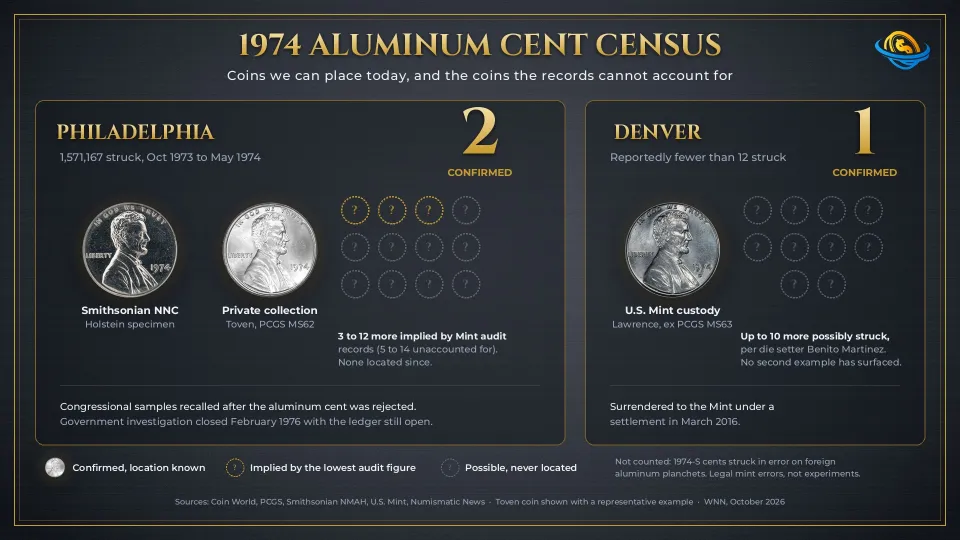
By custodian, the picture is stark. The Mint holds 3 experimental cents: the 1974-D aluminum and the 2 steel reference pieces. The Smithsonian holds 1 Philadelphia aluminum cent. Private hands account for at least 2 confirmed pieces, the Toven coin and the steel cent Coin World examined, with 4 more steel cents strongly reported by the same owner.
For anyone ranking Lincoln cent rarities, the consequence is real. The 1974-D aluminum qualifies cleanly as a one confirmed example coin. The 1974 Philadelphia aluminum cent should not be ranked as “2 known” without qualification; the defensible description is 2 confirmed, with Mint records suggesting that between 5 and 14 may have survived or gone unaccounted for. That makes it a very different animal from the unique 1943-D bronze cent, where the count is one and the record is closed. Here we know two locations and have documentary reason to suspect others.
As for where those others might be, the plausible answer is the dull one. The congressional distribution is well documented, and a coin carried home in a wallet in 1974 could easily sit today in an estate, an old collection or a desk drawer. The colourful alternatives carry less weight. USPatterns has published one man’s recollection of a transient offering rolls of aluminum cents at his grandfather’s Mississippi pawn shop in the 1970s. No coins were ever located or authenticated, and for census purposes the story carries no evidentiary weight at all.
Conclusion
The 1974 aluminum cent has always been sold to the public as a rarity of two. The records tell a stranger story: a coin whose population is defined less by what survives than by what the government could never account for, sitting beside a Denver cousin that may be one of a dozen and a steel sibling whose survivors vanished back into anonymity within weeks of being proved real. Every one of these coins is regarded by the Mint as federal property, which keeps them off the market and out of sight. If another Philadelphia piece ever does surface from a congressional estate, it will not merely add a third coin to the census. It will confirm what Humbert’s shifting totals have suggested for fifty years.
Frequently asked questions
How many 1974 aluminum cents are known to exist?
Two 1974 aluminum cents from Philadelphia are confirmed today: one in the Smithsonian’s National Numismatic Collection and one privately held, the Toven specimen graded PCGS MS62. A single 1974-D aluminum cent is also known and is held by the U.S. Mint. Mint audit records from the 1970s implied that between 5 and 14 Philadelphia pieces remained extant or unaccounted for, so more may survive, but none has been authenticated.
Is it legal to own a 1974 aluminum cent?
The U.S. Mint regards the 1974 experimental aluminum cents as government property because they were never issued, and in 2016 it said it could seek to recover the privately held Toven specimen. That position is why none has sold at public auction. Genuine 1974-S cents struck by error on foreign aluminum planchets are a separate category and have sold legally.
Why did the Mint make aluminum cents in 1974?
Rising copper prices were pushing the cost of the metal in a bronze cent toward its face value. An alloy of at least 96% aluminum offered large savings, so the Philadelphia Mint struck 1,571,167 test pieces weighing about 0.93 gram. Congress rejected the change and almost all of them were destroyed.
What happened to the 1974-D aluminum cent?
The only known 1974-D aluminum cent, graded PCGS MS63, surfaced in the family of a former Denver Mint official and was consigned to Heritage in 2014. The Mint asserted ownership and the coin was withdrawn before the sale. After federal litigation, the owners surrendered it to the Mint under a settlement in March 2016.
How much is a 1974 aluminum cent worth?
No experimental 1974 aluminum cent has a realised auction price. The 1974-D was reportedly valued by Heritage at around $250,000 in 2014, with press estimates as high as $2 million, but it was withdrawn before selling. The only 1974-dated aluminum cent with a public sale is a 1974-S foreign planchet error, which brought $19,200 at Heritage in January 2023.
What is a 1974 bronze clad steel cent?
It is a second experimental 1974 Lincoln cent, struck on a steel core clad in a 90% copper, 10% zinc alloy, so it looks like a normal cent on its faces but shows a grey core at the edge and is magnetic. The Mint confirmed in 1994 that it struck these with regular cent dies and holds 2 in its reference files. A third was examined by Coin World that year, and its anonymous owner said he held 5.
Is a 1974-S aluminum cent the same as the experimental aluminum cent?
No. Known 1974-S aluminum cents are mint errors struck on foreign aluminum planchets, one on a Philippine 1-sentimo blank and one on a Nepal 2-paisa blank. They were struck by accident during normal production and are not part of the recalled experimental series. They should be catalogued separately.