
The 2027 lineup for the American Innovation $1 Coin Program now has its preferred reverses. On April 21, 2026, the Citizens Coinage Advisory Committee met at U.S. Mint headquarters in Washington and forwarded four design recommendations to the Secretary of the Treasury, one each for Oregon, Kansas, West Virginia, and Nevada. The meeting was chaired by Dr. Peter van Alfen in an acting capacity, and produced an unusually wide spread of committee enthusiasm across the four portfolios, from a near-unanimous embrace of the West Virginia telescope to a divided, low-scoring vote on Nevada.
For collectors who follow the Innovation series, this is the moment that effectively defines what those four 2027 reverses will look like. Treasury makes the final call, but Treasury’s selection has historically tracked closely with the recommendations of the CCAC and the Commission of Fine Arts. Here is how the four portfolios played out.
Oregon, Beverly Cleary
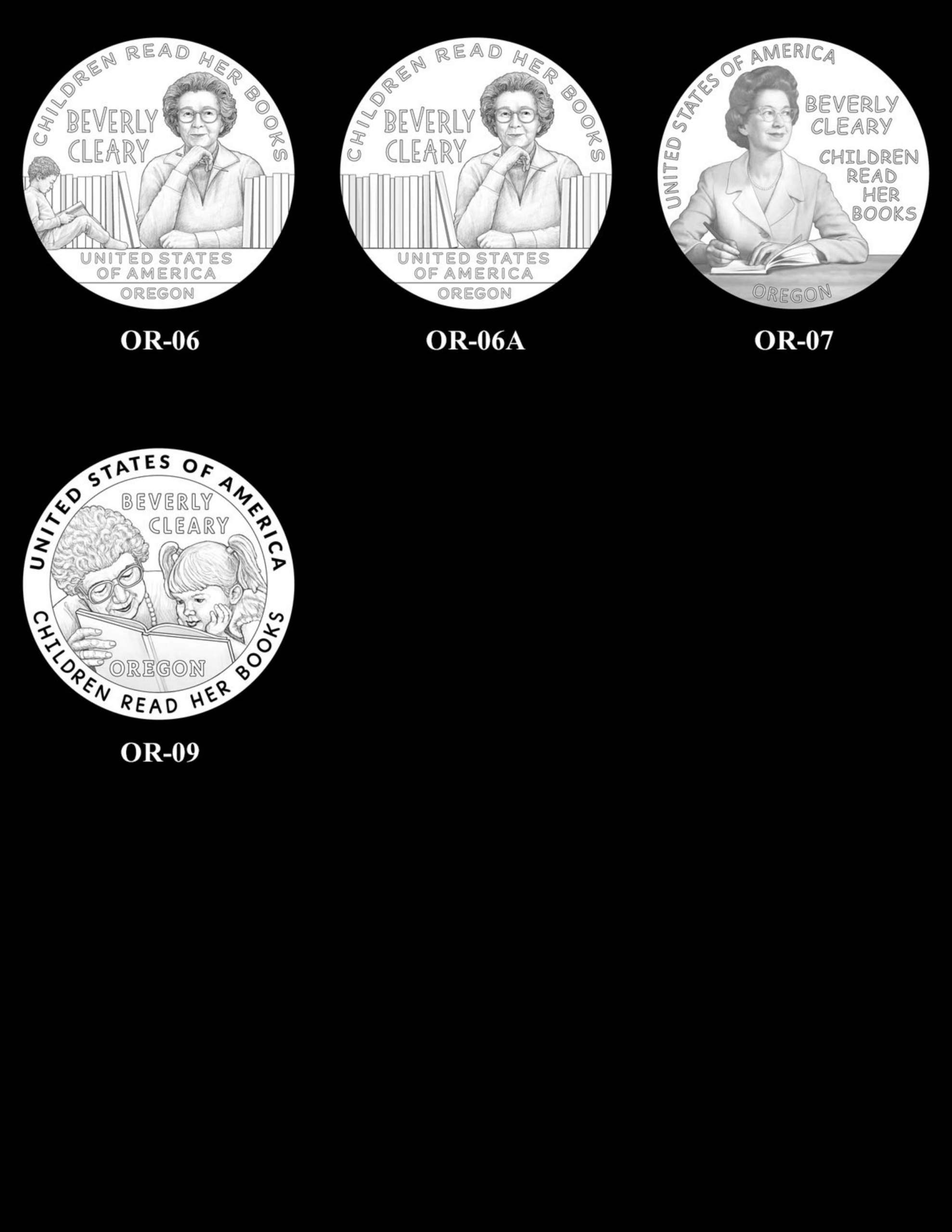
The Oregon coin honors children’s author Beverly Cleary, who was born in McMinnville and spent her early childhood on a farm in nearby Yamhill before her family moved to Portland, the city whose Klickitat Street and Grant Park neighborhood would become the setting for Ramona Quimby, Henry Huggins, and a shelf of books that shaped American childhood reading for generations. The CCAC was joined by Sybil Ackerman-Munson, Chief of Staff for the Oregon State Treasury, and Kerry Tymchuk, Executive Director of the Oregon Historical Society. Cleary’s son Malcolm could not attend in person but submitted written commentary on the candidate designs.
After scoring, the committee unanimously recommended OR-06A, a derivation of OR-06, which had been the preferred design of the state and the Cleary family. The motion was made by Kellen Hoard and seconded by Arthur Bernstein. OR-06A scored 20 out of 27 possible points, the highest of the Oregon portfolio. The design centers on a thoughtful portrait of Cleary in later life, framed by an arc reading **CHILDREN READ HER BOOKS**, with **BEVERLY CLEARY** set in a hand-lettered display face evocative of a children’s-book title page.

Kansas, Jack St. Clair Kilby
Kansas honors Jack St. Clair Kilby, who was born in Jefferson City, Missouri but grew up in Great Bend, Kansas, the town he always called home. Working at Texas Instruments in 1958, Kilby built the first working integrated circuit, the foundational device of essentially every piece of consumer electronics that followed, and the work for which he received the Nobel Prize in Physics in 2000. The CCAC was joined by Patrick Zollner of the Kansas Historical Society, Kilby’s daughter Ann Kilby, and Dr. Karen Nordheden of the University of Kansas.
The recommended design, KS-09A, drew the highest score of the entire meeting at 23 out of 27 points, and the recommendation was, again, unanimous. KS-09A is a refinement of KS-09, the design favored by the Kilby family, and depicts Kilby in profile examining a small chip-form component, with a schematic circuit diagram floating in the field at right and the inscription **INTEGRATED CIRCUIT** curving along the lower rim. **JACK KILBY** runs vertically up the left field. The portrait reads as scientific without becoming clinical, the man and the moment, rather than the patent drawing alone.

West Virginia, The Robert C. Byrd Green Bank Telescope
The West Virginia portfolio celebrates not a person but an instrument: the Robert C. Byrd Green Bank Telescope, the world’s largest fully steerable radio telescope, anchored in Pocahontas County deep inside the National Radio Quiet Zone. The CCAC was joined by Ennis B. Smith of the West Virginia Department of Tourism and Jill Malusky of the National Radio Astronomy Observatory.
WV-01 scored 25 out of 27, the highest mark of any design across all four portfolios, and the recommendation passed by unanimous voice vote. The design situates the telescope in its mountain setting, the dish caught at a working angle and the supporting tower rising against an Allegheny landscape, with a foreground of West Virginia rhododendron in bloom. The design was also the preferred candidate of both the Governor of West Virginia and the Green Bank Observatory itself, which is a rare alignment of state, scientific stakeholder, and committee enthusiasm in a single portfolio.
A subsequent motion from Jeanne Stevens-Sollman, seconded by Donald Scarinci, proposed enlarging the telescope in the composition by ten to fifteen percent. Chief Engraver Joseph Menna, joining virtually, advised against the change, he told the committee the design was aesthetically strong as submitted and that the telescope would read clearly at coin size against the landscape, and that a ten-to-fifteen-percent increase would be effectively negligible once struck. The motion to enlarge failed on voice vote.

Nevada, Copper-Riveted Clothing
The Nevada portfolio drew the meeting’s most divided response. The selected innovation is copper-riveted clothing, the 1873 patent issued to Jacob Davis of Reno and his San Francisco–based business partner Levi Strauss, which transformed durable workwear and ultimately gave the world blue jeans. The CCAC was joined by Daniel P. Thielen, Administrator of the Nevada Division of Museums and History.
The committee openly acknowledged the difficulty of rendering a small clothing fastener as the heroic centerpiece of a circulating coin. Discussion gravitated toward designs that foregrounded the rivet itself rather than narrative figures or settings. After scoring, NV-05, a stripped-back composition centered on a single back pocket of riveted denim, anchored with four corner rivets and bearing **1873** above and **NEVADA** below, emerged with the highest score of the portfolio at 12 out of 24 possible points. By comparison, the recommended Kansas and West Virginia designs scored above 23.
The motion to recommend NV-05 was made by Arthur Bernstein and seconded by Jeanne Stevens-Sollman, and passed 6 in favor with 2 abstentions. John Saunders had departed the meeting prior to the Nevada discussion and did not participate in the scoring or vote, which accounts for the reduced 24-point ceiling.

What Happens Next
The committee’s recommendations now travel to the Secretary of the Treasury, who makes the final selection in consultation with the recommendations of the CCAC and the Commission of Fine Arts. The chosen reverses will then be sculpted, modeled, and ultimately struck for release in 2027 in the standard Innovation $1 formats, uncirculated rolls and bags from the Philadelphia and Denver Mints, with proof and reverse-proof versions from San Francisco. Like the rest of the series, these coins are produced for collectors rather than for general circulation. The series carries the common Statue of Liberty obverse by Justin Kunz, sculpted by Phebe Hemphill.
Taken as a quartet, the 2027 reverses cover an unusual breadth of American invention: children’s literature, semiconductors, radio astronomy, and the prosaic genius of a copper rivet. The committee’s scoring spread tells its own story about how each portfolio landed, the Green Bank Telescope and the Kilby portrait clearly resonated, the Cleary design was strongly preferred in a refined variant, and Nevada’s copper-riveted clothing produced the kind of subdued, divided result that surfaces when a portfolio’s underlying subject resists the disciplines of small-format relief. Whether all four make it through to the final Treasury selection unaltered is now the question, and it is one that will be answered in the months ahead.