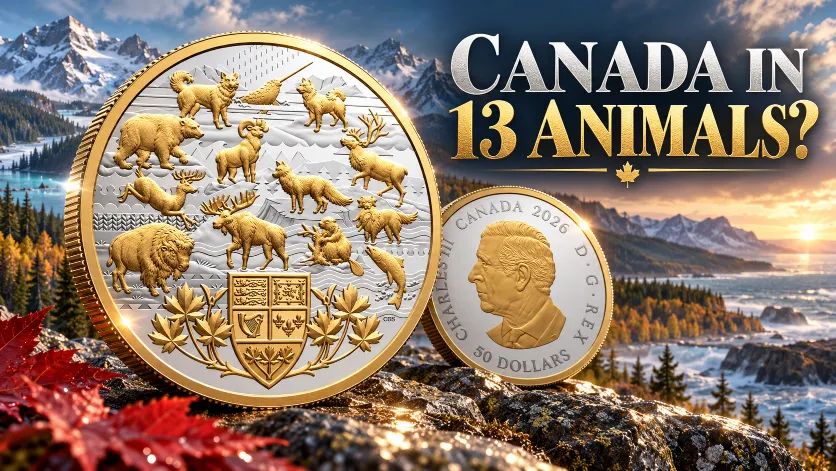
The Royal Canadian Mint has released Heraldic Landscape: Animals of Canada, a 2026 proof silver issue that places one animal for each of the country’s 13 provinces and territories around the shield from the Arms of Canada. It comes in two formats: a 5 kg pure silver coin limited to 120 pieces at $28,899.95 CAD, and a selectively gold plated 5 oz coin limited to 1,400 pieces at $1,029.95 CAD.
The design is the follow-up to the Mint’s 2024 Heraldic Landscape: Birds of Canada, and it comes from the same hand. Reverse designer Cathy Bursey-Sabourin is the heraldic artist who drew the modern rendition of the Arms of Canada, which makes this less a coin that borrows from heraldry than one drawn by the person who wrote the current version of it.
A shield at the centre, a country around it
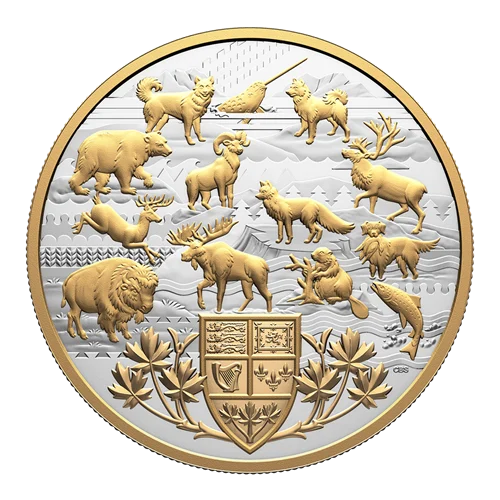
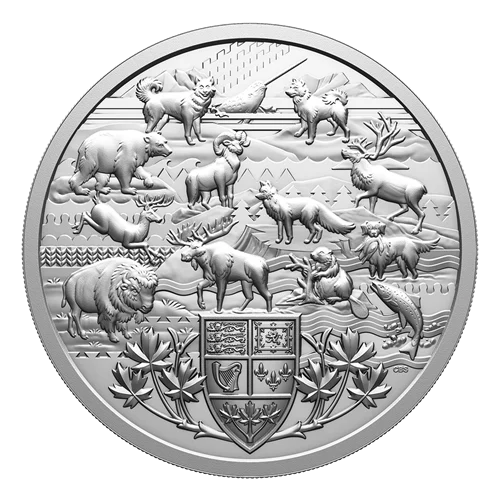
At the heart of the reverse sits the shield from the Arms of Canada, quartered for England, Scotland, Ireland and France, with three maple leaves standing for all Canadians below. Bursey-Sabourin frames it in maple boughs and adds maple keys, the winged seeds of the tree, as a symbol of growth still to come.
Above and around the shield, the 13 animals are arranged in a heraldic style, and the order is the point. Read counter-clockwise from the top right, the design travels the country the way a traveller might, from the Arctic down to the Pacific, over the mountains, across the prairies, through the forests, and out to the Atlantic.
Each animal was chosen, according to the Mint, for its heraldic or historic significance to its province or territory. Not every jurisdiction has an official animal, but many do, and several of the creatures here already appear in provincial arms. The beaver standing for Quebec, for instance, also features on the arms of Manitoba and Alberta and is an official symbol of Canada itself.
Heraldic Landscape: Animals of Canada, from the Arctic to the Atlantic
The journey opens in the North with a Canadian Inuit dog for Nunavut, a narwhal for the Northwest Territories and an Alaskan Malamute for Yukon. The west coast belongs to the Kermode bear, the white spirit bear of British Columbia, before the design climbs to a bighorn sheep for Alberta.
The prairies follow with a white-tailed deer for Saskatchewan and a plains bison for Manitoba. Central Canada brings the moose for Ontario and the beaver for Quebec. The Atlantic run closes the circuit: an Atlantic salmon for New Brunswick, a Nova Scotia duck tolling retriever for Nova Scotia, a red fox for Prince Edward Island and a woodland caribou for Newfoundland and Labrador.
What turns a ring of animals into a landscape is the linework between them. Heraldry has its own vocabulary for the edges that divide a shield, and Bursey-Sabourin uses it as scenery. A barry pattern stands in for Arctic ice floes, and a raguly line, the ragged edge of a lopped branch in heraldic terms, becomes the aurora borealis. Engrailed lines carry the waves of both the Pacific and the Atlantic. A dancetty line, all sharp zigzags, gives the Rocky Mountains, a field carpeted in wheat marks the prairies, a nebuly line, cloud-like and rolling, catches the tides of the Bay of Fundy, and a sapinée line, cut in the shape of fir trees, stands for the forests.
It is a clever piece of translation. Every one of those lines is a real heraldic term with centuries of use behind it, and every one has been bent to describe a real Canadian place. Bursey-Sabourin, in the Mint’s product copy, called the design “an intriguing artistic puzzle to put together,” and the hardest part of that puzzle was plainly making 13 separate habitats read as one country.
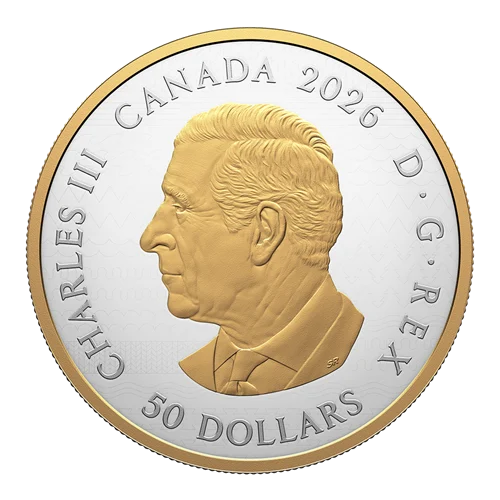
The obverse carries the effigy of King Charles III by Canadian artist Steven Rosati.
Two formats, two very different coins
The two versions share a design but not a character.
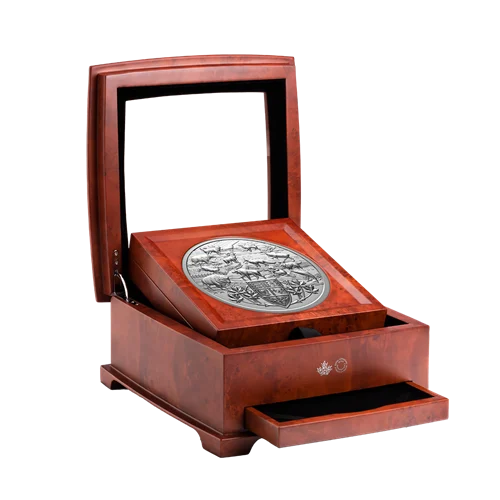
The 5 kg coin is the showpiece. At 180 mm (7.09 in) across, it gives the engravers room to work in the kind of detail heraldry demands, and the Mint relies on intricate frosting against the proof field rather than colour or plating to separate the elements. It carries a $500 face value and is presented in a wooden case with a booklet certificate. With only 120 struck, it is a coin most collectors will see rather than own.
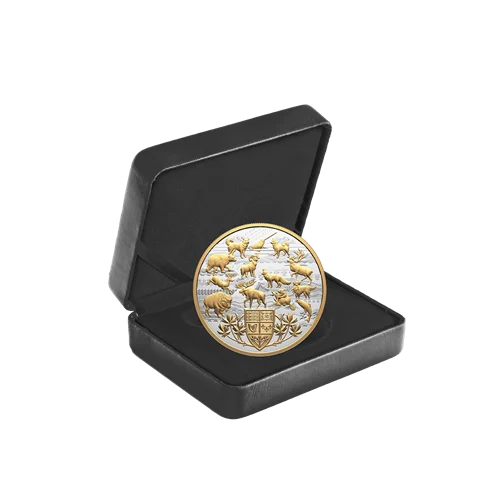
The 5 oz coin takes a different route to contrast. At 65.25 mm (2.57 in), it is still a large canvas, and here the animal emblems on the reverse are selectively plated in gold against unplated engraved elements and a mirror field. It carries a $50 face value and ships in a black clamshell inside a black beauty box.
| Format | Weight | Diameter | Finish and treatment | Face value | Mintage | Issue price (CAD) | Packaging |
|---|---|---|---|---|---|---|---|
| 5 kg pure silver | 5,000 g (99.99% silver) | 180 mm (7.09 in) | Proof, frosted | $500 | 120 | $28,899.95 | Wooden case, booklet certificate |
| 5 oz pure silver | 157.6 g (99.99% silver) | 65.25 mm (2.57 in) | Proof, selective gold plating | $50 | 1,400 | $1,029.95 | Black clamshell, black beauty box |
Both coins have serrated edges, both list shipping to Canada and the United States only, and both were showing as available by phone at the time of writing, with the Mint’s Ottawa and Winnipeg boutiques listed as out of stock.
A second chapter for the series
Animals of Canada repeats the formula that made Birds of Canada work in 2024: the same designer, the same two formats, and the same idea of using heraldry not as decoration but as a way to map the country. There is one telling difference. The 2024 coin could lean on a ready-made roster, since every province and territory has an official bird. No such list exists for animals, so this time the choices had to be argued for, region by region, from heraldry and history. That makes Animals of Canada the more editorial of the two designs, and the division lines between the creatures do as much of the storytelling as the creatures themselves.
For collectors who own the 2024 issue, Heraldic Landscape: Animals of Canada is the natural second piece of what now looks like a developing set. For everyone else, it is a rare chance to see the visual language of the Arms of Canada used by the artist who drew them, this time to tell the story of the country’s wildlife from one coast, and one ocean, to the other.
Frequently asked questions
What is the Heraldic Landscape: Animals of Canada coin? Heraldic Landscape: Animals of Canada is a 2026 proof silver coin design from the Royal Canadian Mint. It places 13 animals, one for each Canadian province and territory, around the shield from the Arms of Canada, using heraldic lines and patterns to suggest each region’s landscape. It follows the 2024 Heraldic Landscape: Birds of Canada.
What sizes is the Animals of Canada coin available in? There are two formats. A 5 kg pure silver coin measuring 180 mm (7.09 in) with a mintage of 120, and a 5 oz pure silver coin with selective gold plating measuring 65.25 mm (2.57 in) with a mintage of 1,400.
How much does the Heraldic Landscape: Animals of Canada coin cost? The Royal Canadian Mint lists the 5 kg coin at $28,899.95 CAD and the 5 oz coin at $1,029.95 CAD.
Who designed the Animals of Canada coin? The reverse was designed by Cathy Bursey-Sabourin, the heraldic artist who created the modern rendition of the Arms of Canada and who also designed the 2024 Birds of Canada coin. The obverse effigy of King Charles III is by Steven Rosati.
Which animals appear on the coin? The 13 animals are a Canadian Inuit dog (Nunavut), narwhal (Northwest Territories), Alaskan Malamute (Yukon), Kermode bear (British Columbia), bighorn sheep (Alberta), white-tailed deer (Saskatchewan), plains bison (Manitoba), moose (Ontario), beaver (Quebec), Atlantic salmon (New Brunswick), Nova Scotia duck tolling retriever (Nova Scotia), red fox (Prince Edward Island) and woodland caribou (Newfoundland and Labrador).
Are all 13 animals official provincial or territorial animals? No. Not every province and territory has an officially designated animal. The Royal Canadian Mint says each animal was chosen for its heraldic or historic significance to its region, and several also appear in provincial arms.
Is the 5 kg coin gold plated like the 5 oz coin? No. Only the 5 oz coin has selective gold plating on its animal emblems. The 5 kg coin is listed as 99.99% pure silver and relies on frosting and fine engraving for contrast.
Can collectors outside Canada buy the Animals of Canada coins? The Royal Canadian Mint lists shipping to Canada and the United States only for both coins. Collectors elsewhere would need to buy through a dealer or distributor.